The 80/20 Rule Or Pareto Principle Rule Explained: Small Effort Big Results

The 80/20 Rule Or Pareto Principle Rule Explained: Small Effort Big Results
The 80/20 Rule, also known as the Pareto Principle, explains how a small part of effort often creates most of the results.
It suggests that around 80% of outcomes usually come from only 20% of inputs. This idea has become a key concept in business, productivity, time management and personal growth.
In early 2026, the rule remains highly popular and widely shared across social media and professional spaces. Many people see it as a smart and practical way to focus on what truly matters instead of spreading attention across everything.
Key Takeaways On 80/20 Rule
- Around 80% of results often come from 20% of effort or activity
- The rule helps people focus on high impact actions
- It is used in business, productivity, habits and relationships
- It is not a strict formula but a common real world pattern
- The concept remains highly relevant in 2026
The rule is named after Italian economist Vilfredo Pareto, who observed long ago that 80% of land in Italy was owned by 20% of people.
Since then, many experts have noticed similar patterns in sales, work performance, customer impact, software issues, habits and even wealth distribution. Today, the rule is often described as the law of the vital few, because a small share of causes tends to produce the majority of results.
Table of Contents
Also Read: PEG Ratio Less Than 1 Rule: Why Investors Watch It Closely
What the Pareto Principle Really Means
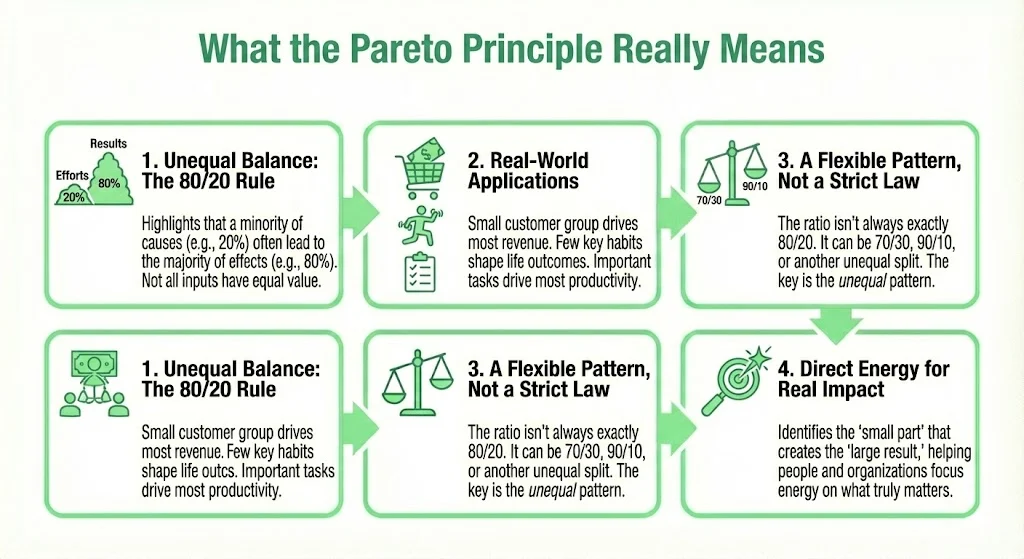
The Pareto Principle highlights an unequal balance between cause and effect. It shows that not all tasks, actions or inputs have equal value.
In many cases, only a small group of actions create the biggest outcomes. For example, a small share of customers often generate most of a company’s revenue. A few key habits shape most life outcomes. A few important tasks drive most work productivity.
The principle is not a strict mathematical law. It does not always equal exactly 80 and 20. Sometimes the ratio may look closer to 70/30 or 90/10.
What matters is the pattern. A small part creates a large result. This is why the principle has become so useful. It helps people and organizations direct energy toward what produces real impact.
Why the 80/20 Rule Is Still Trending in 2026
The 80/20 Rule continues to gain attention on social platforms, especially X. Users describe it as a life and business rule that helps avoid wasting time. High engagement posts often highlight that busy does not always mean productive. Instead, smart work means focusing on the few actions that actually move results.
Many users share examples such as:
- 20% of tasks create 80% of daily output
- 20% of habits shape 80% of life outcomes
- 20% of clients bring 80% of revenue
- 20% of relationships bring 80% of emotional value
Some posts show how the principle applies to relationships. If most parts of a relationship are good, small flaws do not need to ruin it. Other posts highlight success thinking. One popular idea is that high performers rely on focus, not endless effort.
Thought leaders also discuss decision making. For example, investors often highlight that 20% of information can provide most of the insight needed. This helps prevent overthinking and time waste.
Real World Examples of the 80/20 Rule
The rule appears across daily life and work environments. Here are some common examples:
- In sales, a small share of customers often generate most revenue
- In software, a small number of bugs cause most system issues
- In business, a few core products often produce most profit
- In time management, a few high-value tasks produce most results
- In learning, a few concepts often create most understanding
This pattern also appears in wider society. Wealth is often concentrated among a small group. A small number of social issues create most community impact. Even energy projects show similar distribution, where only a limited number of initiatives succeed.
Also Read: PEG Ratio Less Than 1 Rule: Why Investors Watch It Closely
How To Apply The 80/20 Rule In Daily Life

The core goal of the rule is to identify the vital few actions and reduce attention on low impact work. It is not about avoiding effort. It is about placing effort in the right place. Many professionals use the rule during planning, goal setting and prioritization.
One simple way to apply the rule
- List all your tasks, goals or activities
- Identify which ones truly drive progress
- Focus on the top 20% that matter most
- Reduce or delegate low impact work
This approach helps people protect energy, reduce overwhelm and achieve more meaningful progress.
80/20 Rule Use in Business and Work
In business strategy, the rule is used to direct resources toward key customers, key talent and top performing products. Managers use it to understand which problems require urgent attention. Productivity experts use it to encourage intentional action. Instead of reacting to every request, people learn to design their work around high value outcomes.
Customer service teams may study which issues create most complaints. Marketing teams may study which campaigns deliver most leads. Leaders may identify which employees shape most results. This helps improve efficiency and clarity.
80/20 Rule : Role in Personal Growth and Habits
The rule is not only for companies. Many people apply it to personal life. A few core habits often shape most health, happiness and financial stability. A few key relationships create most emotional support. A few wise decisions influence long term outcomes.
Public discussions online show that many people find comfort in this idea. It reduces pressure to be perfect in everything. Instead, the focus shifts to building strength in key areas.
Benefits of Using the Pareto Principle
Using the rule offers several advantages. It improves clarity. It supports better time use. It helps people avoid burnout. It also prevents perfectionism by allowing focus on what matters most.
Teams and individuals often notice:
- Higher productivity
- Stronger decision making
- Clearer goals
- Less wasted effort
- Better momentum
This is why many users on social platforms call it a game changer.
Limitations of the 80/20 Rule
The rule is powerful, but it is not absolute. Not every situation follows the same ratio. Some areas of life still require full attention, even if impact is not immediate. For example, safety checks, legal compliance and essential duties should not be ignored.
Another common misunderstanding is thinking that only 20% of effort is required. This is not true. The rule simply highlights where effort produces the most value. High standards still matter.
Why the Rule Remains Timeless
The 80/20 Rule stays relevant because it reflects real human behavior and economic patterns. It also aligns with modern interest in working smarter, not harder. In 2026, with more information, tasks and distractions than ever before, the principle helps people filter noise and direct focus toward meaningful outcomes.
Its language is simple. Its logic is clear. Its impact is practical. This is why it continues to appear in business discussions, productivity systems, motivational posts and real-world planning.
What People Are Saying On X About 80 20 Rule?
Public opinion on the 80/20 Rule is mostly positive. Many people say it feels real and practical in daily life. They believe a small part of actions often creates most results.
This idea is praised in business, trading, health, and productivity. Marketers use it to focus only on work that brings real revenue. Traders say a few winning trades shape most profits. In health, people say basic habits like sleep, diet, and simple exercise drive the biggest impact.
The rule also appears in life advice, such as reducing stress by dealing with a small group of key problems. Some users question its use in dating or social topics. But criticism is limited compared to support. Overall, the mood is positive.
People admire the rule because it supports smart effort and intentional focus. It has become a simple way to explain how success often comes from a small number of key actions.
Final Thought On 8020 Rule
The Pareto Principle is not a strict law, but a reliable guide for smarter focus. By identifying the small set of actions that produce the biggest gains, people and organizations can achieve more impact with less wasted effort. The rule encourages clarity, priority and balance. This is why it remains admired, shared and applied worldwide.
Read More About Such Rules: Must Know Trading and Investment Rules for Future Millionaires in India
Tags: Pareto Principle, 80 20 Rule, Productivity, Time Management, Business Strategy, Personal Growth
Related Posts :






Share This Post