Federal Reserve Interest Rate Cuts: What December 2025 Changes Mean for Your Money
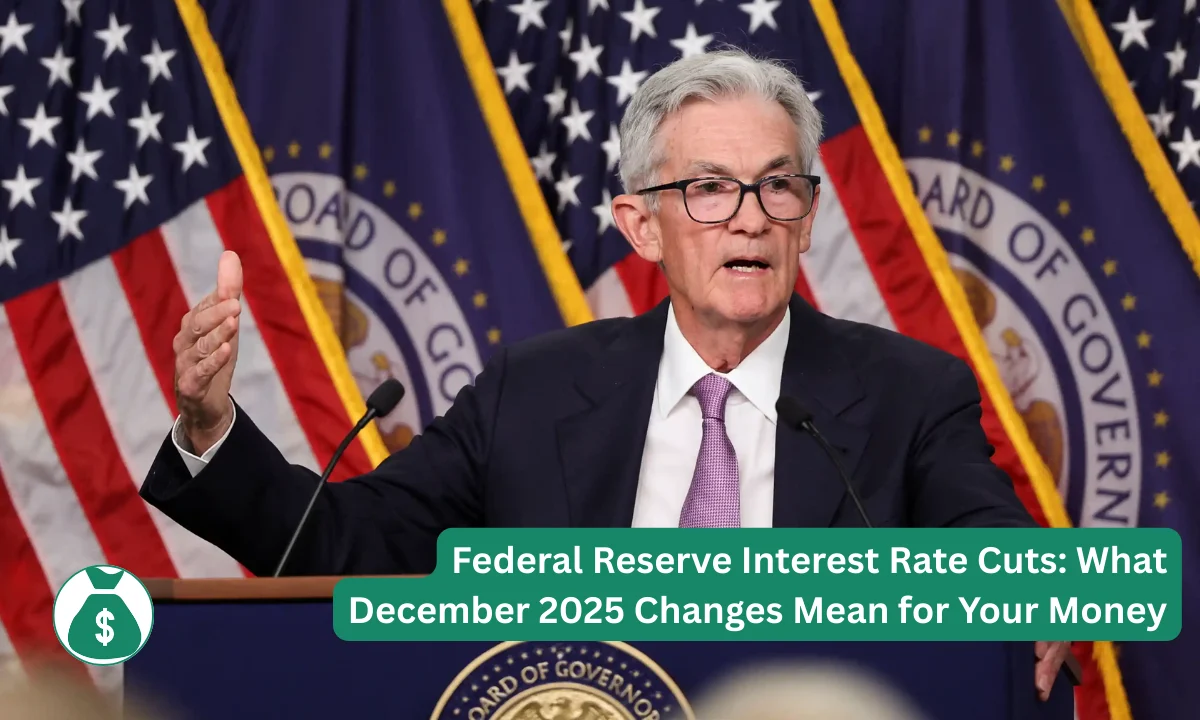
Federal Reserve Interest Rate Cuts: What December 2025 Changes Mean for Your Money
Federal Reserve interest rate cuts have become the talk of the town as the FOMC wrapped up its December meeting with another reduction. The central bank lowered rates by 25 basis points to a target range of 3.50 to 3.75 percent on December 10, 2025. This marks the third consecutive rate cut this year and the sixth since September 2024.
The decision came with a 9 to 3 vote, making it the most divided Fed decision since 2019. Fed Chair Jerome Powell described the current policy stance as neutral, meaning rates are neither pushing the economy forward nor holding it back.
The move aims to support a cooling labor market while keeping inflation concerns in check. For everyday Indians watching global markets, these cuts can affect everything from stock investments to dollar rates. Understanding what drives these decisions and their ripple effects helps you make smarter financial choices in an interconnected world economy.
Key Takeaways
- Fed reduced rates by 25 basis points to 3.50-3.75% range in December 2025
- This is the third consecutive rate cut in 2025, totaling 75 basis points of easing
- The decision was split 9-3, showing disagreement among Fed officials
- Only one more 25 basis point cut expected in 2026 according to Fed projections
- Stock markets reacted positively with S&P 500 rising after the announcement
- Borrowing costs for credit cards and auto loans are decreasing gradually
- Unemployment rate stands at 4.4% with job growth slowing to 119,000 in September
Also Read: Vidya Wires IPO Allotment Status: How to Check Online and What Investors Should Know
Understanding the Latest Fed Rate Cut Decision
The Federal Reserve made its third rate cut of 2025, bringing borrowing costs to their lowest levels since early 2022. The federal funds rate now sits between 3.50 and 3.75 percent after the 25 basis point reduction. This decision was not unanimous though.
Chicago Fed President Austan Goolsbee and Kansas City Fed President Jeffrey Schmid voted against the cut, preferring to keep rates unchanged. On the other hand, Governor Stephen Miran wanted a more aggressive 50 basis point cut instead.
The Fed’s Summary of Economic Projections shows interesting forecasts for the coming years. GDP growth is expected to reach 1.7 percent in 2025 and jump to 2.3 percent in 2026. Inflation measured by PCE is projected at 2.9 percent for 2025 and 2.4 percent for 2026. The unemployment rate is expected to remain steady at 4.5 percent for 2025. These numbers tell us the Fed is walking a tightrope between supporting jobs and controlling prices.
Why the Fed Cut Rates Now
The main reason behind this rate cut is the cooling labor market. Job gains slowed significantly to just 119,000 in September, which was below what economists expected. The unemployment rate also ticked up to 4.4 percent, showing some weakness in hiring. The Fed wants to prevent the job market from weakening too much, which could hurt the overall economy.
However, inflation remains a concern. It is still running above the Fed’s 2 percent target, which is why Powell emphasized a wait and see approach going forward. The Fed also faced some challenges with data gaps caused by a government shutdown that delayed important reports on inflation and jobs. This made their decision-making process more difficult.
Jerome Powell made it clear that the Fed will be monitoring incoming data very closely. The policy is now considered neutral, meaning it is not actively trying to speed up or slow down the economy. This gives the central bank flexibility to respond to new information as it comes in over the next few months.
Impact on Markets and Your Investments
Financial markets responded positively to the rate cut announcement. The S&P 500 rose 0.21 percent immediately after the news, showing investor confidence. US Treasury bonds also rallied, with the 10 year yield dropping below 4 percent. This is good news for bond investors who have been waiting for yields to stabilize.
For cryptocurrency enthusiasts, the rate cut was seen as bullish news. Bitcoin and other digital assets tend to perform well when interest rates fall because investors look for higher returns outside traditional savings. Traders are now pricing in about 85 percent odds of another rate cut, though the Fed’s own projections suggest only one more cut in 2026.
The stock market rally reflects broader optimism about economic conditions. Lower rates make it cheaper for companies to borrow money for expansion and operations. This can boost corporate profits and stock prices over time. However, investors should remember that markets can be unpredictable and other factors like geopolitics also play a role.
What It Means for Borrowers and Savers
If you have credit card debt, you might see some relief soon. Credit card rates have already dropped by about 0.83 percent on average since the rate cuts began. Auto loan rates have also fallen by around 0.5 percent, making car purchases slightly more affordable. These changes happen gradually, so you might not see dramatic drops in your monthly payments immediately.
For home buyers, the impact on mortgage rates has been minimal so far. This is because mortgage rates are influenced by many factors beyond just the Fed’s decisions, including housing supply shortages and long term bond yields. If you are planning to buy a home, rates might improve slightly but do not expect huge changes anytime soon.
Savers face a different challenge. Savings account yields are now at around 3.73 percent APY, which is still decent but declining as rates fall. If you have been earning good returns on savings accounts or certificates of deposit, those yields will likely decrease further. This might push some savers to consider other investment options like bonds or dividend paying stocks for better returns.
Global Connections and What’s Next
The Federal Reserve’s decisions do not happen in isolation. Other central banks around the world are also adjusting their policies. The UAE recently cut rates by 25 basis points to 3.65 percent, while Canada held its rate at 2.25 percent. These coordinated or contrasting moves affect currency values and international trade flows.
For India, Fed rate cuts can have mixed effects. A weaker US dollar makes Indian exports more competitive globally, which is good for manufacturing and IT sectors. However, if foreign investors pull money out of US markets to seek higher returns elsewhere, some of that capital might flow into emerging markets like India, boosting our stock markets.
Political factors are also in play. Former President Trump has criticized the rate cut as too small and suggested it could have been doubled. His influence continues through appointees like Governor Miran who dissented for deeper cuts. Trump’s policies on immigration and spending could also affect labor supply and economic growth, adding uncertainty to future Fed decisions.
Looking ahead, markets expect about 50 more basis points of cuts in 2026, though the Fed’s official projection shows only one 25 basis point reduction.
This gap between market expectations and Fed guidance means there could be surprises either way. Investors should stay informed and be ready to adjust their strategies based on incoming economic data and Fed communications.
Tags: federal reserve rate cuts, fed interest rate decision 2025, FOMC monetary policy, US economy inflation, stock market fed impact, borrowing costs reduction, Jerome Powell fed chair
Related Posts :






Share This Post