List Of Dividend Paying FMCG Stocks In India 2026: High Yield Picks + Passive Income Strategy

List Of Dividend Paying FMCG Stocks In India 2026: High Yield Picks + Passive Income Strategy
If you are someone looking for stable income from the stock market, then dividend paying FMCG stocks in India are something you simply cannot ignore. These companies sell daily-use products, so demand never really goes down. That is why they generate consistent cash flow and reward shareholders through regular dividends.
But here is the catch Most of the articles on the internt only give a basic list and leave you confused about which stock is actually worth it. In this guide, we will go deeper. We will not only list the top dividend FMCG stocks but also explain how to choose them smartly for long-term passive income.
In this blog post you will get dividend paying fmcg stocks that are categorised high, consistent & balanced picks. Along with this i have also linked share price target posts of each stock to see the growth potential of each stock in upcoming years.
Key Takeaways
- FMCG stocks are known for stable dividends and low volatility
- ITC is currently one of the highest dividend yield stocks in FMCG
- Companies like HUL, Colgate, and Nestle focus more on consistency than high yield
- Dividend yield alone is not enough, consistency and cash flow matter
- FMCG sector average dividend yield is around 2 percent
- Public sentiment strongly favors FMCG stocks for passive income
Table of Contents
Understanding FMCG Dividend Stocks In India
FMCG stands for Fast Moving Consumer Goods. These include products like soaps, biscuits, toothpaste, packaged food, and more. Since these are daily essentials, companies in this sector enjoy steady demand.
This stability is the main reason why FMCG companies can pay regular dividends. Unlike cyclical sectors, FMCG companies are less affected by economic slowdowns.
Many investors treat these stocks as “income generators” rather than just growth stocks.
Top Dividend Paying FMCG Stocks In India Here are some of the most popular dividend paying FMCG stocks based on recent data and market trends :
High Dividend Yield Picks
1) ITC Ltd
ITC Ltd is one of the most popular dividend-paying FMCG stocks in India, especially among investors who are focused on generating passive income. The company operates across multiple segments including cigarettes, FMCG products, hotels, paperboards, and agribusiness. However, its cigarette business continues to be the biggest contributor to profits, which allows ITC to generate strong and consistent cash flows year after year.
One of the biggest reasons why ITC stands out is its high dividend yield, which typically ranges between 4.5 to 5 percent. This is significantly higher than most FMCG companies in India. ITC has a long track record of rewarding shareholders through regular interim and final dividends. In fact, many investors rely on ITC dividends as a steady income source.
Another important factor is ITC’s strong balance sheet. The company is virtually debt-free, which reduces financial risk and ensures that dividend payouts remain sustainable even during economic slowdowns. Its high operating margins and strong cash reserves further support consistent dividend distribution.
From a growth perspective, ITC has been expanding its FMCG segment aggressively with brands like Aashirvaad, Sunfeast, Bingo, and Yippee. While this segment is still catching up in terms of profitability compared to cigarettes, it adds long-term growth potential to the business.
Overall, ITC is often considered a “core dividend stock” in Indian portfolios. It may not deliver very high capital appreciation in the short term, but its combination of high yield, strong fundamentals, and consistent payouts makes it a reliable choice for long-term income-focused investors.
Emami Ltd
Emami Ltd is another strong contender in the FMCG dividend space, especially for investors looking for a balance between yield and growth. The company is well known for its personal care and healthcare products such as Navratna oil, Boroplus, and Zandu Balm. These brands have strong recall in both urban and rural markets, which helps Emami maintain steady revenue streams.
Emami typically offers a dividend yield of around 3 percent, which is quite attractive compared to the broader FMCG sector average. What makes Emami interesting is its improving dividend track record. Over the past few years, the company has shown a clear intent to reward shareholders by increasing its payout ratio whenever cash flows allow.
The company’s business model is relatively asset-light, which helps it maintain healthy margins and generate consistent free cash flow. This is a key factor that supports its dividend payments. Additionally, Emami has been focusing on reducing debt and improving operational efficiency, which further strengthens its financial position.
Another positive aspect is its strong presence in rural India. Since a large portion of FMCG demand comes from rural areas, Emami is well positioned to benefit from any recovery in rural consumption. The company is also expanding its product portfolio and exploring new categories to drive future growth.
However, investors should also be aware that Emami’s growth can sometimes be affected by seasonal demand and raw material price fluctuations. Despite this, its consistent dividend payouts and improving fundamentals make it a solid mid-cap FMCG stock for income-focused investors.
Gillette India
The company operates in the grooming and oral care segments with strong brands like Gillette razors and Oral-B toothbrushes. Being a subsidiary of Procter & Gamble, Gillette India benefits from global expertise, strong brand positioning, and premium product offerings. This allows it to maintain high profit margins compared to many other FMCG companies.
Gillette India’s dividend yield may not always appear very high on paper, but when special dividends are included, the effective yield can become quite attractive. The company has a history of distributing a large portion of its profits as dividends, thanks to its strong cash generation and low capital expenditure requirements.
Another key strength is its focus on premium products. While this limits its reach in price-sensitive segments, it ensures higher profitability and stable cash flows. This, in turn, supports consistent dividend payouts.
However, one limitation is that Gillette India has a relatively narrow product portfolio compared to diversified FMCG giants. This means its growth is somewhat dependent on specific categories. Despite this, its strong brand equity, high margins, and generous dividend policy make it a compelling choice for investors who value quality and occasional high payouts.
Consistent Dividend Payers
1) Hindustan Unilever Ltd
Hindustan Unilever Ltd (HUL) is one of the most dominant FMCG companies in India and a consistent dividend-paying giant. Backed by its parent company Unilever, HUL has built a massive portfolio of trusted brands such as Surf Excel, Lux, Dove, Lifebuoy, Rin, and many more. These products are deeply embedded in Indian households, which gives the company a strong competitive advantage and ensures steady demand across economic cycles.
When it comes to dividends, HUL is known more for consistency than high yield. The dividend yield typically stays around 1.5 to 2 percent, but what makes it attractive is its regular payout history. The company has been paying dividends consistently for decades, often declaring interim and final dividends within the same financial year. This reliability makes it a preferred choice for conservative investors who prioritize stability over aggressive returns.
HUL also maintains strong financial health with high return ratios like ROE and ROCE, reflecting efficient capital usage. Its asset-light model and strong cash flow generation allow it to distribute a significant portion of profits as dividends. Even during challenging economic periods, HUL has managed to maintain its payout track record, which highlights the resilience of its business model.
Another important factor is its pricing power. HUL can pass on rising input costs to consumers due to its strong brand positioning. This helps protect margins and ensures that dividend payouts remain sustainable. Additionally, the company continues to innovate and expand into premium segments, which supports long-term growth.
However, one downside is valuation. HUL often trades at a high PE ratio, which limits capital appreciation potential. So, it is better suited for investors looking for steady income rather than high growth.
Overall, Hindustan Unilever is a classic example of a defensive FMCG stock that offers predictable dividends, strong brand equity, and long-term stability.
2) Colgate Palmolive India
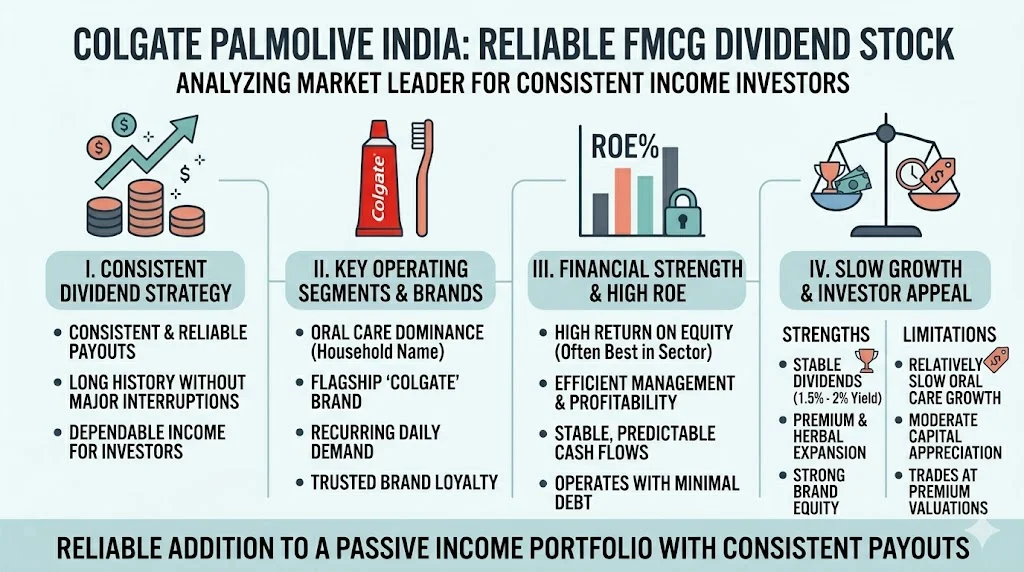
Colgate Palmolive India is another well-known FMCG company that has built a strong reputation for consistent dividend payouts. The company dominates the oral care segment in India, with its flagship brand Colgate being a household name for decades. Its market leadership gives it a stable revenue base and predictable cash flows, which are essential for regular dividend distribution.
The dividend yield of Colgate Palmolive India generally ranges between 1.5 to 2 percent. While this may not seem very high, the company compensates with consistency and reliability. It has a long history of paying dividends without major interruptions, making it a dependable choice for income-focused investors.
One of the key strengths of Colgate is its high return on equity (ROE), often among the best in the FMCG sector. This indicates efficient management and strong profitability. The company operates with minimal debt, which further enhances its ability to sustain dividend payouts even during uncertain times.
Colgate also benefits from strong brand loyalty. Oral care is a daily necessity, and consumers tend to stick with trusted brands. This ensures recurring demand and stable earnings. Additionally, the company continues to expand its product range into premium and herbal segments, which helps maintain growth momentum.
However, growth in the oral care segment can be relatively slow compared to other FMCG categories. This means that while dividends are stable, capital appreciation may be moderate. Also, like many FMCG stocks, Colgate trades at premium valuations, which can limit upside potential.
Despite these limitations, Colgate Palmolive India remains a solid dividend stock for long-term investors. Its combination of strong brand presence, high profitability, and consistent payouts makes it a reliable addition to a passive income portfolio.
3) Nestle India
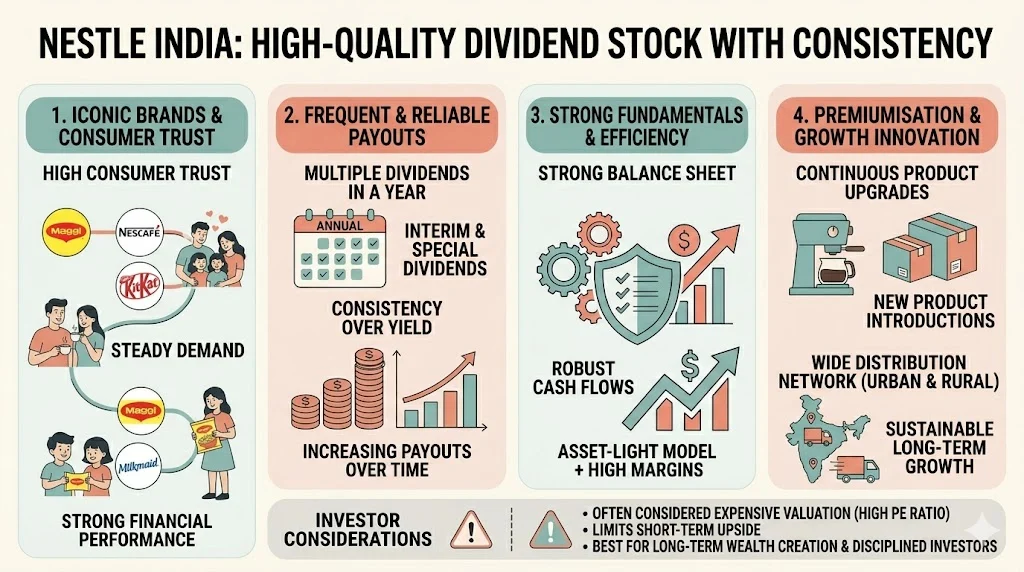
Nestle India is widely regarded as one of the highest quality FMCG companies in the country. Known for iconic brands like Maggi, Nescafe, KitKat, and Milkmaid, the company has built a strong presence in the packaged food segment. Its products enjoy high consumer trust, which translates into steady demand and strong financial performance.
In terms of dividends, Nestle India offers a relatively lower yield, usually around 1 to 1.5 percent. However, what sets it apart is the consistency and frequency of its payouts. The company often declares multiple dividends in a year, including interim and special dividends, which enhances overall shareholder returns.
Nestle operates with a strong balance sheet and generates robust cash flows. Its asset-light model and efficient operations allow it to maintain high margins and distribute a significant portion of profits as dividends. The company also has a history of increasing its dividend payouts over time, reflecting its commitment to rewarding shareholders.
Another major advantage is its focus on premiumisation and innovation. Nestle continuously introduces new products and upgrades existing ones to cater to changing consumer preferences. This helps sustain growth even in a competitive market. Additionally, its strong distribution network ensures wide reach across urban and rural areas.
However, Nestle India is often considered expensive in terms of valuation. Its high PE ratio reflects its premium positioning and strong fundamentals, but it also limits short-term upside. Investors need to be patient and focus on long-term wealth creation rather than quick gains.
Overall, Nestle India is a high-quality dividend stock that combines stability, brand strength, and consistent payouts. It may not offer the highest yield, but it provides reliability and long-term value, making it a preferred choice for disciplined investors.
Balanced Picks
1) Dabur India
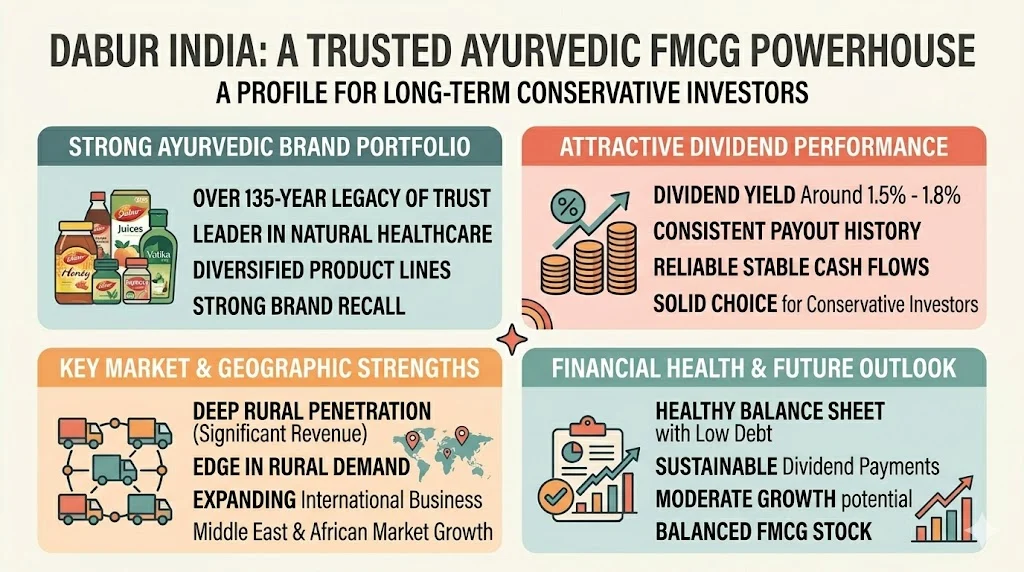
Dividend Yield around 1.5 to 1.8 percentDabur India is one of the oldest and most trusted FMCG companies in the country, known for its strong presence in Ayurvedic and natural healthcare products. The company has built a powerful brand portfolio that includes products like Dabur Honey, Real juices, Vatika hair oil, and Hajmola.
What makes Dabur particularly attractive for dividend investors is its consistent performance and stable cash flow generation over the years.One of Dabur’s biggest strengths is its deep rural penetration. A significant portion of its revenue comes from rural markets, which gives it an edge when rural demand improves.
This also makes the company less dependent on urban consumption trends alone. Additionally, Dabur has been expanding its international business, especially in the Middle East and African markets, which adds another layer of growth.From a dividend perspective, Dabur has maintained a steady payout history.
While the yield may not be very high compared to ITC, the consistency and reliability of dividends make it a solid choice for long-term investors. The company also maintains a healthy balance sheet with low debt, ensuring that dividend payments remain sustainable.Overall, Dabur is a balanced FMCG stock that offers moderate growth along with stable dividend income, making it suitable for conservative investors.
2) Godrej Consumer Products
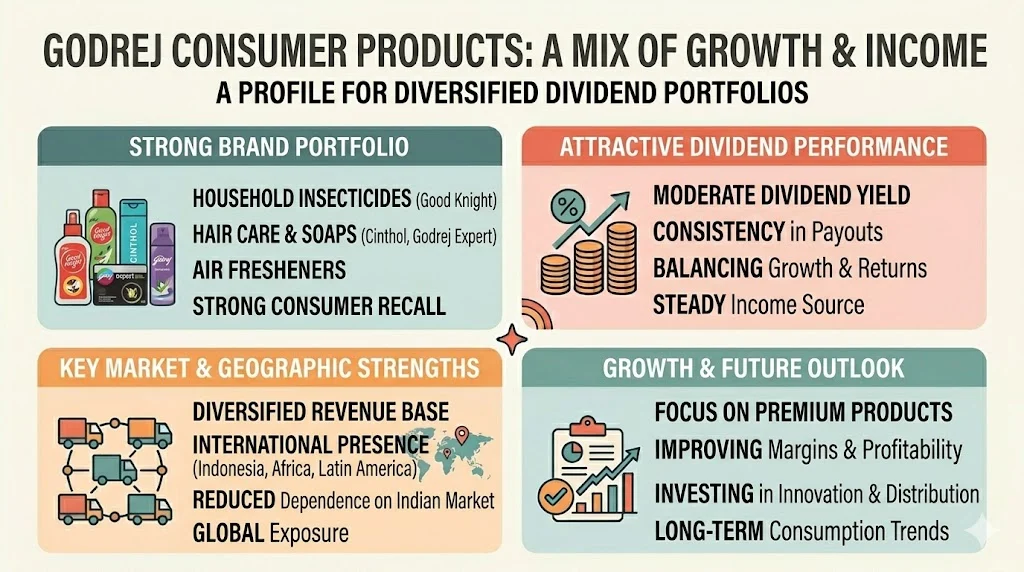
Growing business with decent dividendsGodrej Consumer Products (GCPL) is a well-known FMCG company with a strong presence in both domestic and international markets. Its product portfolio includes household insecticides, hair care products, soaps, and air fresheners. Brands like Good Knight, Cinthol, and Godrej Expert have strong recall among consumers.
One of the key advantages of GCPL is its diversified revenue base. A large portion of its income comes from international markets such as Indonesia, Africa, and Latin America. This global exposure helps reduce dependency on the Indian market and provides additional growth opportunities.In terms of dividends, GCPL offers a moderate yield but has shown consistency in payouts.
The company focuses on balancing growth investments with shareholder returns. Its improving margins and focus on premium products are expected to support future profitability.GCPL is also investing heavily in innovation and distribution expansion.
With increasing demand for household and hygiene products, the company is well-positioned to benefit from long-term consumption trends.For investors, GCPL represents a mix of growth and income. While it may not be the highest dividend payer, its expanding business and steady payouts make it a good addition to a diversified dividend portfolio.
3) Britannia Industries
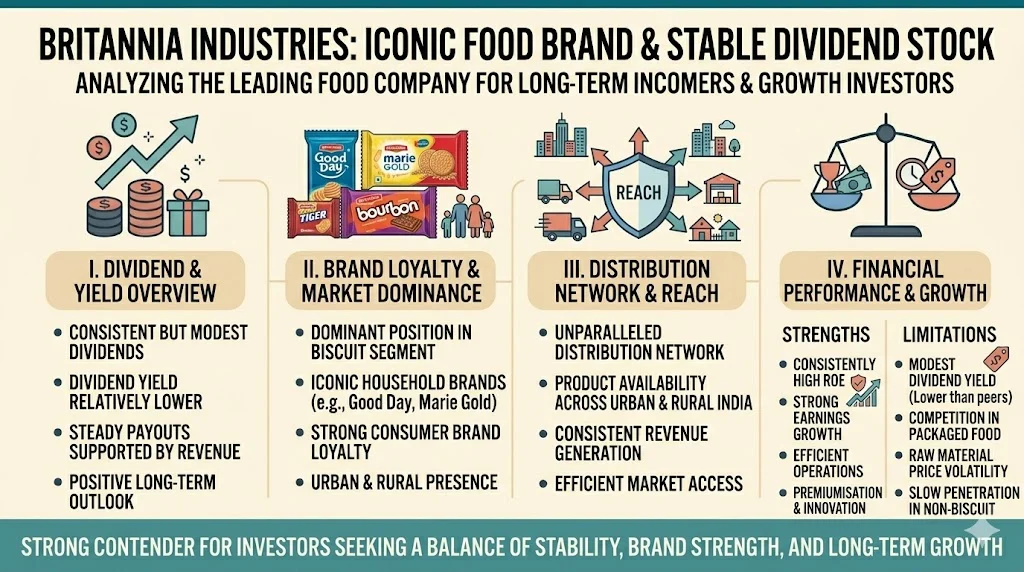
Lower yield but strong brand loyaltyBritannia Industries is one of India’s leading food companies, known for its iconic brands like Good Day, Marie Gold, Bourbon, and Tiger biscuits.
The company has a dominant position in the biscuit segment and has been expanding into dairy and bakery products as well.Britannia’s biggest strength lies in its brand loyalty and distribution network.
Its products are available across urban and rural India, making it a household name. This strong market presence ensures consistent revenue generation, which supports its ability to pay dividends.Although Britannia’s dividend yield is relatively lower compared to some other FMCG stocks, it compensates with strong earnings growth and high return ratios.
The company has consistently delivered high ROE and maintains efficient operations, which is a positive sign for long-term investors.
Another important factor is Britannia’s focus on premiumisation and product innovation. The company is continuously launching new products and improving margins, which can lead to better profitability in the future.For investors who are looking for a combination of stability, brand strength, and long-term growth along with modest dividends, Britannia Industries is a strong contender in the FMCG space.
Latest Dividend Announcements (2026 Snapshot)
Here is a quick snapshot of some recent dividend announcements in the FMCG space:
| Company | Dividend Type | Announcement Month |
|---|---|---|
| ITC | Interim | Jan 2026 |
| Gillette India | Interim + Special | Jan 2026 |
| Nestle India | Interim | Jan 2026 |
| Emami | Interim | Feb 2026 |
| Godrej Consumer | Interim | Jan 2026 |
This shows that FMCG companies continue to reward investors regularly.
How To Choose The Best Dividend FMCG Stocks
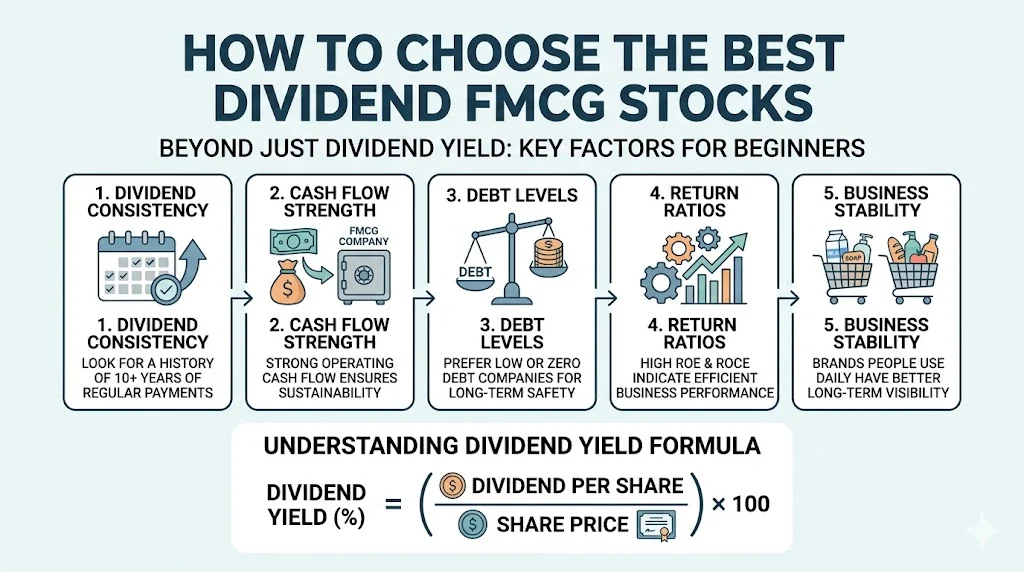
Many beginners make one mistake. They only look at dividend yield. But that is not enough. Here are key factors you should check:
- Dividend Consistency: A company paying dividends for 10 plus years is more reliable than one with a sudden high payout.
- Cash Flow Strength: Strong operating cash flow ensures sustainability of dividends.
- Debt Levels: Low or zero debt companies are safer for long-term income.
- Return Ratios: High ROE and ROCE indicate efficient business performance.
- Business Stability: Brands that people use daily have better long-term visibility.
Dividend Yield Formula
| Metric | Formula |
|---|---|
| Dividend Yield (%) | (Dividend Per Share / Share Price) × 100 |
Why Investors Love FMCG Dividend Stocks
There is a clear reason why these stocks are always in demand:
- Stable Income: You get regular payouts which can be used or reinvested.
- Low Volatility: FMCG stocks do not fall sharply like other sectors.
- Defensive Nature: They perform well even during economic downturns.
- Passive Income Potential:Many investors use these stocks to cover expenses like fees or bills.
Public Opinion And Investor Sentiment
Looking at recent discussions on Twitter, one thing is very clear. FMCG dividend stocks have a strong fan base.
- ITC is often called a “must-have dividend stock”
- Many investors share how dividends are credited regularly and used for small expenses
- Some investors even reinvest dividends to grow their portfolio faster
- There is also a trend of comparing ITC with HUL for income vs stability
At the same time, some users mention that FMCG stocks are expensive in terms of valuation. So they are better for income rather than aggressive growth. This mix of opinions shows that FMCG stocks are best suited for long-term investors who want peace of mind.
Challenges In FMCG Dividend Investing
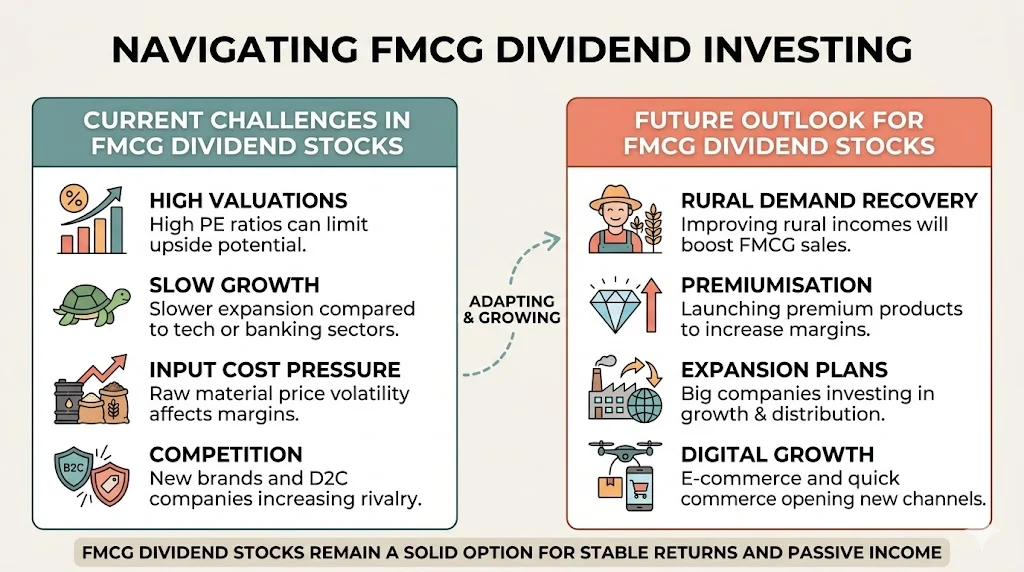
Even though FMCG stocks are stable, they are not perfect.
- High Valuations: Many stocks trade at high PE ratios, which limits upside.
- Slow Growth: Compared to sectors like tech or banking, growth can be slower.
- Input Cost Pressure: Raw material prices can affect margins.
- Competition: New brands and D2C companies are increasing competition.
Future Outlook Of FMCG Dividend Stocks
The future looks quite stable for this sector.
- Rural Demand Recovery: Improving rural income will boost FMCG sales.
- Premiumisation: Companies are launching premium products to increase margins.
- Expansion Plans: Big companies are investing heavily in growth and distribution.
- Digital Growth: E-commerce and quick commerce are opening new channels.
Overall, FMCG dividend stocks will continue to remain a solid option for investors looking for stable returns and passive income.
Final Thoughts
If your goal is to build passive income from the stock market, FMCG dividend stocks are a smart starting point. You may not see explosive growth, but you get consistency, stability, and peace of mind.
A balanced approach works best. You can combine high yield stocks like ITC with stable performers like HUL or Colgate. This way you get both income and reliability. Just remember one thing. Do not chase yield blindly. Focus on quality businesses that can sustain dividends for years.
Related Posts :





Share This Post