20 Stock Falling Since Last 6 Months: The Complete 2026 Survival Guide Every Investor Needs

20 Stock Falling Since Last 6 Months: The Complete 2026 Survival Guide Every Investor Needs
Stock falling since last 6 months has become one of the most discussed topics among investors in 2026. Many people are seeing their portfolios in red. This situation is creating confusion and fear. Both new investors and experienced investors are struggling to understand what is happening in the market. This is not a small decline. This is a widespread correction across multiple sectors and countries.
The decline is not limited to one type of stock. Technology companies are falling. Fintech companies are falling. Even strong businesses are under pressure. Many investors are asking the same question. Should they sell or should they hold. This article will help you understand the full picture. It will explain the reasons behind the fall. It will also explain what smart investors are doing in this situation.
You will also learn about market psychology. You will understand how emotions affect decisions. You will see real examples of losses. Most importantly you will learn how to respond in a practical way. This is not just about numbers. This is about mindset and strategy.
Key Takeaways
- Most stocks have declined more than 5 percent in the last six months across global markets
- Growth sectors like tech and fintech are facing the biggest pressure
- Market correction is driven by global risks and economic uncertainty
- Historical trends show recovery follows every correction phase
- Smart investors focus on strategy instead of panic
Table of Contents
Why Stocks Are Falling Since Last 6 Months
The current fall is not caused by one single event. It is the result of multiple factors working together. This makes the situation more complex.
The first reason is the shift from growth to value investing. Over the past few years investors were chasing high growth companies. Many of these companies had very high valuations. These valuations were based on future expectations. Now investors want real profits and stability. This shift is causing selling pressure in growth stocks.
The second reason is global tension. Oil prices are rising due to conflicts. This increases inflation. When inflation rises central banks take strict actions. This affects liquidity in the market.
The third reason is economic uncertainty. Job data is mixed. Interest rates are high. Policies are changing frequently. All these factors create fear among investors. As per recent market data most major indices have shown weakness. The decline is gradual but consistent. This type of fall creates more stress compared to sudden crashes.

Indian Stock Market Performance In 2026
The Indian stock market is also under pressure. The Nifty index has corrected significantly from its peak. Here is a simple breakdown:
| Metric | Value |
|---|---|
| Nifty Peak | 26,373 |
| Current Level | 23,114 |
| Decline | Around 14% |
| Category | Mild Correction |
This level of correction is not new. It has happened in the past. The difference is the reaction of investors. Many investors entered the market during a bull phase. They are not used to seeing losses. This is why the current situation feels more painful.
Top Stocks That Fell More Than 5 Percent
Many well known companies have seen a decline over the last six months. These are not weak businesses. These are fundamentally strong companies that are currently facing market pressure due to broader economic and sectoral shifts.
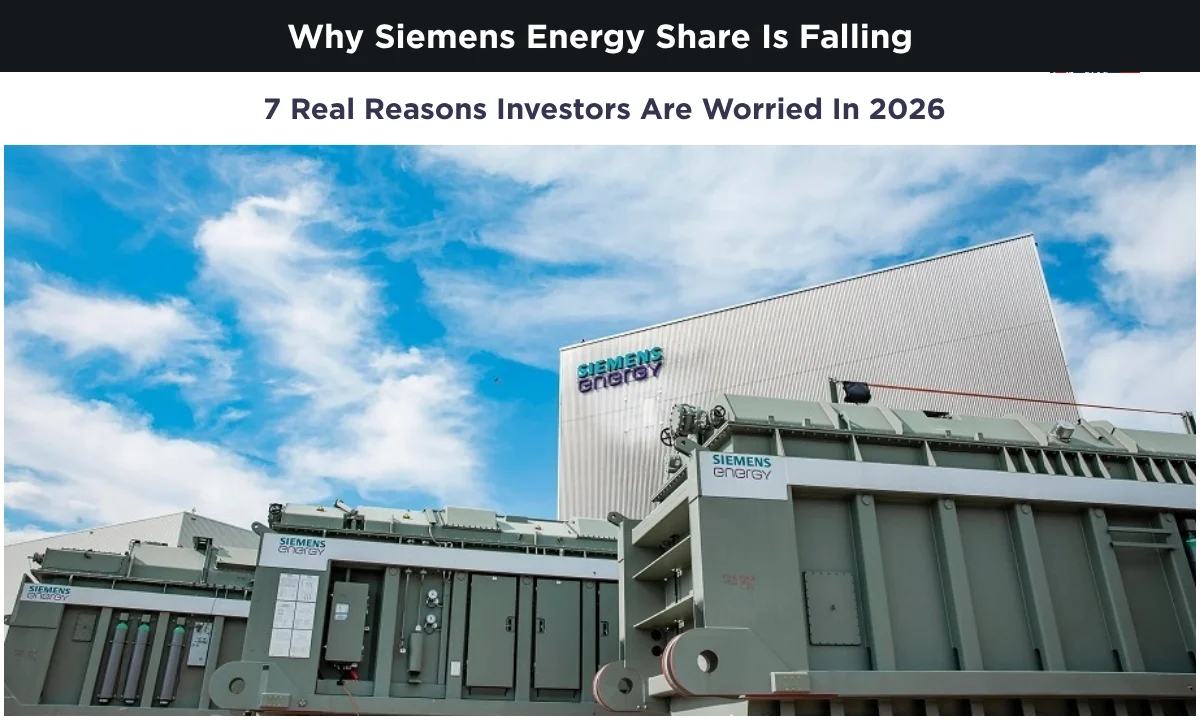
1) Siemens Energy
Siemens Energy has declined over the last six months due to a combination of factors that have impacted investor confidence and valuation levels. Key reasons include:
- Profit Booking After Rally – The stock saw a strong upward movement earlier, leading investors to lock in gains once valuations became stretched.
- High Valuation Concerns – The price-to-earnings ratio moved beyond comfortable levels, making the stock appear expensive relative to its growth prospects.
- Slower Earnings Growth – Recent financial results did not match the high expectations set during the rally phase.
- Sector Rotation – Investors shifted funds from capital goods and energy stocks to other sectors offering better short-term opportunities.
- Rising Input Costs – Increased raw material and operational costs put pressure on margins, impacting profitability outlook.
Read In Detail: Why Siemens Energy Share Is Falling Since 6 Months: Strong Growth But Short Term Pain Explained
2) Tata Motors Passenger Vehicles
- Tata Motors Passenger Vehicles has seen pressure due to a slowdown in domestic demand, especially in entry-level and mid-segment cars where competition has intensified.
- The company’s financials show moderate revenue growth but declining margins, which has raised concerns among investors about near-term earnings visibility.
- Increased competition from both traditional automakers and new EV players has affected market share expectations.
3) Interglobe Aviation
Interglobe Aviation has corrected despite strong operational growth, and several data-backed factors explain this decline:
- High Valuation Pressure: The stock was trading at a P/E ratio of around 28–30x, which is significantly higher than the historical average of 18–20x, leading to profit booking by institutional investors.
- Rising Fuel Costs: Aviation turbine fuel (ATF) prices increased by nearly 12% over the last six months, directly impacting operating margins since fuel accounts for approximately 35–40% of total costs.
- Margin Compression: Despite revenue growth of 18% YoY to ₹17,160 crore in the latest quarter, EBITDA margins declined from 25% to around 21%, signaling cost pressures.
- Currency Depreciation Impact: The weakening of the Indian Rupee against the US Dollar (₹83–₹84 range) increased lease and maintenance expenses, as most aircraft costs are dollar-denominated.
- Profit Booking After Rally: The stock had already delivered over 60% returns in the previous year, prompting investors to lock in gains.
- Capacity Expansion Costs: Aggressive fleet expansion plans, including orders for over 500 aircraft, have raised concerns about future capital expenditure and debt levels.
These combined factors have led to short-term correction despite strong passenger growth and market leadership.
4) Bajaj Finance
Bajaj Finance has declined over the last six months due to multiple fundamental and macroeconomic factors that investors are closely tracking:
- The stock has corrected nearly 18% from its recent high of around ₹8,200 to approximately ₹6,700, reflecting valuation compression in the NBFC space.
- The company reported a loan book growth of 31% YoY, reaching ₹3.3 lakh crore, but concerns remain about sustaining this pace in a tighter liquidity environment.
- Gross NPA remains controlled at 0.95%, but investors are cautious about potential asset quality deterioration in unsecured lending segments.
5) Indian Hotels Company
Indian Hotels Company has seen a dip after a strong rally. The fall is largely due to profit booking by investors who entered earlier at lower levels and are now locking in gains. However, several deeper factors explain the recent 6-month decline:
- Slower Revenue Growth: Q4 FY24 revenue stood at ₹1,905 crore, showing moderate growth compared to previous quarters, leading to cautious sentiment.
- Debt Levels: Total debt remains around ₹2,200 crore, which concerns some investors despite improving cash flows.
- Global Uncertainty: Weak global travel sentiment and inflation fears have also contributed to short-term pressure on hospitality stocks.
6) Bajaj Holdings & Investments
Bajaj Holdings & Investments has corrected in line with the broader financial sector weakness. Market sentiment towards financial stocks has turned cautious, affecting its performance. However, several strong fundamentals continue to support its long-term value:
- Strong Net Asset Value (NAV): The company’s NAV stands above ₹9,500 per share, while the stock trades at a significant discount of over 40%, indicating undervaluation.
- Robust Profit Growth: Bajaj Holdings reported a net profit of ₹1,800+ crore in FY24, driven by strong dividend income from group companies like Bajaj Finance and Bajaj Finserv.
- High Dividend Yield: The company offers a consistent dividend payout, with a yield of around 2.5%–3%, making it attractive for long-term investors.
- Consistent Cash Reserves: The company maintains cash and liquid investments exceeding ₹2,000 crore, providing flexibility for future investments.
These factors highlight that the recent fall is more sentiment-driven rather than due to weak fundamentals.
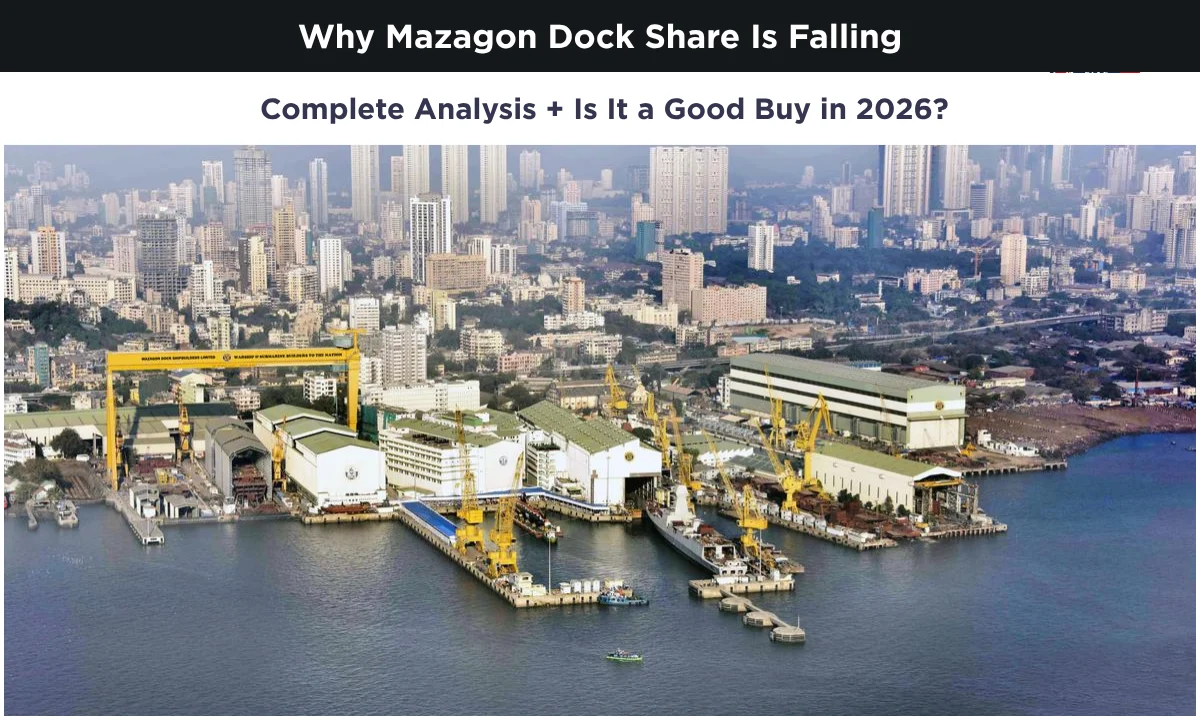
7) Mazagon Dock Shipbuilders
Mazagon Dock Shipbuilders has declined after a massive rally. The correction indicates cooling momentum as investors reassess valuations after sharp price appreciation. However, several strong fundamentals continue to support long-term value:
- Strong Order Book: The company has an order book exceeding ₹38,000 crore, providing clear revenue visibility for the next 3–4 years.
- Revenue Growth: FY24 revenue stood at around ₹9,466 crore, showing consistent growth driven by defense contracts.
- Profitability: Net profit for FY24 was approximately ₹1,937 crore, with a healthy net margin above 20%.
- Export Potential: Increasing focus on exporting warships and submarines can boost future earnings.
- Valuation Correction: The recent fall has brought the P/E ratio down from overheated levels, making it relatively more attractive for long-term investors.
8) Cholamandalam Investment
Cholamandalam Investment has declined over the last six months due to multiple fundamental and macroeconomic factors that investors are closely tracking:
- Rising interest rates have increased the company’s cost of borrowing, putting pressure on net interest margins (NIM), which stood around 7.5% but are expected to compress further.
- Credit growth has slowed, with loan book expansion moderating to nearly 18% YoY compared to over 25% in previous periods.
- Asset quality concerns have emerged, with Gross NPA rising slightly to around 3.2%, indicating stress in certain borrower segments.
- Higher provisioning requirements due to cautious risk management are affecting overall profitability and return ratios.
9) Solar Industries
Solar Industries has corrected over the last six months due to multiple fundamental and market-driven factors. Here are the key reasons with financial insights:
- Valuation Cooling: The stock had rallied significantly, pushing its P/E ratio above 60x, leading to profit booking as investors sought more reasonable valuations.
- Order Execution Delays: Some defense and export orders faced execution delays, impacting short-term earnings visibility.
- Profit Booking by Institutions: FIIs reduced holdings marginally, triggering selling pressure in the stock.
- Sector Rotation: Investors shifted capital from high-growth industrial stocks to defensive sectors like banking and FMCG.
10) Hyundai Motor India
Hyundai Motor India has declined over the last six months due to multiple fundamental and macroeconomic factors that investors are closely tracking:
- Export Weakness: Export volumes fell nearly 8% YoY due to slowdown in key markets like Europe and Latin America.
- Inventory Build-Up: Dealer inventory levels increased to 45–50 days versus the ideal 30 days, signaling slower retail demand.
- Profit Growth Moderation: Net profit growth slowed to around 6% YoY compared to 18% in the previous year, raising concerns about earnings sustainability.
11) Pidilite Industries
Pidilite Industries has declined due to weak consumption trends. Slower demand in the consumer segment is impacting revenue growth expectations. However, several strong fundamentals indicate long-term value potential:
- Strong Profit Margins: The company maintains an EBITDA margin of around 22%, which is among the highest in the adhesives and chemicals sector.
- Net Profit Strength: Net profit stood at approximately ₹1,850 crore, reflecting consistent profitability even during weak consumption cycles.
- Market Leadership: Pidilite holds over 70% market share in the adhesives segment with brands like Fevicol and Fevikwik.
- Low Debt Position: The company remains virtually debt-free, ensuring financial stability during downturns.
- Raw Material Cost Advantage: Declining crude-linked input costs are expected to improve margins in upcoming quarters.
- Strong Cash Flow: Operating cash flow remains robust, supporting expansion and dividend payouts.
12) CG Power & Industrial Solutions
CG Power & Industrial Solutions has declined over the last six months due to a combination of valuation correction and sector-specific factors. Here are the key reasons with financial insights:
- The stock corrected nearly 18% from its recent high of ₹485 to around ₹398, indicating profit booking after a sharp rally of over 120% in the previous year.
- Despite strong fundamentals, the price-to-earnings (P/E) ratio expanded beyond 75x, making it expensive compared to industry peers averaging around 45x.
- Quarterly revenue growth slowed slightly, with Q4 FY25 revenue at ₹2,210 crore versus ₹2,050 crore in the previous quarter, showing only ~7.8% sequential growth.
13) Adani Enterprises
Adani Enterprises has declined significantly over the last six months due to a combination of financial pressure, regulatory scrutiny, and weakening investor confidence. Key reasons include:
- Revenue growth slowdown: The company reported revenue of ₹96,420 crore in FY24 compared to ₹1,04,372 crore in FY23, reflecting a decline of nearly 7.6%, raising concerns about core business momentum.
- Profit margin pressure: Net profit dropped to ₹3,240 crore from ₹4,820 crore year-on-year, indicating shrinking margins due to rising operational costs and debt servicing.
- High debt levels: Total debt remains elevated at approximately ₹2.2 lakh crore, increasing financial risk and impacting valuation multiples.
- Regulatory and governance concerns: Ongoing scrutiny by SEBI and global agencies has created uncertainty, affecting institutional investor participation.
- FII outflows: Foreign institutional investors reduced holdings by nearly 3.5% over the last two quarters, signaling reduced confidence.
14) HDFC Bank
HDFC Bank has declined over the last six months due to a combination of valuation concerns, slowing deposit growth, and sector rotation. Key reasons include:
- Net Interest Margin (NIM) compression from 4.1% to around 3.6% due to rising cost of funds
- Deposit growth lagging at ~15% YoY compared to loan growth of ~18%, creating liquidity pressure
- CASA ratio declining from 44% to nearly 38%, impacting low-cost funding advantage
- Post-merger integration challenges with HDFC Ltd affecting operational efficiency
- Profit growth slowing to ~33% YoY in recent quarters versus earlier higher expectations
Despite strong fundamentals, these factors have reduced investor confidence in the near term.
15) Ambuja Cements
Ambuja Cements has declined over the last six months due to a combination of demand slowdown and margin pressures. Key reasons include:
- Weak infrastructure demand: Government capex growth slowed in recent quarters, impacting cement offtake in core regions.
- Volume growth moderation: Q4 FY25 volumes grew only around 3–4% YoY compared to double-digit growth earlier.
- Margin pressure: EBITDA per ton declined to approximately ₹850–₹900 due to rising input costs like coal and petcoke.
- Rising expenses: Freight and logistics costs increased by nearly 8–10%, impacting profitability.
- Financial performance: Revenue stood near ₹8,900 crore in the latest quarter, but net profit dropped to around ₹1,050 crore, reflecting margin compression.
- Valuation concerns: The stock was trading at a premium EV/EBITDA multiple above 18x, leading to profit booking.
16) HDFC AMC
HDFC AMC has corrected due to multiple fundamental and macro factors that have impacted both its earnings visibility and investor sentiment:
- Decline in Net Inflows: Equity mutual fund net inflows dropped from ₹34,697 crore in December 2025 to ₹19,271 crore in February 2026, directly affecting HDFC AMC’s AUM growth trajectory.
- Slower AUM Growth: The company’s average AUM growth slowed to around 8% YoY compared to 18% YoY in the previous year, indicating reduced momentum in asset accumulation.
- Pressure on Revenue: Quarterly revenue stood at approximately ₹780 crore, showing only marginal growth, while operating margins compressed from 42% to around 38% due to lower fee income.
- Decline in SIP Contributions: Monthly SIP inflows across the industry fell from ₹17,073 crore to ₹15,800 crore, impacting long-term recurring revenue streams.
- Market Volatility Impact: Equity market correction of nearly 14% in benchmark indices reduced mark-to-market AUM value, directly affecting management fees.
- Valuation Correction: The stock was trading at a high P/E of around 35x, which corrected to nearly 28x as investors shifted towards value stocks.
- Increased Competition: Rising competition from low-cost passive funds and ETFs is putting pressure on expense ratios and profitability.
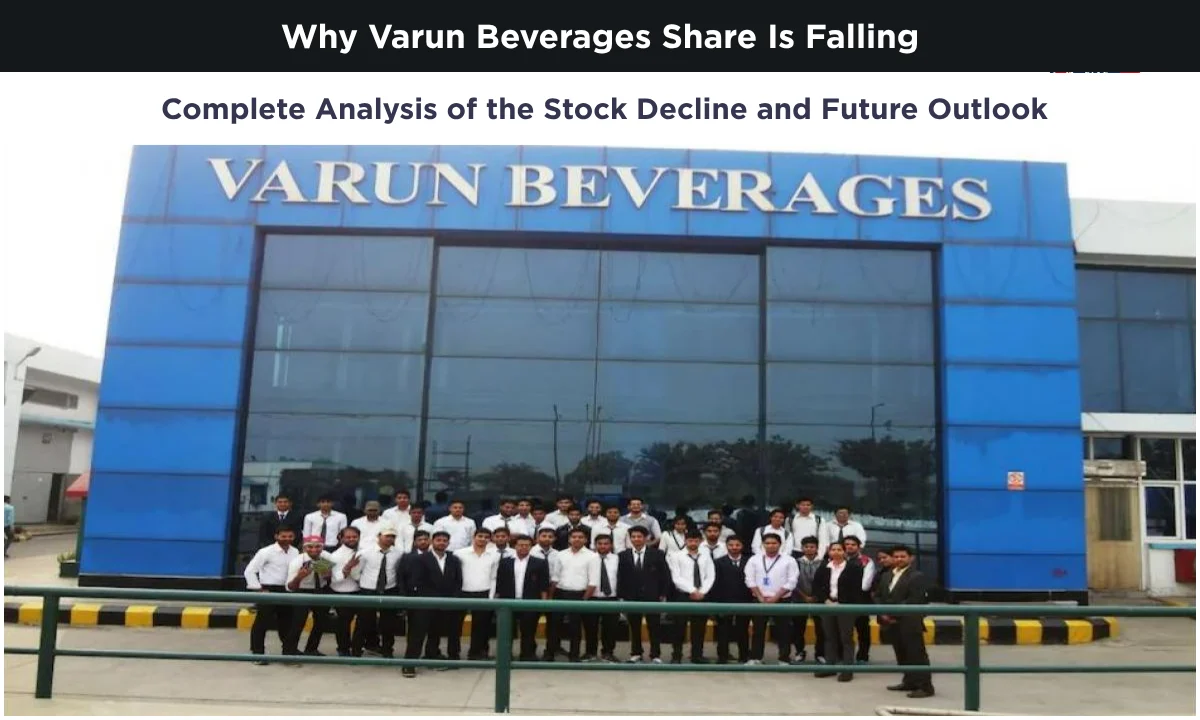
17) Varun Beverages
Varun Beverages has declined over the last six months due to a combination of macroeconomic pressure, valuation correction, and company-specific factors. Here are the key reasons explained with financial context:
- Net Profit Slowdown: Net profit stood at ₹548 crore versus ₹563 crore last year, reflecting a slight decline of ~2.6%.
- High Valuation Correction: The stock was trading at a P/E of over 60x, leading to profit booking by institutional investors.
- Seasonal Demand Impact: Weak summer demand in certain regions affected volume growth, which is critical for beverage companies.
- Rising Debt Levels: Total debt increased to approximately ₹6,800 crore due to expansion and acquisitions, raising investor concerns.
- Global Expansion Costs: Investments in international markets like South Africa and Zimbabwe increased operational expenses.
18) Godrej Consumer Products
Godrej Consumer Products has declined over the last six months due to multiple fundamental and macroeconomic factors that have impacted its growth outlook:
- Weak rural demand continues to be a major concern, with rural volume growth remaining in low single digits, directly affecting categories like soaps and hair color where rural contribution is significant.
- Palm oil prices, a key raw material, have remained volatile, increasing cost pressure and limiting margin expansion despite price hikes.
- International business, especially in Africa, has shown slower growth, contributing less than expected to overall revenue, which stands at approximately ₹13,000 crore annually.
- Increased competition from regional and unorganized players is impacting market share in key segments.
19) Bajaj Finserv
Bajaj Finserv has corrected along with the broader financial sector. Concerns around valuations and interest rates are influencing investor sentiment. However, several key factors explain this decline in more detail:
- The stock has fallen nearly 18% in the last six months, tracking weakness in NBFC and insurance segments.
- Bajaj Finserv reported consolidated revenue of ₹1.10 lakh crore in FY25, but growth slowed compared to previous years.
- Insurance subsidiaries like Bajaj Allianz Life and General Insurance have seen slower premium growth due to competitive pressure.
- RBI regulations on NBFCs have tightened liquidity norms, affecting lending flexibility.
20) IRFC
IRFC has declined after strong gains, but this correction is driven by multiple measurable factors that investors should understand:
- Profit Booking After Rally: The stock delivered over 120% returns in the previous year, leading to heavy profit booking by institutional and retail investors.
- Valuation Compression: IRFC’s P/E ratio expanded to around 35x at peak levels, significantly higher than its historical average of 10–12x, triggering a correction toward fair valuation.
- Slower Earnings Growth: Recent quarterly results showed net profit growth of around 15% YoY, compared to 30%+ growth in earlier quarters, indicating moderation.
- Rising Interest Costs: IRFC’s borrowing cost increased to approximately 7.5%, impacting net interest margins slightly.
- Government Policy Uncertainty: Changes in railway capex allocation and funding structure created short-term uncertainty.
- High Debt Structure: Total borrowings remain above ₹4.5 lakh crore, making the company sensitive to interest rate movements.
- Market Rotation: Investors are shifting from PSU stocks to private sector growth stocks, reducing demand for IRFC shares.
These factors collectively explain the recent decline despite strong fundamentals.
Sector Wise Breakdown Of Market Weakness
Not all sectors are affected equally. Some sectors are facing heavy selling pressure due to valuation concerns, slowing earnings growth, and global uncertainty. Others are relatively stable because they are backed by strong fundamentals, consistent demand, or government support.
Most affected sectors:
- Technology
- SaaS companies
- Fintech businesses
- Consumer discretionary
- AI and EV related stocks
These sectors were among the biggest winners during the previous bull run. Many companies in these categories were trading at very high valuations based on future growth expectations. Now, as interest rates remain high and liquidity tightens, investors are becoming more cautious. They are questioning whether these companies can justify their valuations in the near term. As a result, even small negative news leads to sharp corrections in these stocks.
Stable or better performing sectors:
- Power and utilities
- Metals
- Public sector banks
- Pharma companies
These sectors are showing resilience because they are either linked to essential services or benefiting from favorable economic conditions. For example, power and utilities are supported by consistent demand and infrastructure growth. Public sector banks are gaining from improved balance sheets and credit growth. Pharma companies are relatively defensive, as healthcare demand remains stable regardless of economic cycles.
This clearly shows that money is rotating. It is not exiting the market. It is shifting from risky sectors to stable sectors. This phenomenon is known as sector rotation, and it is a normal part of market cycles. Smart investors track this movement closely because it helps them identify where institutional money is flowing. Understanding this shift can help investors make better decisions instead of reacting emotionally to short-term price movements.
Understanding Market Corrections Through History
Market corrections are a normal part of investing. Every investor faces them at some point in their journey. The key is not to avoid corrections but to understand their nature, causes, and implications. When investors understand why markets fall, they are better prepared to respond rationally instead of reacting emotionally.
There are three main types of corrections, and each behaves differently in terms of severity, duration, and recovery pattern.
Event based correction happens due to sudden and unexpected events. These events include pandemics, wars, political instability, or financial shocks. These corrections are usually sharp because panic spreads quickly across markets. However, recovery is often fast once the uncertainty reduces and confidence returns. A good example is the COVID-19 crash, where markets fell rapidly but also recovered strongly within months.
Liquidity based correction happens when the flow of money in the economy reduces. This usually occurs when central banks increase interest rates or tighten monetary policy to control inflation. As borrowing becomes expensive, businesses slow down and investors become cautious. This type of correction tends to last longer than event-based corrections because it is driven by policy changes rather than temporary shocks.
Structural correction is the most serious type. It happens due to deep-rooted economic problems such as weak growth, high debt levels, or systemic financial issues. These corrections take longer to recover because they require fundamental changes in the economy. Investors need strong patience and discipline during such phases.
Here is a simple comparison:
| Type | Average Fall | Duration | Recovery Speed |
|---|---|---|---|
| Event Based | 34% | 5 months | Fast |
| Liquidity Based | 36% | 10 months | Medium |
| Structural | 53% | 16 months | Slow |
Understanding these categories helps investors set realistic expectations. The current market looks like a mix of liquidity and structural correction. This means recovery may not be immediate, and patience becomes one of the most valuable assets for long-term investors.
Public Opinion And Investor Sentiment (Data From X)
Investor sentiment plays a huge role in market movement. Social media shows real emotions of investors. Many investors are frustrated. They are seeing continuous losses. Some investors are advising others to stop checking their portfolios daily. A common idea is becoming popular. Investors believe there are only three choices.
- Sell and exit
- Ignore for six months
- Keep watching and feel stress
This shows the emotional side of investing. Markets are not just numbers. They are also about human behavior. Retail investors are facing pressure. Many of them invested during hype cycles. Now they are seeing the downside.
Real Examples Of Heavy Losses
Some stocks have fallen sharply. This shows the risk of high growth investing, especially when valuations are driven more by future expectations than current earnings. During bullish phases, investors often overlook fundamentals and chase momentum, which can lead to inflated prices. When market sentiment shifts, these same stocks tend to correct aggressively.
Growth stocks have fallen between 20 to 60 percent. Some small cap stocks have fallen even more. This is because smaller companies usually have lower liquidity and higher volatility. When selling pressure increases, there are fewer buyers available, which accelerates the decline. Additionally, many of these companies are still in their expansion phase and may not have stable cash flows, making them more vulnerable during uncertain times.
Fintech companies are under pressure. Many have lost a large portion of their value. This sector was one of the biggest beneficiaries during the digital boom, but rising interest rates and tighter regulations have impacted their growth outlook. Investors are now questioning their profitability timelines, leading to sharp corrections.
Some extreme cases show declines of more than 70 percent. These cases are usually in high risk or low liquidity stocks. In many situations, these companies had weak fundamentals, high debt levels, or unrealistic growth projections. Once confidence breaks, recovery becomes difficult and takes a long time.
This teaches an important lesson. High returns always come with high risk. Investors should not blindly chase high growth stories without understanding the underlying business. Proper research, diversification, and risk management are essential to protect capital during volatile market phases.
Market Breadth And Oversold Signals
Market breadth indicators show how many stocks are participating in the trend. Current data shows weakness across the market. Only a small percentage of stocks are trading above their moving averages. This indicates oversold conditions.
Oversold does not mean immediate recovery. It means the market is preparing for a possible reversal. Investors should be careful. Acting too early can be risky.
What Happens After A Market Bottom
History gives a strong message. Every correction is followed by recovery. After market bottoms strong returns are usually seen. Here is historical data:
| Time Period | Average Return |
|---|---|
| 1 Month | 18% |
| 3 Months | 23% |
| 6 Months | 39% |
| 12 Months | 62% |
This shows the importance of patience. Most investors miss these gains because they exit during fear.
What Smart Investors Are Doing Now?
Experienced investors are not panicking. They are making strategic moves based on data, experience, and long-term thinking rather than short-term emotions.
- They are reducing exposure to risky stocks, especially those with weak earnings visibility or high valuations. Instead of chasing momentum, they are reallocating capital toward stable sectors such as banking, utilities, and essential consumption, where earnings are more predictable even during uncertain times.
- They are holding cash for future opportunities. Cash is not seen as idle money but as a strategic asset. When markets correct further or quality stocks become undervalued, this liquidity allows them to enter at better prices without stress.
- They are avoiding leverage. Margin trading is very risky in volatile markets because even small price movements can trigger forced selling. Experienced investors understand that preserving capital is more important than chasing aggressive returns during uncertain phases.
- They are focusing on strong companies with good fundamentals. These include businesses with consistent cash flow, low debt, strong management, and a proven track record. Such companies tend to recover faster when the market stabilizes.
- In addition to these steps, they are also reviewing their portfolios regularly. They are identifying underperforming assets and deciding whether to hold, reduce, or exit based on fundamentals rather than emotions. Many are also using systematic investment approaches like SIPs to average their buying cost during market dips.
- Another important strategy is diversification. Instead of concentrating investments in one sector, they are spreading risk across multiple industries and asset classes. This reduces the overall impact of volatility.
Risks That Still Exist In The Market
Even after the correction risks are still present, and understanding these risks in detail is important for making informed investment decisions. The current market environment is influenced by multiple interconnected factors that continue to create uncertainty and volatility.
Oil prices remain elevated due to supply constraints and geopolitical conflicts. Higher oil prices directly impact transportation and manufacturing costs, which eventually lead to increased inflation. When inflation rises, central banks are forced to maintain or increase interest rates, which puts additional pressure on both businesses and consumers.
Geopolitical tensions across different regions are another major concern. Conflicts and trade disputes disrupt global supply chains and reduce investor confidence. These uncertainties make investors more cautious, leading to reduced capital inflows into equity markets.
Interest rates are still at relatively high levels compared to previous years. High interest rates increase borrowing costs for companies, which can slow down expansion plans and reduce profitability. For investors, higher rates also make fixed-income instruments more attractive compared to equities, resulting in reduced liquidity in the stock market.
Earnings growth is also showing signs of slowdown in several sectors, especially in technology and consumer discretionary industries. Companies are facing margin pressure due to rising input costs and weaker demand. This creates doubts about future growth potential.
Foreign institutional investors are becoming more cautious due to global uncertainties and currency fluctuations. Their reduced participation can significantly impact market momentum, especially in emerging markets. All these factors combined create a challenging environment where volatility can persist for a longer period. Investors need to stay aware of these risks and adjust their strategies accordingly.
Opportunities Hidden In This Correction
Every correction brings opportunities, but only for those who are prepared to identify them with a clear strategy. Market downturns often create temporary mispricing, where fundamentally strong companies trade below their intrinsic value. This is where disciplined investors can build long-term wealth.
Good companies are available at lower prices, especially those with strong balance sheets, consistent earnings, and competitive advantages. Instead of focusing on short-term price movements, investors should analyze business fundamentals such as revenue growth, debt levels, and management quality.
Long term sectors like banking and infrastructure are becoming attractive due to their strong role in economic recovery. Banking stocks benefit from credit growth cycles, while infrastructure companies gain from government spending and development projects.
Dividend paying stocks are gaining attention because they provide steady income even during volatile periods. These stocks can act as a cushion against market fluctuations and are often preferred by conservative investors.
Value investing is becoming popular again as investors shift focus from high-growth narratives to sustainable profitability. Buying undervalued stocks with strong fundamentals can generate significant returns when the market stabilizes.
Here are some key opportunity areas investors are exploring:
- Large-cap stocks with stable earnings
- Public sector companies benefiting from reforms
- Infrastructure and capital goods sectors
- High dividend yield stocks
- Companies with low debt and strong cash flow
Many investors are now looking for buying opportunities instead of panic selling. However, it is important to invest gradually rather than all at once. Systematic investing helps reduce risk and improves long-term outcomes.
Lessons From Current Market Scenario
This market phase is teaching important lessons that every investor should understand and apply. Corrections are not just about losses; they are also about learning how markets behave under pressure.
Diversification is very important. Putting all money in one sector is risky because sector-specific downturns can significantly impact the portfolio. A balanced allocation across sectors and asset classes helps reduce overall risk.
Chasing hype stocks can lead to losses. Many investors enter stocks based on trends or social media influence without understanding the business. When the hype fades, prices fall sharply.
Risk management is necessary for long term success. Investors should define their risk tolerance, avoid excessive leverage, and maintain a margin of safety in their investments.
Patience is the biggest advantage in investing. Markets reward those who stay invested during difficult times. Selling in panic often locks in losses and prevents participation in recovery. Emotional control is critical. Decisions based on fear or greed can lead to poor outcomes. Investors should follow a disciplined approach and avoid reacting to short-term noise.
Additional key lessons include:
- Always invest with a clear goal and time horizon
- Maintain liquidity for unexpected opportunities
- Review portfolio periodically instead of reacting daily
- Focus on quality over quantity of stocks
These lessons are valuable for every investor and can significantly improve long-term investment success.
Psychological Impact Of Market Decline
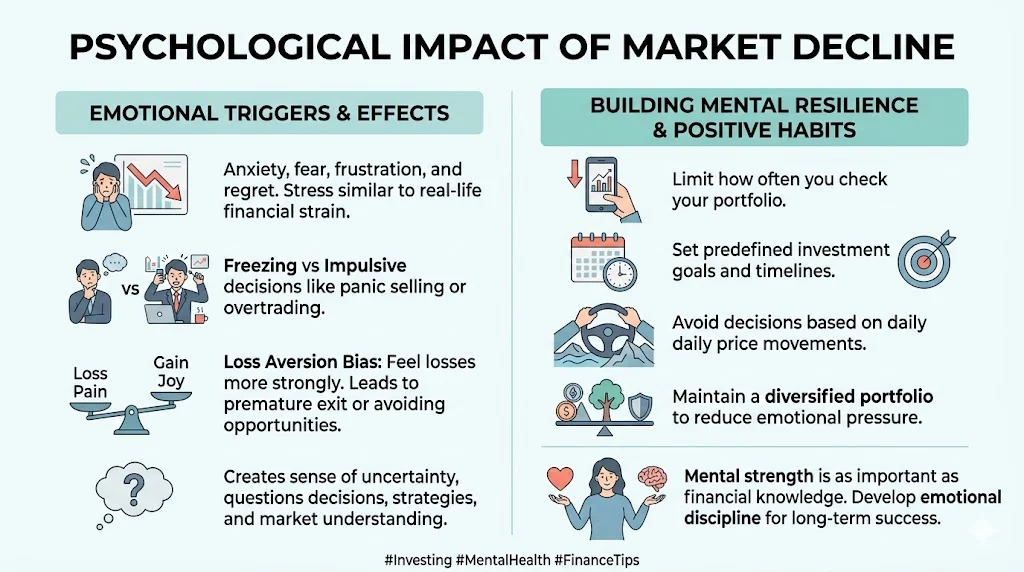
Market decline affects mental health in ways many investors underestimate. When portfolios consistently show losses, it triggers emotional responses similar to real-life financial stress. Anxiety, fear, frustration, and even regret become common. This is especially true for investors who entered the market during bullish phases and are not mentally prepared for downturns.
Seeing losses daily can be difficult because it creates a sense of uncertainty about the future. Investors begin to question their decisions, strategies, and even their understanding of the market. This often leads to two extreme reactions. Some investors freeze and avoid taking any action, while others make impulsive decisions like panic selling or overtrading.
Loss aversion plays a major role here. Psychologically, people feel the pain of losses more strongly than the joy of gains. This bias can push investors to exit positions prematurely or avoid good opportunities due to fear.
To manage this, investors should adopt practical habits:
- Limit how often you check your portfolio
- Set predefined investment goals and timelines
- Avoid making decisions based on daily price movements
- Maintain a diversified portfolio to reduce emotional pressure
It is important to stay calm and remember that volatility is a natural part of investing. Mental strength is as important as financial knowledge. Investors who develop emotional discipline are more likely to succeed in the long run.
Long Term Vs Short Term Thinking
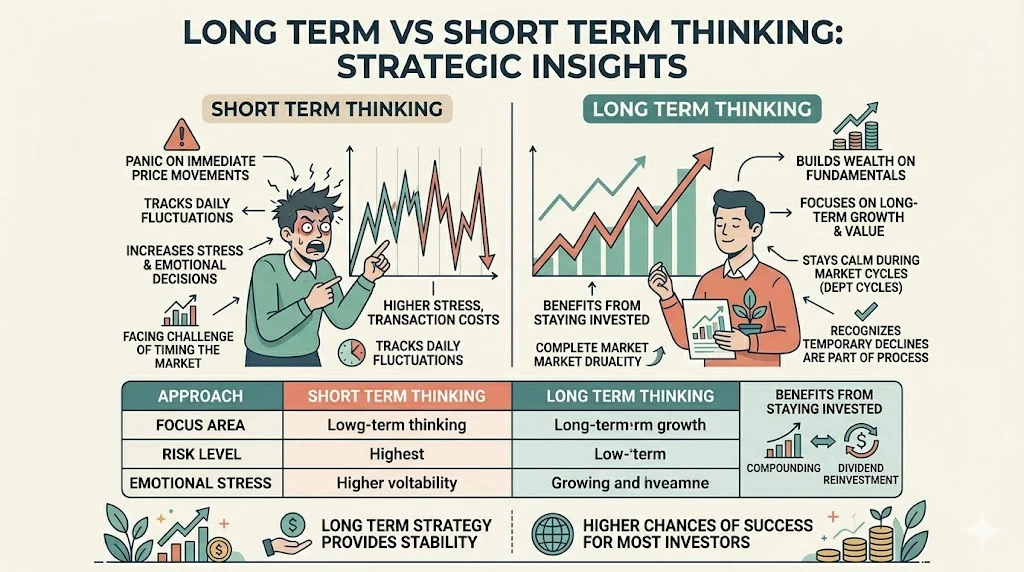
Short term thinking often leads to panic because it focuses on immediate price movements. When investors track daily fluctuations, even small declines can feel significant. This creates stress and increases the likelihood of emotional decisions.
Long term thinking, on the other hand, builds wealth by focusing on fundamentals and growth over time. Markets move in cycles, and temporary declines are part of this process. Investors who understand this are less likely to panic during downturns.
Historical data consistently shows that long term investors benefit from staying invested. Compounding returns, dividend reinvestment, and market recovery all contribute to wealth creation over time. Short term traders, however, face higher stress, transaction costs, and the challenge of timing the market correctly.
Here is a simple comparison:
| Approach | Focus Area | Risk Level | Emotional Stress |
|---|---|---|---|
| Short Term | Daily movements | High | High |
| Long Term | Growth & value | Moderate | Low |
Choosing the right approach depends on your goals, risk tolerance, and time horizon. However, for most investors, a long term strategy provides better stability and higher chances of success.
Importance Of Asset Allocation
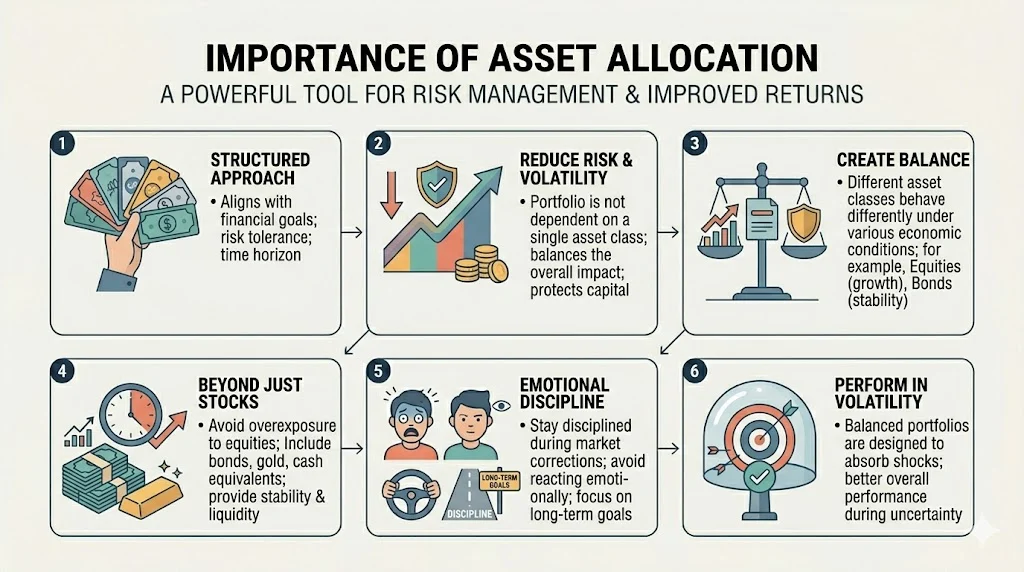
Asset allocation is one of the most powerful tools available to investors for managing risk and improving long term returns. It is not just about spreading money across different investments. It is about creating a structured approach that aligns with your financial goals, risk tolerance, and time horizon.
Asset allocation helps reduce risk by ensuring that your portfolio is not dependent on a single asset class. When one asset underperforms, another may perform better and balance the overall impact. This reduces volatility and protects capital during uncertain market conditions.
Investing in different asset classes provides balance. Each asset class behaves differently under various economic conditions. For example, equities perform well during economic growth, while bonds provide stability during downturns. Gold often acts as a hedge against inflation and currency fluctuations.
Stocks are important but not the only option. Overexposure to equities can increase risk, especially during market corrections. Including bonds, gold, or even cash equivalents can provide stability and liquidity when needed.
Balanced portfolios perform better during volatility because they are designed to absorb shocks. Instead of reacting emotionally to market movements, investors with proper allocation can stay disciplined and focused on long term goals.
A simple example of asset allocation:
| Asset Class | Allocation |
|---|---|
| Equities | 60% |
| Bonds | 25% |
| Gold | 10% |
| Cash | 5% |
This type of allocation can be adjusted based on age, income, and risk appetite. Younger investors may prefer higher equity exposure, while conservative investors may increase allocation to bonds and gold.
Common Mistakes Investors Are Making
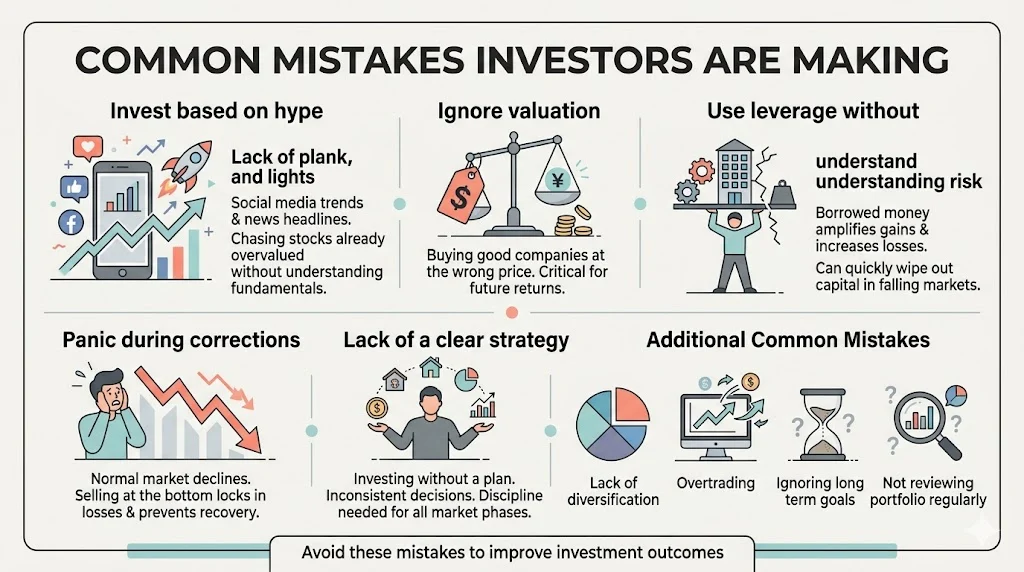
Many investors repeat the same mistakes, especially during volatile market phases. These mistakes often come from lack of planning, emotional decision making, and following market noise instead of data.
They invest based on hype. Social media trends and news headlines often influence decisions. Investors chase stocks that are already overvalued without understanding the fundamentals.
They ignore valuation. Buying a good company at the wrong price can lead to losses. Valuation plays a critical role in determining future returns. They use leverage without understanding risk. Borrowed money can amplify gains but also increases losses. In falling markets, leverage can quickly wipe out capital.
They panic during corrections. Market declines are normal, but many investors sell at the bottom due to fear. This locks in losses and prevents participation in recovery. They do not have a clear strategy. Investing without a plan leads to inconsistent decisions. A defined strategy helps maintain discipline during both bull and bear phases.
Additional common mistakes include:
- Lack of diversification
- Overtrading and high transaction costs
- Ignoring long term goals
- Not reviewing portfolio regularly
Avoiding these mistakes can significantly improve investment outcomes and reduce unnecessary stress.
Future Outlook Of Stock Market
The future of the stock market depends on multiple interconnected factors. Understanding these factors helps investors prepare for different scenarios instead of reacting blindly. Interest rates may change. Central banks play a major role in controlling liquidity. Lower interest rates can boost markets, while higher rates can slow down growth.
Oil prices may stabilize. Energy costs impact inflation and corporate profitability. Stable oil prices can support economic recovery. Economic growth may improve. Strong GDP growth leads to better earnings for companies, which supports stock prices.
Global tensions may reduce. Geopolitical stability improves investor confidence and encourages capital inflow. If these factors improve, market sentiment will improve. Positive developments can trigger a strong recovery phase.
If not, volatility may continue. Markets may remain range bound or experience further corrections. The market is currently in a transition phase. This phase often creates uncertainty but also opens opportunities for long term investors. Historically, such phases have been followed by strong growth cycles.
Investors should focus on fundamentals, maintain discipline, and stay prepared for both risks and opportunities in the coming months.
Related Posts :



Share This Post