Why Hyundai Motor Share Is Falling in India: Market Share Loss, Analysis & Investment Outlook
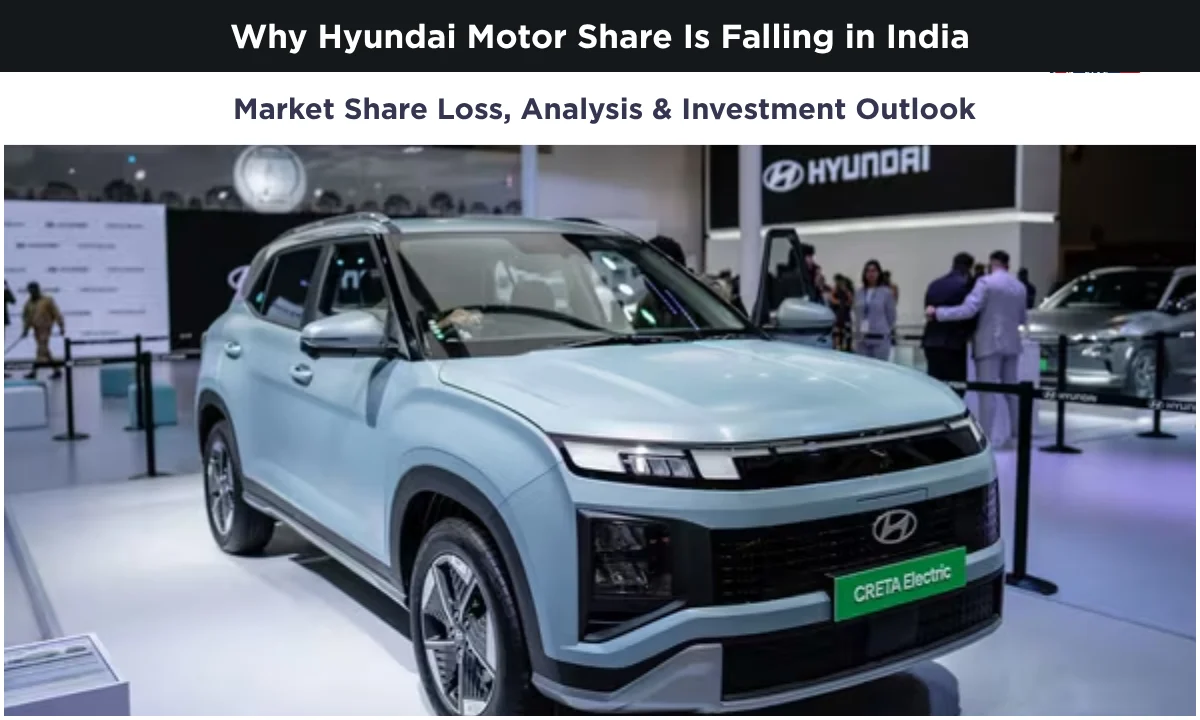
Why Hyundai Motor Share Is Falling in India: Market Share Loss, Analysis & Investment Outlook
Why Hyundai Motor share is falling in India? This question is dominating stock market discussions as Hyundai Motor India Ltd (HMIL) has crashed over 20% from its peak and now trades below its IPO price of ₹1,960. Once India’s second-largest carmaker and the country’s biggest IPO, Hyundai has become one of the worst-performing large-cap stocks, declining 6.99% in just one week ending March 27, 2026.
If you’re wondering why is HYUNDAI losing market share and whether this creates a buying opportunity, this comprehensive analysis covers the fundamental reasons behind the crash, competitive dynamics, and answers the critical question: Is HYUNDAI share good to buy?
Table of Contents
Hyundai Motor India: From IPO Star to Underperformer
Hyundai Motor India made history with India’s largest IPO in October 2024, raising ₹27,870 crore. The stock listed at ₹1,960 and surged to an all-time high of ₹2,890 in September 2025 – a 71% gain from April to mid-September. However, the story changed dramatically:
| Metric | Data |
|---|---|
| IPO Price | ₹1,960 |
| All-Time High | ₹2,890 (September 2025) |
| Current Price | ~₹1,770-1,814 (March 2026) |
| Decline from Peak | ~38% |
| Performance vs IPO | ~10% below listing price |
| Weekly Decline (Mar 23-27) | 6.99% |
| YTD Performance | Significant underperformance vs NIFTY50 |
The stock has closed lower in six of the last seven trading sessions as of March 30, 2026, hitting intraday lows near ₹1,734 far below what IPO investors paid.
Why Hyundai Motor Share Is Falling in India: 7 Key Reasons
Understanding why Hyundai Motor share is falling in India requires examining multiple interconnected factors ranging from market share erosion to global geopolitical tensions.
1. Severe Market Share Erosion (The Core Problem)
Why is HYUNDAI losing market share? This is the single biggest concern driving the stock down:
| Period | Market Share | Trend |
|---|---|---|
| FY2019 (Peak) | ~16-17.5% | Market leader after Maruti |
| FY2020 | 16% | Stable |
| FY2022-2024 | Steady decline | Losing ground |
| H1 FY2026 | 13.3% | 24-year low |
| 9M FY2026 | 12.6% | Continued slide |
Key Insight: Hyundai has lost 4-5 percentage points of market share in just a few years a massive value destruction in India’s competitive PV market.
Why competitors are winning:
- Mahindra & Mahindra: Aggressive SUV lineup (Thar, XUV700, Scorpio-N) capturing rural and urban markets
- Tata Motors: Strong EV and SUV portfolio with better feature-to-price ratio
- Kia: Sister brand eating Hyundai’s lunch with fresher designs
- Toyota: Rising presence with hybrid technology
Analysts at Jefferies India note: “Competitive landscape in PVs has changed meaningfully…improved SUV portfolios of Mahindra & Mahindra and Tata Motors, the entry of Kia, and rising presence of Toyota have brought market shares of the top-two OEMs, Maruti Suzuki and Hyundai Motor India, to 14- and 24-year lows, respectively.”
2. Weak Domestic Sales Growth
December 2025 data reveals the operational stress:
- Domestic Sales Growth: Just 0.5% YoY (massively missed Street estimates of ~13% growth)
- Export Growth: 26%+ (strong, but insufficient to offset domestic weakness)
- Volume Misses: Repeated quarterly disappointments vs. analyst expectations
The India passenger vehicle market is growing, but Hyundai isn’t participating in that growth. This divergence is fatal for a market priced for premium growth.
3. Profitability Pressures & Margin Compression
| Metric | Status |
|---|---|
| Q4 Operating Profit | ~40% drop YoY |
| EBITDA Margin | Missed estimates in Q3 FY26 despite YoY improvement |
| New Plant Costs | Pune facility weighing on margins |
| Commodity Inflation | Steel, aluminum, copper prices surging |
| Price Hikes | 0.6% weighted average (January 2026) insufficient to offset costs |
Geopolitical Impact: West Asia tensions have disrupted supply chains, pushing raw material costs higher. Aluminum prices jumped significantly after Iran attacked production facilities in the region.
4. Product Portfolio Gaps & Strategic Missteps
Critics and auto experts highlight critical portfolio weaknesses:
Missing Segments:
- No strong MPV (Multi-Purpose Vehicle) to compete with Kia Carens, Maruti Ertiga
- Limited offerings above Creta (₹15-20 lakh+ segment)
- No dedicated rural/off-roader focus
- Weak diesel portfolio as diesel demand declines
Technology Gaps:
- Petrol engines less efficient than competitors
- Slower EV adaptation vs. Tata Motors’ aggressive push
- Perceived design downgrade in recent models
- Indian OEMs offering better features and interiors at lower prices
Safety vs. Sales Paradox: Despite 5-star Bharat NCAP ratings (Venue), safety achievements haven’t translated to sales momentum.
5. Analyst Downgrades & Valuation Concerns
Brokerage sentiment has turned bearish:
| Brokerage | Rating | Target Price | Key Concern |
|---|---|---|---|
| Asit C. Mehta | Hold | ~₹2,060 | 5% upside only; market share risks |
| Multiple Firms | Reduce/Sell | ₹1,904–2,023 | Valuation stretched |
| Mojo Grade | Sell | – | Technical weakness, valuation |
| Jefferies | Cautious | – | Competitive intensity |
Valuation Metrics (March 2026):
- P/E Ratio: ~29x (stretched vs. peers)
- P/B Ratio: ~9.6x
- EV/EBITDA: 15.91
At IPO, these multiples were justified by growth expectations. With market share declining, the valuation premium is unwinding painfully.
6. Macroeconomic & Currency Headwinds
- Rupee Depreciation: Hit record lows against USD in March 2026
- RBI Intervention: Caps on forex positions creating volatility
- Import Dependency: Hyundai relies on imports for components; weaker rupee = higher costs
- FII Outflows: Foreign investor exodus from Indian equities pressuring all stocks
7. Technical Breakdown & Sentiment Shift
Technical indicators confirm bearish momentum:
- Trading Below All Moving Averages: 5-day, 20-day, 50-day, 100-day, and 200-day
- MACD: Bearish crossover
- Bollinger Bands: Sustained downward pressure
- Support Levels: Broken below ₹2,300 (Anshul Jain of Lakshmishree sees ₹2,050 as next support)
- Volume Pattern: Low-volume rally followed by high-volume decline = classic distribution
Deep Dive: Why Is HYUNDAI Losing Market Share?
To understand why is HYUNDAI losing market share, we must examine the structural shifts in India’s auto market:
The SUV Revolution Hyundai Missed
India’s passenger vehicle market has pivoted aggressively toward SUVs (now ~50% of sales). While Hyundai has the Creta and Venue, competitors have been more aggressive:
| Competitor | Winning Strategy |
|---|---|
| Mahindra | Dominant SUV portfolio (Thar, Scorpio, XUV series), rural penetration |
| Tata Motors | Feature-loaded SUVs (Nexon, Punch, Harrier), aggressive pricing |
| Kia | Modern design language, better feature packaging than Hyundai |
| Toyota | Hybrid technology leadership, reliability perception |
Feature & Value Perception Gap
Social media and automotive forums consistently highlight:
- Hyundai interiors feeling dated vs. Tata/Mahindra
- Feature-to-price ratio favoring Indian OEMs
- Infotainment and connected car tech lagging
- After-sales service costs higher than competitors
EV Transition Lag
While Tata Motors captured ~70% of India’s nascent EV market, Hyundai’s EV push (Kona, Ioniq 5) has been:
- Price Positioning: Too premium for mass market
- Product Gaps: Missing affordable EVs in ₹10-15 lakh segment
- Battery Strategy: Slower localization vs. competitors
Is HYUNDAI Share Good to Buy? Investment Analysis
Now to the crucial question: Is HYUNDAI share good to buy at current levels (~₹1,770-1,800)? Let’s examine bull and bear cases.
The Bull Case: Why It Could Recover
| Factor | Potential Upside |
|---|---|
| Export Strength | 26%+ growth; global manufacturing hub potential |
| Valuation Correction | Down 38% from peak; P/E compressed from 35x+ to ~26x |
| Management Response | 26 new products planned by FY30; ₹450 billion investment |
| Market Share Target | Aiming to recover to 15% by FY30 (from 12.6% now) |
| Revenue Target | 1.5x growth to ₹1,000+ billion by FY30 |
| EBITDA Margin Target | 11-14% guidance (vs. current pressure) |
| GST 2.0 Tailwinds | Potential demand boost from tax rationalization |
| Safety Leadership | 5-star NCAP ratings building brand trust |
| Operational Metrics | ROCE 59.51%, ROE 32.56% remain strong |
Long-Term Potential: If management executes the turnaround, current prices could offer 40-60% upside over 3-4 years.
The Bear Case: Why It Could Fall Further
| Risk Factor | Downside Potential |
|---|---|
| Market Share Trajectory | Continued slide to <10% possible if competition intensifies |
| Execution Risk | 26 new products in 4 years is ambitious; history suggests execution challenges |
| Margin Compression | New plant costs, commodity inflation, price wars |
| EV Disruption | Missing the EV bus could be existential by 2030 |
| Technical Weakness | Break below ₹1,700 could see ₹1,500-1,600 levels |
| Valuation Still Rich | 26x P/E for declining market share is still premium vs. global auto |
| Management Credibility | Repeated guidance misses damage investor trust |
Analyst Consensus & Price Targets
| Rating | Target Price | Upside/Downside |
|---|---|---|
| Sell | ₹1,800-1,900 | Limited downside, no upside |
| Hold | ₹2,000-2,100 | 10-15% upside |
| Buy | ₹2,400-2,600 | 35-45% upside (rare) |
Current Reality: Most analysts have Hold to Sell ratings. The valuation upgrade to “attractive” by some firms reflects price correction, not fundamental improvement.
Investment Strategy: Should You Buy Hyundai Now?
For Different Investor Types:
| Investor Profile | Recommendation | Rationale |
|---|---|---|
| Short-Term Trader | AVOID | Technicals bearish; no catalyst until Q1 FY27 results |
| Medium-Term Investor | WAIT | Better entry near ₹1,600-1,700 if market share stabilizes |
| Long-Term Value Investor | ACCUMULATE SMALL | Start SIP-like buying; full position only on market share recovery proof |
| IPO Investor (Stuck) | HOLD/PARTIAL EXIT | Don’t panic sell at bottom; trim if rallies to ₹2,000+ |
Key Levels to Watch
| Level | Significance | Action |
|---|---|---|
| ₹1,700 | Psychological support | Watch for bounce |
| ₹1,600-1,650 | Strong technical support | Aggressive buying zone if fundamentals stabilize |
| ₹2,000 | Previous resistance | Partial profit booking zone |
| ₹2,300 | Major resistance/200-DMA | Full trend reversal confirmation |
Hyundai’s Turnaround Plan: Can It Work?
Management outlined an aggressive strategy at their October 2025 Investor Day:
The 4-Pillar Strategy
| Pillar | Details | Risk |
|---|---|---|
| 26 New Products | By FY30 across all segments | Execution history is weak |
| ₹450 Billion Investment | FY26-FY30 capex | Will pressure margins initially |
| Market Share Recovery | From 12.6% to 15%+ | Competitors not standing still |
| Revenue Growth | 1.5x to ₹1,000+ billion | Requires 7% volume CAGR vs. industry 5.2% |
Critical Success Factors
- Product Refresh Speed: Can Hyundai launch competitive products faster than the market evolves?
- Pricing Strategy: Will they sacrifice margins for market share?
- EV Pivot: Can they localize affordable EVs before Tata dominates?
- Rural Penetration: Can they build products for Bharat, not just India?
Public Sentiment: What Investors Are Saying
Twitter/X sentiment analysis reveals:
Negative Sentiment:
- “India’s biggest IPO now dips below issue price amid global tensions & rising costs”
- “Hyundai’s portfolio is weak for 2026 market… misses products above Creta, no MPV, no rural products”
- “Design downgrade, diesel becoming weak, petrol engines less efficient than competitors”
Cautious Optimism:
- “Still bullish long-term? Exports growing 26%, new models coming”
- “After-sales parts business could be underappreciated moat”
- “Safety ratings (5-star) provide foundation for recovery”
Consensus: Retail investors see the dip as sentiment-driven but question near-term catalysts. Institutional investors remain on sidelines awaiting execution proof.
Final Verdict: Is HYUNDAI Share Good to Buy?
The Honest Answer: It depends on your conviction in management’s turnaround execution.
Buy If:
- You believe Hyundai’s brand strength + export potential offset domestic challenges
- You have 3-5 year horizon and can withstand 20-30% more downside
- You see value at <25x P/E with 30%+ ROE
- You believe the auto cycle will favor organized players post-GST 2.0
Avoid If:
- You need returns within 12 months
- You believe market share loss is structural, not cyclical
- You think EV disruption will make traditional ICE players obsolete
- You can’t tolerate further 15-20% decline
The Middle Path (Recommended):
Wait for confirmation. Don’t catch a falling knife. Consider buying only when:
- Market share shows 2 consecutive quarters of stabilization
- Stock holds above ₹1,700 on heavy volume
- Management delivers on at least 3-4 new product launches successfully
- EV strategy becomes clearer with affordable product pipeline
Price Target for Entry: ₹1,600-1,700 offers better risk-reward than current levels.
Key Takeaways
| Question | Answer |
|---|---|
| Why Hyundai Motor share is falling in India? | Market share erosion (24-year low), weak domestic sales, margin pressure, product gaps, analyst downgrades, and technical breakdown |
| Why is HYUNDAI losing market share? | SUV transition missteps, feature gaps vs. Tata/Mahindra, slower EV adoption, pricing challenges, and portfolio gaps (MPV, rural) |
| Is HYUNDAI share good to buy? | Cautious Hold for existing investors; Wait for better entry (₹1,600-1,700) for new buyers. Not a buy-and-forget stock anymore – requires active monitoring |
Quick Reference
| Metric | Current Status |
|---|---|
| Stock Price | ~₹1,770-1,814 |
| IPO Price | ₹1,960 |
| All-Time High | ₹2,890 (Sept 2025) |
| Market Cap | ~₹1.45 lakh crore |
| P/E Ratio | ~26-29x |
| ROE | 32.56% |
| Market Share | 12.6% (9M FY26) |
| Export Growth | 26%+ |
| Analyst Rating | Hold to Sell |
Related Posts :


Share This Post