JSW Steel Share Price Target 2026, 2027, 2030, 2040, 2050: Investment Analysis Based on Latest Financial Data & Strategic Partnerships
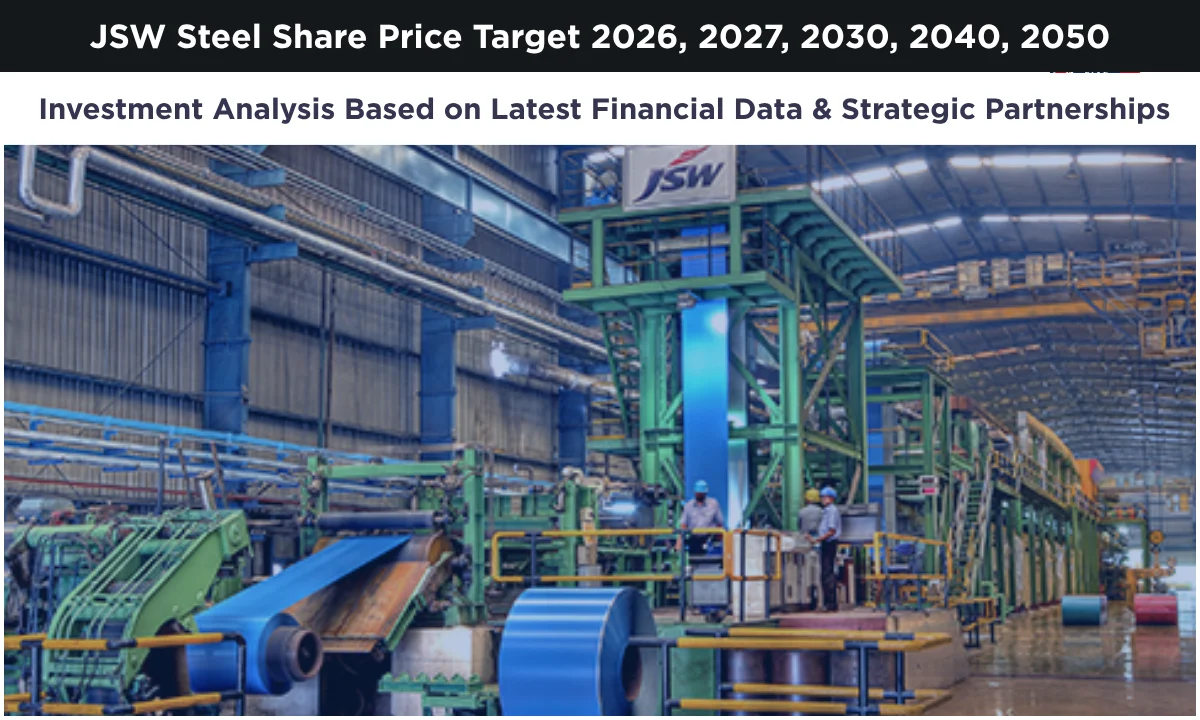
JSW Steel Share Price Target 2026, 2027, 2030, 2040, 2050
JSW Steel stands as India’s largest steel producer by market capitalization and a cornerstone of the nation’s industrial infrastructure. As of early April 2026, the company trades at approximately ₹1,100 to ₹1,130 per share, with recent volatility reflecting both operational milestones and broader market sentiment.
The stock has demonstrated resilience with a 52-week range between ₹879.60 and ₹1,223.75, showing a 17% appreciation over the past year despite sector headwinds.
The steel giant operates with a current market capitalization of ₹2.85 trillion and maintains a dominant position in India’s steel landscape with a total installed capacity of 35.7 million tonnes per annum (MTPA). This includes 34.2 MTPA in Indian operations and 1.5 MTPA in the United States. The company serves as the flagship entity of the $23 billion JSW Group, which maintains diversified interests across energy, cement, infrastructure, real estate, paints, and sports sectors.
What makes JSW Steel particularly compelling for long-term investors is its aggressive expansion roadmap targeting 50 MTPA domestic capacity by fiscal year 2031. This growth trajectory is supported by strategic partnerships, technological upgrades, and favorable government policies supporting domestic steel consumption. However, investors must also weigh regulatory risks, including an ongoing antitrust investigation by the Competition Commission of India (CCI), which could impact near-term sentiment.
In this in detail blog post we will examines JSW Steel share price targets from the year 2026 to 2050, with the help of latest financial results, strategic developments, and analyst forecasts to help investors make informed decisions.
Table of Contents
Current Financial Health & Performance Metrics
Q3 FY26 Results: A Strong Quarter with 235% Profit Surge
JSW Steel delivered exceptional financial performance in the third quarter of fiscal year 2026, reporting a consolidated net profit of ₹2,410 crore. This represents a remarkable 235% increase compared to the same period in the previous fiscal year. The company achieved record revenue from operations of ₹45,991 crore, marking an 11.15% year-on-year growth.
A significant contributor to this profit surge was the recognition of a ₹1,439 crore deferred tax asset related to its subsidiary, Bhushan Power and Steel (BPSL). This accounting adjustment reflects improved financial management and tax planning efficiency. Excluding this exceptional item, the core operational performance remained robust, driven by higher steel prices and improved operational leverage.
The December 2025 quarter also saw the company maintain strong operational metrics despite planned maintenance activities. The Vijayanagar plant’s Blast Furnace 3 underwent capacity upgradation from 3 MTPA to 4.5 MTPA, which temporarily affected overall utilization rates. However, excluding this planned shutdown, Indian operations ran at approximately 97% capacity utilization, indicating strong underlying demand for steel products.
Full-Year Financial Snapshot
JSW Steel’s trailing twelve-month revenue stands at ₹1.74 trillion, with a gross profit of ₹733.61 billion and EBITDA of ₹267.86 billion. The company reported net income available to common shareholders of ₹60.27 billion, translating to diluted earnings per share of ₹24.64. The quarterly earnings growth year-on-year reached an impressive 269.70%, while revenue growth maintained a steady 13.80% pace.
The company’s profitability metrics show room for improvement. The profit margin stands at 3.45%, with an operating margin of 10.10%. Return on assets is 4.47%, while return on equity is 7.28%. These figures suggest that while JSW Steel generates substantial revenue, margin expansion remains a key focus area for management.
Balance Sheet Strength and Debt Position
JSW Steel’s balance sheet reflects the capital-intensive nature of the steel industry. The company holds total cash of ₹189.33 billion (approximately ₹77.69 per share) against total debt of ₹1.01 trillion. This results in a debt-to-equity ratio of 118.74%, which is typical for the sector but requires monitoring as the company embarks on its aggressive expansion plans.
The current ratio of 1.09 indicates adequate short-term liquidity, while the book value per share of ₹340.32 provides a foundation for the stock’s valuation. The company’s enterprise value stands at ₹3.89 trillion, reflecting the total value of the business including debt obligations.
Cash flow generation remains healthy, with operating cash flow of ₹282.57 billion and levered free cash flow of ₹50.59 billion over the trailing twelve months. These cash flows are critical for funding the company’s expansion projects while maintaining dividend payments to shareholders.
The JFE Steel Joint Venture: A Game-Changing Partnership
Investment Details & Strategic Significance
In late March 2026, JSW Steel announced a landmark partnership with Japan’s JFE Steel Corporation that fundamentally transforms the company’s growth trajectory. JFE Steel has invested ₹7,875 crore (approximately $850 million) as the first tranche to acquire a 25% stake in JSW Kalinga Steel.
This investment establishes joint control between JSW Steel and JFE Steel over JSW Kalinga and its wholly owned subsidiary, JSW Sambalpur Steel.
The transaction structure involves two phases. In the first phase completed on March 30, 2026, JFE Steel acquired 2.26 crore equity shares of JSW Kalinga. The second phase will see JFE invest an additional ₹7,875 crore to acquire another 25% stake, resulting in a 50:50 joint venture structure. The total investment of ₹15,750 crore values the BPSL assets significantly and provides JSW Steel with substantial capital inflows.
This partnership brings multiple strategic advantages. First, JFE Steel contributes advanced Japanese steelmaking technology and process expertise that will enhance product quality and operational efficiency. Second, the collaboration opens access to global markets and premium customer segments, particularly in automotive and high-grade steel applications. Third, the joint venture structure shares capital requirements and risk for expanding BPSL’s capacity from the current 4.5 MTPA to 10 MTPA.
Financial Impact of the JV
The JFE partnership delivers immediate financial benefits to JSW Steel. The transaction is projected to generate a total cash inflow of ₹32,000 crore and facilitate debt reduction of approximately ₹37,000 crore. This deleveraging strengthens the company’s balance sheet and improves its capacity to fund additional expansion projects without straining credit metrics.
The Competition Commission of India approved this joint venture on January 21, 2026, clearing regulatory hurdles for the transaction. The approval came after detailed scrutiny of the deal’s competitive implications, with CCI concluding that the partnership would not adversely affect market competition.
For investors, this JV validates JSW Steel’s asset quality and growth potential. The valuation achieved in the transaction provides a benchmark for the company’s broader enterprise value and supports positive sentiment around the stock.
Capacity Expansion Roadmap: The Path to 50 MTPA by 2031
Dolvi Phase III Expansion
JSW Steel’s expansion strategy centers on brownfield and greenfield projects across multiple locations. The Dolvi facility in Maharashtra represents a critical component of this strategy. The Phase III expansion will increase Dolvi’s capacity from 10 MTPA to 15 MTPA, requiring an estimated capital expenditure of ₹210 billion. The company has already placed orders for long lead-time items and established letters of credit for equipment procurement.
This expansion is scheduled for completion by September 2027. The Dolvi plant benefits from coastal location advantages, enabling efficient import of raw materials and export of finished products. The expanded facility will incorporate modern steelmaking technology and enhanced environmental controls.
Jagatsinghpur Greenfield Project
The greenfield 5 MTPA integrated steel plant at Jagatsinghpur in Odisha represents JSW Steel’s largest single investment. The project, housed under subsidiary JSW Utkal Steel Ltd, entails a capital expenditure of ₹31,600 crore with commissioning targeted by fiscal year 2030. This facility will include a blast furnace, steelmaking shop, hot strip mill, and a 350 MW captive power plant.
The Jagatsinghpur site offers significant expansion potential, with plans to eventually scale to 13.2 MTPA. To support this facility, JSW has commenced construction of two 8 MTPA pellet plants and a 30 MTPA slurry pipeline to transport iron ore from captive mines. The pellet plants are expected for commissioning by fiscal year 2028, while the slurry pipeline should become operational in fiscal year 2027.
Vijayanagar Metallics and Brownfield Expansions
The Vijayanagar plant in Karnataka, already the world’s sixth-largest single-location steel plant with 17.5 MTPA capacity, continues to expand. The Vijayanagar Metallics project added 3.3 MTPA in 2024, with an additional 1.7 MTPA under commissioning expected to become operational in the second quarter of fiscal year 2026.
Beyond these major projects, JSW Steel has identified brownfield expansion potential of approximately 5 MTPA at the Vijayanagar complex. This includes a 4 MTPA green steel project utilizing hydrogen-based steelmaking technology. The company is also developing a 1 MTPA electric arc furnace facility at Kadapa, with commissioning targeted by fiscal year 2029.
Timeline and Capital Requirements
The expansion roadmap requires substantial capital investment over the next five years. JSW Steel has indicated that funding will come from internal accruals, the JFE joint venture proceeds, and prudent debt financing. The company’s strong cash flow generation, evidenced by ₹282 billion in operating cash flow over the trailing twelve months, provides a foundation for self-funded growth.
The projected capacity additions follow this timeline:
- Fiscal year 2026: Completion of Vijayanagar Metallics (1.7 MTPA remaining) and BF-3 upgrade (additional 1.5 MTPA)
- Fiscal year 2027: Dolvi Phase III completion (5 MTPA additional)
- Fiscal year 2028: Pellet plants and slurry pipeline operational
- Fiscal year 2029: Kadapa EAF commissioning (1 MTPA)
- Fiscal year 2030: Jagatsinghpur Phase I commissioning (5 MTPA)
- Fiscal year 2031: Achievement of 50 MTPA domestic capacity target
Regulatory Environment & Risk Factors
CCI Antitrust Investigation
A significant overhang on JSW Steel’s stock performance is the ongoing antitrust investigation by the Competition Commission of India. In January 2026, CCI’s investigation wing submitted a report finding that 28 steel companies, including JSW Steel, Tata Steel, and SAIL, violated antitrust rules by allegedly colluding on pricing between 2015 and 2023.
The investigation examined WhatsApp messages from groups named “Friends of Steel,” “Tycoons,” and “Steel Live Market,” where industry participants allegedly shared pricing intentions and coordinated supply reductions. The CCI report concluded there was “enough circumstantial evidence” of concerted efforts by major producers to influence market prices.
The investigation named JSW Steel Chairman Sajjan Jindal among 56 senior executives held liable for the alleged rule breaches. If penalties are imposed, they could reach up to three times the profit gained from the alleged collusion or 10% of turnover for the relevant period. However, the CCI has not yet issued a final order, and the companies have opportunities to respond to the findings.
For investors, this investigation creates uncertainty around potential financial penalties and reputational damage. However, the final order may take months to materialize, and the companies are contesting the allegations. The steel industry has argued that price movements reflect global commodity trends rather than coordinated behavior.
Environmental and Sustainability Initiatives
JSW Steel has positioned itself as a leader in sustainable steel production, which may mitigate regulatory risks and attract ESG-focused investors. The company has committed to reducing CO2 emissions by 42% by 2030 and achieving net-zero emissions for operations under its control by 2050.
At the Vijayanagar plant, JSW has implemented numerous energy efficiency initiatives. The company eliminated steam injection in Blast Furnaces 2 and 4, saving approximately 8 kg of CO2 per tonne of crude steel. The plant has achieved “zero-effluent discharge” status and recycles more than 95% of process waste.
JSW Steel has also partnered with JSW Energy for green hydrogen supply. Under a seven-year offtake agreement, JSW Steel will receive 3,800 metric tons per year of green hydrogen and 30,000 metric tons per year of green oxygen. An additional memorandum of understanding covers supply of 85,000 to 90,000 metric tons of green hydrogen annually by 2030. This positions the company to produce low-carbon steel and meet evolving environmental regulations.
JSW Steel Share Price Target 2026
Monthly Target Analysis
The year 2026 represents a transitional period for JSW Steel as the company integrates the JFE partnership, completes ongoing capacity expansions, and navigates regulatory challenges. Based on current analyst consensus and fundamental valuation, the share price target for 2026 ranges between ₹1,117 and ₹1,600, with the lower bound representing conservative estimates and the upper bound reflecting optimistic scenarios.
The following table presents month-by-month targets incorporating seasonal demand patterns, expected operational milestones, and earnings announcements:
| Month | Minimum Target (₹) | Maximum Target (₹) | Key Catalysts |
|---|---|---|---|
| January | 1,117 | 1,134 | Q3 FY26 results announcement; JFE JV completion |
| February | 1,118 | 1,135 | Post-results consolidation; capacity utilization updates |
| March | 1,120 | 1,138 | Fiscal year-end positioning; Q4 guidance |
| April | 1,115 | 1,132 | New fiscal year begins; annual report release |
| May | 1,118 | 1,140 | Q4 FY26 results (scheduled May 14, 2026); dividend announcement |
| June | 1,120 | 1,145 | Monsoon season demand assessment; Dolvi progress update |
| July | 1,125 | 1,150 | Post-monsoon demand recovery; half-yearly review |
| August | 1,130 | 1,155 | Festival season preparation; steel price trends |
| September | 1,135 | 1,160 | Vijayanagar BF-3 upgrade completion; utilization improvement |
| October | 1,140 | 1,165 | Festival demand peak; quarterly results |
| November | 1,145 | 1,170 | Year-end institutional positioning; FY27 guidance |
| December | 1,117 | 1,120 | Annual consolidation; tax-loss harvesting impact |
Investment Rationale for 2026
The 2026 targets reflect several supporting factors. First, the JFE joint venture provides both capital infusion and technology transfer that enhances operational capabilities. Second, the company’s 97% capacity utilization rate (excluding planned shutdowns) indicates strong demand visibility. Third, government infrastructure spending continues to drive steel consumption growth at 7-10% annually.
However, risks remain. The CCI antitrust investigation could result in penalties or operational restrictions. Raw material price volatility, particularly for iron ore and coking coal, affects margin stability. Global steel prices and Chinese import competition create pricing pressure in the domestic market.
Analysts maintain a consensus “Moderate Buy” rating with an average 12-month target of ₹1,235. High estimates reach ₹1,420 (Motilal Oswal), while conservative targets sit around ₹975 (Citi). The forward price-to-earnings ratio of 17.48x suggests reasonable valuation relative to growth prospects.
JSW Steel Share Price Target 2027
Monthly Target Analysis
By 2027, JSW Steel should demonstrate tangible benefits from its expansion investments. The Dolvi Phase III project is scheduled for completion by September 2027, adding 5 MTPA of capacity. The integration of Kalinga Steel operations with JFE’s technology input should improve product mix and margins.
The share price target for 2027 ranges between ₹1,196 and ₹1,850, reflecting the operational ramp-up and improved earnings visibility. The following table outlines monthly expectations:
| Month | Minimum Target (₹) | Maximum Target (₹) | Key Catalysts |
|---|---|---|---|
| January | 1,196 | 1,212 | FY27 operational guidance; New Year demand |
| February | 1,200 | 1,220 | Budget impact assessment; infrastructure allocation |
| March | 1,205 | 1,225 | Fiscal year-end; Q4 FY27 results preview |
| April | 1,198 | 1,218 | New fiscal year; Jagatsinghpur construction progress |
| May | 1,202 | 1,230 | Q4 FY27 results; annual dividend declaration |
| June | 1,208 | 1,235 | Monsoon impact; working capital management |
| July | 1,215 | 1,245 | Post-monsoon recovery; pellet plant commissioning |
| August | 1,220 | 1,255 | Festival demand build-up; export order flow |
| September | 1,225 | 1,850 | Dolvi Phase III completion; capacity addition realization |
| October | 1,230 | 1,840 | Peak demand season; quarterly earnings |
| November | 1,235 | 1,835 | Institutional year-end positioning |
| December | 1,196 | 1,200 | Annual consolidation; FY28 outlook |
Growth Drivers for 2027
The 2027 targets assume successful execution of the Dolvi expansion and continued demand growth from infrastructure and automotive sectors. The JFE partnership should begin contributing to earnings through improved operational efficiency at Kalinga Steel. The company’s debt reduction following the JV completion should lower interest costs and improve net profitability.
Analyst estimates for fiscal year 2027 earnings per share average ₹66.08, representing 30.85% growth from fiscal year 2026. Revenue estimates reach ₹2.1 trillion, with 47% growth driven by volume expansion and price recovery.
JSW Steel Share Price Target 2028
Monthly Target Analysis
The year 2028 marks a potential inflection point as major expansion projects reach completion and operational maturity. The Jagatsinghpur pellet plants and slurry pipeline should be fully operational, reducing logistics costs and improving raw material security.
The share price target for 2028 ranges between ₹1,278 and ₹2,100:
| Month | Minimum Target (₹) | Maximum Target (₹) | Key Catalysts |
|---|---|---|---|
| January | 1,278 | 1,294 | New capacity utilization trends; FY28 guidance |
| February | 1,285 | 1,305 | Union Budget infrastructure allocation |
| March | 1,290 | 1,315 | Fiscal year-end results; dividend policy review |
| April | 1,282 | 1,300 | Q1 FY29 commencement; operational updates |
| May | 1,288 | 1,325 | Annual results; capacity utilization metrics |
| June | 1,295 | 1,335 | Monsoon season navigation |
| July | 1,300 | 1,350 | Post-monsoon demand surge |
| August | 1,305 | 1,375 | Festival season preparation |
| September | 1,310 | 1,400 | Quarterly results; export market expansion |
| October | 1,315 | 2,100 | Peak demand; margin expansion realization |
| November | 1,320 | 2,080 | Year-end positioning; FY29 outlook |
| December | 1,278 | 1,280 | Annual consolidation |
Strategic Positioning
By 2028, JSW Steel should be operating with significantly expanded capacity and improved cost structures. The green steel initiatives should begin contributing to premium product segments, potentially commanding higher margins. The company’s export capabilities should strengthen with improved product quality from JFE technology transfer.
JSW Steel Share Price Target 2029
Monthly Target Analysis
The year 2029 represents operational stability with most major expansion projects fully integrated. The Kadapa EAF facility should be commissioned by this year, adding 1 MTPA of capacity focused on long products and green steel production.
The share price target for 2029 ranges between ₹1,364 and ₹2,350:
| Month | Minimum Target (₹) | Maximum Target (₹) | Key Catalysts |
|---|---|---|---|
| January | 1,364 | 1,380 | FY29 operational targets; sustainability milestones |
| February | 1,370 | 1,395 | Policy environment assessment |
| March | 1,375 | 1,410 | Fiscal year-end; annual performance review |
| April | 1,368 | 1,385 | Q1 FY30 commencement |
| May | 1,375 | 1,420 | Annual results; dividend announcement |
| June | 1,380 | 1,430 | Monsoon season management |
| July | 1,385 | 1,450 | Post-monsoon recovery |
| August | 1,390 | 1,480 | Festival demand build-up |
| September | 1,395 | 2,350 | Kadapa EAF commissioning; green steel production |
| October | 1,400 | 2,320 | Peak demand realization |
| November | 1,405 | 2,300 | Year-end institutional flows |
| December | 1,364 | 1,365 | Annual consolidation; decade-end positioning |
Market Position
By 2029, JSW Steel should be approaching its 50 MTPA capacity target with a diversified product portfolio spanning flat products, long products, and specialty steels. The company’s green hydrogen integration should position it favorably for carbon-conscious customers and export markets with environmental standards.
JSW Steel Share Price Target 2030
Monthly Target Analysis
The year 2030 represents the target year for achieving 50 MTPA domestic capacity. The Jagatsinghpur Phase I project should be commissioned by this year, representing the final major capacity addition in the current expansion cycle.
The share price target for 2030 ranges between ₹1,454 and ₹2,700:
| Month | Minimum Target (₹) | Maximum Target (₹) | Key Catalysts |
|---|---|---|---|
| January | 1,454 | 1,471 | FY30 capacity target achievement; 50 MTPA milestone |
| February | 1,460 | 1,490 | Decade outlook presentation |
| March | 1,465 | 1,510 | Fiscal year-end; comprehensive annual results |
| April | 1,458 | 1,480 | Q1 FY31 commencement; post-target strategy |
| May | 1,465 | 1,520 | Annual results; dividend declaration |
| June | 1,470 | 1,540 | Monsoon season navigation |
| July | 1,475 | 1,560 | Post-monsoon demand assessment |
| August | 1,480 | 1,580 | Festival preparation; market share analysis |
| September | 1,485 | 2,700 | Jagatsinghpur Phase I commissioning; capacity peak |
| October | 1,490 | 2,650 | Peak demand; full capacity utilization |
| November | 1,495 | 2,600 | Year-end positioning; FY31 guidance |
| December | 1,454 | 1,455 | Annual consolidation; long-term outlook |
Long-Term Valuation
The 2030 targets assume successful execution of all announced expansion projects and maintenance of current market share in a growing steel market. The company’s focus on green steel and sustainability should command valuation premiums as environmental regulations tighten globally.
Analyst consensus suggests that by 2030, JSW Steel could trade at a price-to-earnings ratio of 15-18x on normalized earnings, supporting the upper target range of ₹2,300-2,700. This valuation assumes the company achieves its capacity targets, maintains operational efficiency, and successfully navigates regulatory requirements.
JSW Steel Share Price Target 2040
Decade-Long Transformation
Looking ahead to 2040, JSW Steel could emerge as a global leader in sustainable steel production. The company’s early investments in green hydrogen and low-carbon steelmaking should mature into competitive advantages as carbon pricing mechanisms expand worldwide.
The share price target for 2040 is estimated between ₹3,500 and ₹5,000, representing a compound annual growth rate of approximately 8-10% from 2030 levels. This projection assumes:
- Successful transition to near-zero carbon steel production
- Maintenance of dominant market position in India
- Expansion into adjacent materials and advanced steel products
- Continued infrastructure development driving steel demand
- Potential consolidation benefits from industry maturation
The 2040 outlook depends heavily on the company’s ability to execute its green steel roadmap. JSW Steel has committed to 100% renewable energy for steelmaking by 2030 and net-zero emissions by 2050. Achievement of these targets should position the company favorably for premium valuations and customer segments.
JSW Steel Share Price Target 2050
Half-Century Vision
By 2050, JSW Steel could represent a fundamentally different entity than today, potentially having achieved carbon neutrality and diversified into new materials and energy solutions. The share price target for 2050 is estimated between ₹6,000 and ₹10,000, though long-term projections carry significant uncertainty.
Key assumptions for the 2050 target include:
- Achievement of net-zero emissions across all operations
- Transformation into a materials science company beyond traditional steel
- Integration with circular economy models and recycling leadership
- Potential geographic expansion beyond current markets
- Adaptation to evolving transportation and construction technologies
Investors should recognize that 25-year projections involve substantial uncertainty regarding technological disruption, regulatory evolution, and market structure changes. These targets represent directional indicators rather than precise forecasts.
Shareholding Pattern & Institutional Confidence
JSW Steel maintains a stable shareholding structure that reflects confidence among various investor categories. The promoter holding stands at 44.81%, indicating strong alignment between management and shareholder interests. This level of promoter holding is considered healthy in the Indian context, suggesting long-term commitment to business growth.
Foreign institutional investors hold 26.32% of the company, reflecting international confidence in India’s steel sector and JSW’s market position. This substantial FII holding provides liquidity and valuation support while exposing the stock to global capital flows.
Domestic institutional investors hold 10%, while public shareholders account for 18.87%. The remaining ownership is distributed among mutual funds and other categories. This diversified ownership structure provides stability while allowing for sufficient free float for institutional investment.
The high foreign institutional ownership reflects confidence in JSW Steel’s long-term growth trajectory and leadership position within the Indian steel sector. Foreign investors typically conduct rigorous due diligence, suggesting validation of the company’s strategic direction and financial management.
Dividend Policy & Shareholder Returns
JSW Steel maintains a conservative dividend policy focused on reinvestment for growth. The company declared a final dividend of ₹2.80 per share for fiscal year 2025, translating to a dividend yield of approximately 0.25%. This represents a reduction from the ₹7.30 dividend paid in fiscal year 2024, reflecting the company’s prioritization of capital for expansion projects.
The dividend history shows variability based on earnings performance and capital requirements:
| Financial Year | Dividend Per Share (₹) | Ex-Dividend Date |
|---|---|---|
| FY 2025 | 2.80 | July 8, 2025 |
| FY 2024 | 7.30 | July 9, 2024 |
| FY 2023 | 3.40 | July 11, 2023 |
| FY 2022 | 17.35 | July 4, 2022 |
| FY 2021 | 6.50 | July 5, 2021 |
| FY 2020 | 2.00 | July 6, 2020 |
The low dividend yield indicates that JSW Steel is prioritizing growth investments over immediate income distribution. This approach is appropriate for a capital-intensive industry requiring substantial ongoing investment, but income-focused investors should consider this factor in their allocation decisions.
Competitive Position & Industry Dynamics
Market Share and Competitive Landscape
JSW Steel holds approximately 17.5% of the Indian steel market, making it the largest private sector producer. The company competes with Tata Steel (13.3% market share), SAIL (10%), and various smaller players. The top four producers control roughly 44.4% of the domestic market, creating an oligopolistic structure that supports pricing power while attracting regulatory scrutiny.
The competitive dynamics are shaped by several factors. First, the steel industry exhibits cyclical demand patterns tied to construction, automotive, and infrastructure cycles. Second, global steel prices and Chinese export volumes significantly impact domestic pricing. Third, raw material security, particularly iron ore and coking coal access, determines cost competitiveness.
JSW Steel’s competitive advantages include its integrated operations with captive iron ore mines, coastal plant locations enabling logistics efficiency, and scale economies from large single-location facilities. The JFE partnership adds technological capabilities for high-grade steel production, potentially opening premium market segments.
Industry Growth Outlook
India’s steel industry is projected to grow at 7-10% annually, driven by government infrastructure spending, urbanization, and manufacturing expansion. The National Steel Policy targets 300 MTPA production capacity by 2030, with current capacity at approximately 180 MTPA. This growth trajectory provides a favorable demand environment for JSW Steel’s expansion plans.
However, the industry faces challenges from Chinese imports, which have historically disrupted domestic pricing. Government safeguard duties, formalized for three years in recent policy announcements, provide protection against unfair competition but require periodic renewal.
Investment Decision Framework: Should You Buy JSW Steel?
Bull Case Summary
Investors considering JSW Steel should weigh several positive factors. The company is executing the largest capacity expansion in its history, with clear milestones and funding arrangements. The JFE Steel partnership provides both capital and technology validation. India’s infrastructure growth creates sustained demand visibility. The company’s market leadership and scale provide competitive moats. Green steel initiatives position the company for future regulatory environments.
Bear Case Summary
Risks include the ongoing CCI antitrust investigation, which could result in financial penalties or operational restrictions. The steel industry’s cyclicality creates earnings volatility. High capital requirements strain free cash flow generation. Raw material price volatility affects margin stability. Global economic slowdowns could reduce steel demand and pricing power.
Valuation Assessment
At current levels around ₹1,100-1,130, JSW Steel trades at a forward price-to-earnings ratio of approximately 17.5x based on fiscal year 2027 earnings estimates. This valuation is reasonable relative to growth prospects but higher than historical averages for steel companies. The price-to-book ratio of 3.42x reflects asset quality and growth optionality.
The consensus analyst rating is “Moderate Buy” with an average target of ₹1,235. High estimates reach ₹1,420, suggesting 10-25% upside potential from current levels. However, investors should recognize that steel stocks typically trade at discounts to the broader market due to cyclicality and capital intensity.
Conclusion: A Long-Term Play on India’s Industrialization
JSW Steel represents a compelling long-term investment for investors seeking exposure to India’s infrastructure and manufacturing growth. The company’s strategic initiatives, including the JFE partnership and capacity expansion to 50 MTPA, position it to capture growing domestic steel demand over the coming decades.
The share price targets presented in this analysis reflect a range of outcomes based on execution success, market conditions, and regulatory developments. The 2026 target of ₹1,117-1,600, 2027 target of ₹1,196-1,850, 2030 target of ₹1,454-2,700, and long-term targets through 2050 provide a framework for evaluating investment potential across different time horizons.
Investors should approach JSW Steel as a core holding within a diversified portfolio, recognizing the cyclical nature of the steel industry while appreciating the company’s strategic positioning. Regular monitoring of quarterly results, capacity utilization trends, and regulatory developments is essential for active management of this position.
The information presented in this analysis is based on publicly available data as of April 2026. Investors should conduct independent due diligence and consider consulting financial advisors before making investment decisions. Steel stocks carry inherent risks related to commodity prices, economic cycles, and regulatory changes that require careful consideration within individual risk tolerance frameworks.
Related Posts :


Share This Post