Deepinder Goyal Steps Down as Eternal CEO as Founder Era Enters a New Phase
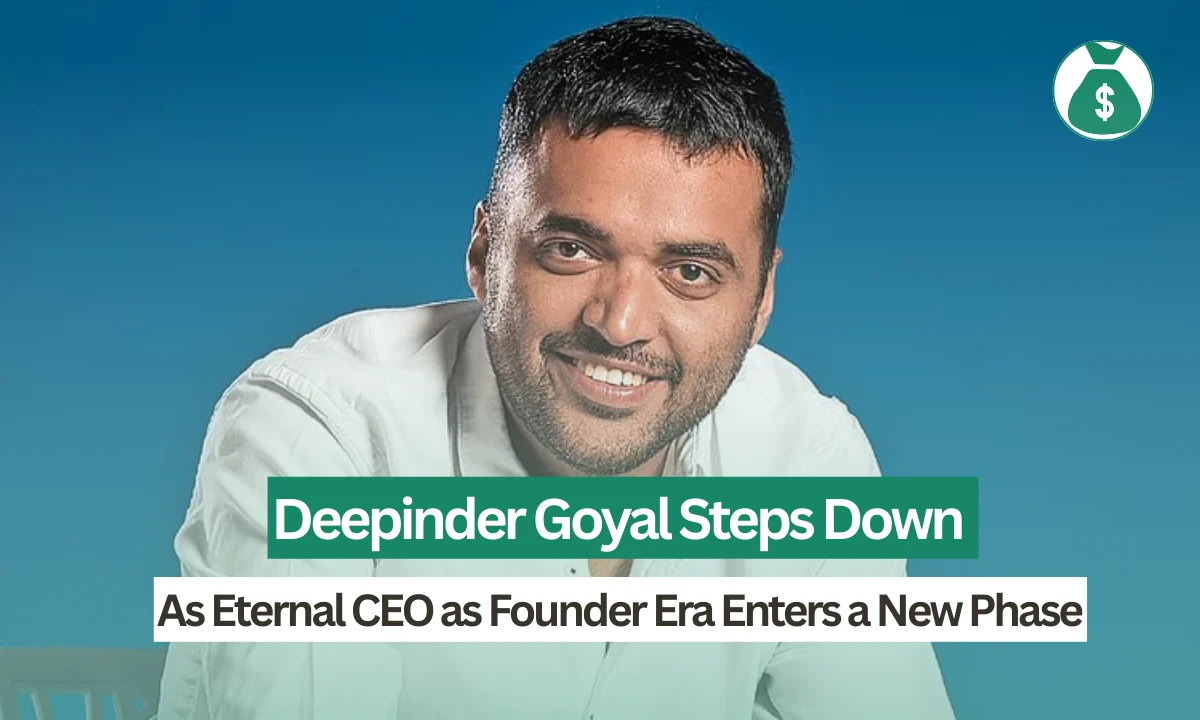
Deepinder Goyal Steps Down as Eternal CEO as Founder Era Enters a New Phase | Image Via Outlook Business
Deepinder Goyal’s decision to step down as Group CEO and Managing Director of Eternal has triggered one of the most debated moments in Indian startup leadership this year. The announcement, made public on January 21, 2026, comes at a time when the company is reporting strong financial growth and rising influence across food delivery and quick commerce.
Effective February 1, 2026, Goyal will move away from executive responsibilities and take on the role of Vice Chairman of the board, subject to shareholder approval. The transition marks a structural shift rather than a complete exit, with execution responsibility moving to Albinder Dhindsa, who will assume the role of Group CEO.
Table of Contents
Key Takeaways
- Deepinder Goyal will step down as Group CEO of Eternal on February 1, 2026
- Albinder Dhindsa will take over as the new Group CEO
- Goyal will remain Vice Chairman, pending shareholder approval
- He plans to focus on high-risk ideas outside a public company structure
- Public reaction remains sharply divided
Also Read: Kalyan Jewellers Stock Falling Sharply Amid Panic Selling – Stock Hits 52-Week Low
Why Deepinder Goyal Is Stepping Away From the CEO Role?
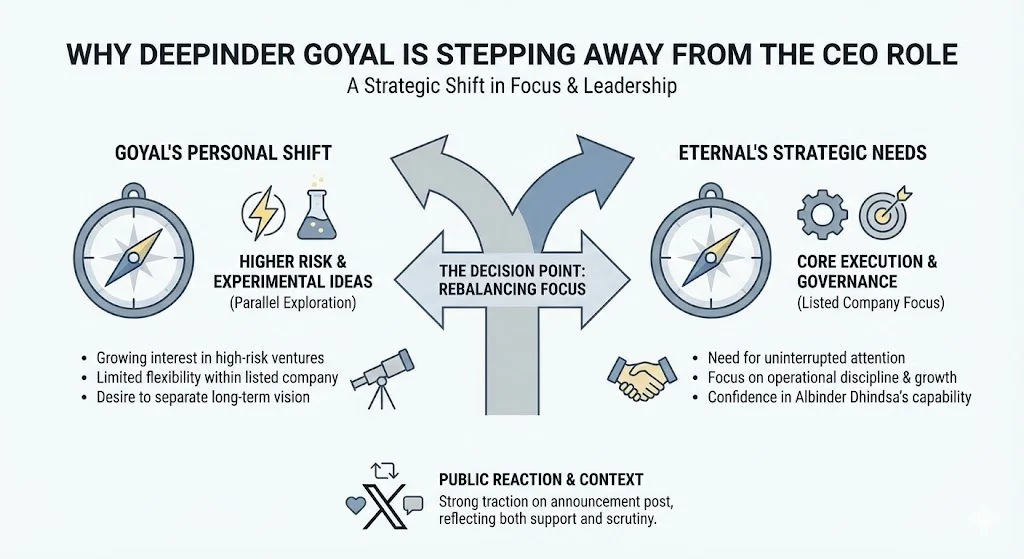
In his shareholder letter, Goyal explained that his decision was shaped by a personal shift in focus. He stated that he has increasingly been drawn toward ideas that require higher levels of risk and experimentation, which are difficult to pursue within a listed company.
According to him, Eternal now requires uninterrupted attention on execution, governance, and operational discipline. The responsibilities of a public company CEO in India demand full-time focus, leaving little space for parallel exploration.
The key reasons highlighted by Goyal include:
- A growing interest in high-risk and experimental ideas
- Limited flexibility to explore such ideas within a listed company
- The need for Eternal to remain focused on core business growth
- Confidence in Albinder Dhindsa’s execution capability
- A desire to separate long-term vision from daily operations
His announcement post on X gained strong traction within hours, receiving thousands of likes, reposts, and replies. This reflected both support and scrutiny around the timing and intent of the decision.
Albinder Dhindsa Takes Charge of Eternal’s Execution
Albinder Dhindsa’s appointment as Group CEO is being viewed as an execution-led transition. Under his leadership, Blinkit moved from acquisition to adjusted EBITDA profitability, a key milestone for Eternal’s quick commerce strategy.
Goyal acknowledged that Dhindsa has built strong internal systems, including supply chain discipline, team culture, and operational rhythm. He described him as a battle-hardened founder with a stronger execution mindset.
The company’s decentralised structure will continue, with individual business heads retaining autonomy. This model is expected to support faster decisions and tighter operational control under the new leadership.
Financial Performance at the Time of Transition
The leadership change comes during a strong financial phase for Eternal. Revenue growth has remained sharp, supported by improved margins and scale efficiencies across its platforms.
Below is a snapshot of key financial indicators discussed around the transition:
| Metric | Recent Performance |
|---|---|
| Year-on-year revenue growth | Approximately 190 to 202 percent |
| Total revenue | Around ₹16,692 crore |
| Blinkit status | Adjusted EBITDA profitable |
| Profit trend | Sharp increase in recent quarters |
| Market valuation | Estimated above ₹2.35 lakh crore |
Blinkit continues to be one of the largest growth drivers, while Zomato maintains leadership in food delivery. The company’s inclusion in major indices has further strengthened investor confidence.
ESOP Surrender and Long-Term Alignment
One of the most widely discussed elements of Goyal’s decision was his surrender of all unvested ESOPs. These stock options will return to the ESOP pool, enabling the company to reward future leaders without increasing shareholder dilution.
Goyal stated that his financial future remains closely tied to Eternal’s long-term performance. By giving up unvested equity, he aimed to reinforce alignment with shareholders and support leadership continuity within the group.
This move was seen by many investors as a sign of institutional thinking rather than founder attachment.
Public Reaction Shows Sharp Division (Data Taken From X)
Reaction to the announcement has been mixed. Startup founders, investors, and business leaders largely praised the move as a mature leadership transition. Many described it as stepping away at the right time, when the company is financially strong.
At the same time, gig economy critics linked the resignation to delivery partner protests seen in late 2025 and early 2026. Some argued that leadership changes do not automatically resolve concerns around earnings stability and worker policies.
Social media responses reflected this divide, ranging from admiration for founder discipline to frustration over unresolved labour issues.
Gig Economy Debate Continues
Goyal has previously defended the gig economy model, highlighting job creation and flexibility. However, criticism around pay structures and income security has continued.
Several responses questioned whether the leadership transition would lead to policy changes or if the operational model would remain unchanged. These concerns are likely to persist as Eternal enters its next phase under new leadership.
Focus Shifts to High-Risk Personal Ventures
Attention has now shifted to the projects Goyal plans to explore outside Eternal. These include LAT Aerospace and Temple, a brain-health wearable initiative linked to his Gravity Ageing Hypothesis.
While LAT Aerospace recently shared test flight footage that did not fully succeed, Goyal described it as part of the learning process. Temple has also drawn scrutiny, with medical professionals urging caution due to lack of public validation. Goyal has clarified that no commercial launch has taken place.
What This Transition Means for Eternal
From a governance standpoint, the move separates long-term vision from daily execution. Goyal will remain involved in strategy, culture, and ethics, while Dhindsa will lead operations and business decisions.
Investors will closely track how Eternal navigates competition in quick commerce, where margins remain tight. Blinkit’s performance will be a key indicator of execution success under the new structure.
A Defining Moment in Indian Startup Leadership
Deepinder Goyal’s exit from the CEO role marks the end of a defining chapter in India’s internet economy. His journey reflects the transition of Indian startups from founder-led ventures to institution-driven companies.
The next phase will test Eternal’s ability to sustain growth under execution-first leadership, while Goyal’s experiments outside the company will shape his next legacy.
Tags: Deepinder Goyal, Eternal Ltd, Zomato News, Blinkit CEO, Indian Startups, Startup Leadership
Related Posts :


Share This Post