[In Detail] NALCO Share Price Target 2026, 2027, 2028, 2029, 2030, 2040 & 2050
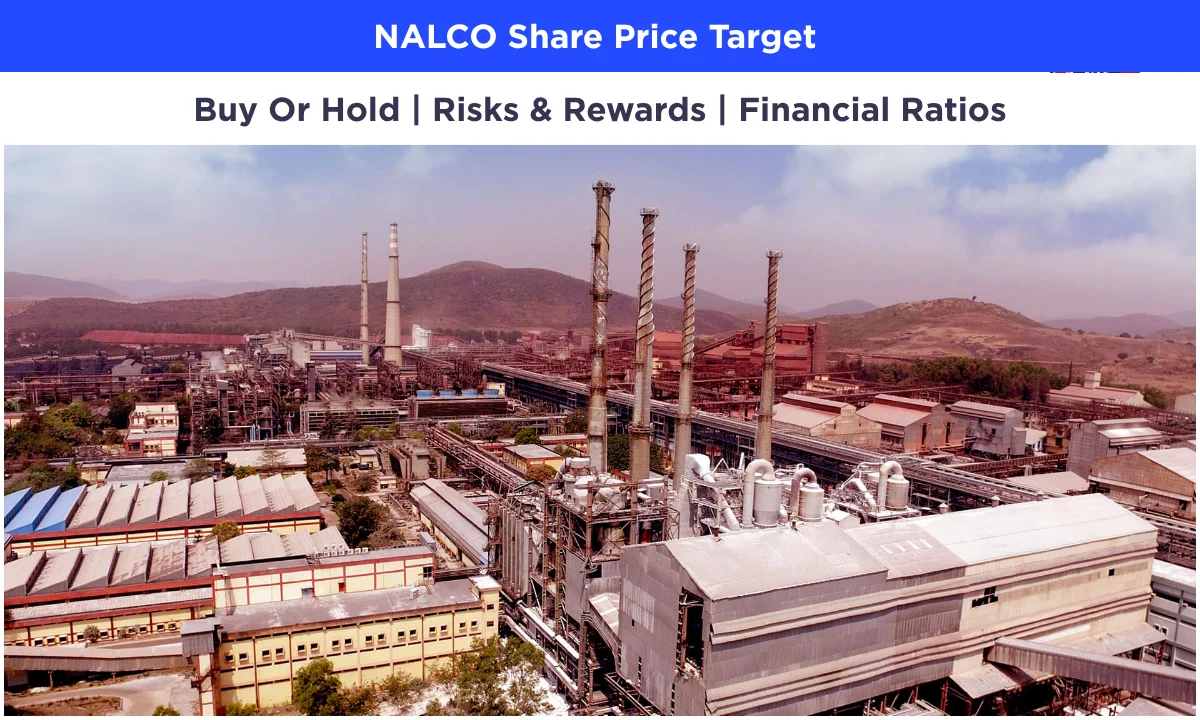
NALCO Share Price Target | Image Via © nalcoindia.com
National Aluminium popularly known as NALCO, is one of India’s most respected public sector enterprises. It operates under the Ministry of Mines and holds the status of a Navratna PSU. The company runs an integrated business that covers bauxite mining, alumina refining, aluminium smelting, and captive power generation.
Its products include aluminium ingots, wire rods, billets, rolled products, and alumina hydrate. These are used across sectors like power cables, construction, automobiles, packaging, and defence. NALCO’s captive bauxite mines are located in Odisha’s Panchpatmali region which gives the company a strong raw material advantage over many competitors.
From a financial stand point view NALCO has shown consistent growth over the past five years. The company’s revenue grew from Rs. 10,819 crore in FY2021 to Rs. 18,098 crore in FY2025. That is a CAGR of around 13.6%. More impressively, the profit after tax jumped from Rs. 1,053 crore in FY2021 to Rs. 6,142 crore in FY2025.
This translates to a profit CAGR of nearly 42.7% over the same period. The net profit margin which stood at 9.7% in FY2021 expanded sharply to 33.9% by FY2025. The company’s earnings per share rose from Rs. 2.76 to Rs. 16.10 in the same period.
Promoter holding which is the Government of India has remained stable at around 51.28% to 51.3% throughout this period. The debt-to-equity ratio has steadily dropped from 0.12 in 2021 to just 0.04 in 2025 showing that the company is nearly debt-free. NALCO’s market cap stands at over Rs. 71,000 crore as of March 2026.
Table of Contents
NALCO Share Price Target 2026
| Minimum Target (₹) | Maximum Target (₹) | |
|---|---|---|
| January 2026 | ₹289 | ₹320 |
| December 2026 | ₹350 | ₹403 |
NALCO entered 2026 with strong momentum. The company posted its best-ever nine-month results with a net profit of Rs. 4,098 crore for the April to December 2025 period. This was a 26% jump compared to the same period last year. Revenue for the same nine months stood at Rs. 12,830 crore which was also a record. These numbers reflect how NALCO has benefited from firmer global aluminium prices and strong domestic demand.
One of the most important stories of 2026 is NALCO’s capacity expansion. The company is in the process of commissioning a 1 MTPA alumina refinery which was around 85% complete as of early 2026. Once this refinery goes live in June 2026, it will significantly increase NALCO’s alumina output and reduce dependence on imported or traded alumina. This kind of integration further strengthens the cost position of the company.
In February 2026, NALCO launched the IA91 Grade Aluminium Alloy Ingot. This is a new product designed for advanced industrial applications. The launch shows that NALCO is not just expanding in volume but also moving up the value chain by offering specialty aluminium products. Such moves are important for improving margins and getting better pricing from industrial customers.
The company also signed an MoU with NLC India for a 1.2 GW energy collaboration covering both thermal and renewable energy sources. Securing long-term power at competitive rates is one of the biggest cost advantages for any aluminium producer. This partnership directly strengthens NALCO’s future cost structure.
NALCO’s management revised its assumed aluminium price upward to $2,900 to $3,000 per tonne for 2026. Earlier, the assumption was $2,670 per tonne. This change reflects confidence in the global aluminium market driven partly by the shutdown of the Qatalum facility in Qatar and supply disruptions in West Asia. For NALCO, a higher realised price means better revenue even without increasing volumes. The Union Budget 2026 also announced infrastructure capex of Rs. 12.2 lakh crore. Projects in power, railways, and construction are major consumers of aluminium. This domestic demand push is a positive tailwind for NALCO’s volumes in the near to medium term.
NALCO Share Price Target 2027
| Minimum Target (₹) | Maximum Target (₹) | |
|---|---|---|
| January 2027 | ₹415 | ₹480 |
| December 2027 | ₹500 | ₹578 |
By 2027, the full effect of NALCO’s capacity expansion should be visible in its financials. The 1 MTPA alumina refinery, expected to be commissioned by June 2026, will begin contributing to FY27 revenues for a full year. Alumina is a key intermediate product and higher refining capacity means NALCO can either use more internally for smelting or sell the surplus in the global market. Both options improve revenue and margins.
NALCO’s plan to increase its green power share to 15 to 20% by 2030 will see concrete progress by 2027. The MoU with NLC India for thermal and renewable power is a step in this direction. Aluminium production is one of the most energy-intensive industrial processes in the world. Every unit of cheaper or renewable power directly reduces cost of production. As NALCO transitions more of its power supply to renewables, it will also become compliant with future EU Carbon Border Adjustment Mechanism rules. This matters because NALCO exports aluminium and alumina to global markets.
The new quality control regulation issued in March 2026 by the Ministry of Commerce mandates BIS certification for a range of aluminium products. For organised players like NALCO which already maintains high quality standards, this regulation works as a competitive moat. It makes it harder for smaller or informal producers to compete. This structural benefit should reflect in NALCO’s market positioning by 2027.
India’s infrastructure build-out will continue to create demand for aluminium in cables, roads, buildings, and railways. NALCO is one of the largest domestic producers and is well placed to capture this demand. The domestic aluminium market is also showing increased interest in recycled and green aluminium which aligns with NALCO’s stated direction. The all-India vendor meet held by NALCO in early 2026 to strengthen supply chains points to the company preparing its ecosystem for higher throughput in the coming years.
Global aluminium demand is expected to remain firm through 2027. Analysts who track the commodity cycle point to a supply deficit in the market. NALCO’s CMD has publicly stated confidence in this cycle continuing. If aluminium prices stay above $2,700 to $3,000 per tonne, NALCO’s earnings power in 2027 will remain strong. Analysts from firms tracking the company have also noted that the chemicals segment, which saw a 34% decline in Q3 FY26, may recover as pricing stabilises. All these factors make 2027 an important year for NALCO’s growth story.
Also Read: Best Metal & Mining Dividend Stocks in India 2026
NALCO Share Price Target 2028
| Minimum Target (₹) | Maximum Target (₹) | |
|---|---|---|
| January 2028 | ₹595 | ₹690 |
| December 2028 | ₹720 | ₹828 |
By 2028, NALCO is expected to be operating at significantly higher capacity than today. The newly commissioned alumina refinery will be running at full utilisation. Combined with NALCO’s existing smelter capacity, this creates a more vertically integrated and cost-efficient business. Vertical integration in the metals industry is a proven way to protect margins during commodity price cycles. When aluminium prices dip, a company that owns its bauxite and alumina supply chain absorbs the shock better than one that buys raw materials from the market.
The decarbonisation roadmap published by NITI Aayog in January 2026 sets the direction for the entire Indian aluminium sector. It emphasises transitioning away from coal-based power, adopting green hydrogen, and implementing carbon capture. NALCO is already aligned with this roadmap through its renewable energy partnerships and green power targets. By 2028, the company’s green credentials could become a meaningful advantage when it comes to export pricing and global tenders.
India’s aluminium demand is expected to grow steadily through the 2020s. The domestic per-capita aluminium consumption in India is still much lower than the global average. As income levels rise and infrastructure spending continues, this gap will narrow. NALCO is one of the few domestic producers with the scale to serve this growing demand. This structural demand story underpins the long-term case for NALCO’s revenue growth beyond FY27.
NALCO’s near-zero debt position is also an important factor for 2028. A company with minimal debt can use its cash flows for expansion, buybacks, or dividends without worrying about interest burden. NALCO has been consistently reducing its debt over the past five years. By 2028, the balance sheet could be virtually debt-free. This creates headroom for new capital expenditure programmes to prepare for the next phase of growth beyond 2030. The company’s track record of strong cash generation and steady promoter backing from the Government of India makes it a relatively stable bet in the metals sector.
NALCO Share Price Target 2029
| Minimum Target (₹) | Maximum Target (₹) | |
|---|---|---|
| January 2029 | ₹850 | ₹900 |
| December 2029 | ₹1000 | ₹1188 |
As NALCO approaches 2029, the company is likely to be at a more mature stage of its current expansion cycle. New capacity additions completed between 2026 and 2028 will be operating efficiently. Revenue growth during this phase will be driven more by volume increases, product mix improvements, and realisations rather than just price-driven gains. This kind of organic growth is seen as more sustainable and is typically rewarded by markets with higher valuation multiples.
By 2029, NALCO’s progress toward its 15 to 20% green power target will be clearly visible. The MoU with NLC India for 1.2 GW of energy is just the beginning. As more renewable capacity gets added, the company’s power cost per unit should fall. For an aluminium smelter where power can account for 30 to 40% of total production cost, even a modest reduction in per-unit power cost has a large impact on margins. This is one of the structural drivers that can keep NALCO’s EBITDA margins improving even when aluminium prices are flat.
India’s government capex programme is also likely to keep driving domestic aluminium demand through the end of the decade. Power sector investments, solar panel manufacturing, electric vehicle adoption, and smart city projects all require substantial amounts of aluminium. As one of India’s largest integrated aluminium producers, NALCO is a natural beneficiary of this demand. A stable promoter holding of over 51% also ensures that the company’s long-term strategic direction remains consistent without sudden changes.
NALCO Share Price Target 2030
| Minimum Target (₹) | Maximum Target (₹) | |
|---|---|---|
| January 2030 | ₹1223 | ₹1420 |
| December 2030 | ₹1500 | ₹1703 |
The year 2030 represents a milestone in NALCO’s green energy transition plan. The company has set a target of 15 to 20% green power share by 2030. Achieving this target will not only reduce costs but also unlock access to international markets that are increasingly demanding green or low-carbon aluminium. The global trend toward sustainable supply chains is real and companies that cannot prove low-carbon credentials will face pricing pressure in export markets. NALCO is investing ahead of this curve.
By 2030, the cumulative effect of capacity expansions, energy cost reductions, product diversification, and market access improvements should be well reflected in the company’s financials. Revenue is expected to grow substantially from current levels, driven by both volume and realisations. The company’s profit margins which expanded dramatically in FY25 are likely to stabilise at healthier levels than historical averages thanks to structural cost improvements.
Analyst targets for NALCO’s share price by 2030 range widely from conservative estimates of around Rs. 425 to optimistic projections of Rs. 650 to Rs. 785. These estimates are driven by assumptions about aluminium prices, volume growth, and energy cost trends. The company’s integrated business model, near-zero debt, strong cash flows, and government backing provide a solid foundation for long-term growth.
NALCO Share Price Target 2040
| Year | Min Price | Max Price |
|---|---|---|
| 2040 | ₹4200 | ₹5200 |
The year 2040 is still nearly 15 years away. Predicting an exact price target with confidence is not realistic. However, the underlying business dynamics point to a much larger and more profitable company by then. India’s per-capita aluminium consumption is currently very low by global standards. As the country urbanises and its middle class grows, demand for aluminium in housing, appliances, automobiles, packaging, and infrastructure will grow rapidly.
NALCO’s fully integrated model from bauxite to finished aluminium gives it a durable competitive advantage. Unlike companies that rely on spot markets for raw materials, NALCO controls its input costs. This becomes especially important during commodity price cycles. By 2040, NALCO is expected to have completed multiple rounds of capacity expansion and energy transition. If it successfully increases its renewable power share and adopts green aluminium production methods, it could become a preferred supplier for global companies that have committed to net-zero supply chains.
Government support will continue to be a factor. As a Navratna PSU, NALCO benefits from policy backing in mining, export incentives, and priority in domestic procurement by government entities. The Aluminium and Aluminium Alloy Products Quality Control Order of 2026 is the first of many regulations that will benefit organised producers over informal ones. By 2040, the regulatory environment is expected to further consolidate market share among large players.
Electric vehicles are a major long-term driver of aluminium demand. Every electric vehicle uses significantly more aluminium than a conventional car because of the need to reduce weight and offset battery weight. As EV adoption in India accelerates through the 2030s, NALCO will benefit from this structural shift. Combined with the solar energy push, where aluminium is used in panel frames and mounting structures, the demand outlook for the next decade and a half remains compelling.
NALCO Share Price Target 2050
| Month | Min Price | Max Price |
|---|---|---|
| Jan 2050 | ₹4200 | ₹4800 |
| Dec 2050 | ₹5000 | ₹5800 |
The year 2050 is a generation away. Any price target for that far in the future is speculative. However, the fundamental case for NALCO over a very long time horizon rests on a few durable pillars. First is the physical reality that aluminium is the most abundant metal in the earth’s crust and will remain essential to human civilisation. Second is India’s growth trajectory. By 2050, India is projected to be one of the largest economies in the world. This translates to enormous demand for aluminium across every sector.
Third is NALCO’s resource position. The company controls bauxite reserves in Odisha which give it a natural advantage that cannot easily be replicated. Access to raw materials at low cost is one of the most durable moats in the metals business. By 2050, these reserves will still be a key advantage. Fourth is the energy transition. If NALCO successfully shifts to largely renewable energy for its smelting operations over the next 25 years, it will become a genuinely green aluminium producer. This could command premium pricing in global markets where carbon pricing and carbon border adjustments have become standard.
The risks over such a long time frame are also significant. These include changes in technology that could replace aluminium in certain applications, geopolitical disruptions, global recessions, regulatory shifts, and commodity price crashes. Any investor thinking about NALCO at this time horizon must weigh these structural positives against these long-term risks. The company’s track record of consistent dividends and steady promoter backing does provide comfort that it will not disappear or lose relevance quickly. But no one should invest based on a 2050 price target alone.
Should I Buy NALCO Share?
NALCO is a company with a clear and well-defined business strategy. It is focused on expanding its production capacity, reducing energy costs through renewables, moving into specialty aluminium products, and strengthening its supply chain. All of these are the right priorities for a metals company in today’s environment. The company is also investing in energy partnerships like the NLC India MoU and aligning with national decarbonisation goals. The product launch of IA91 Grade Aluminium Alloy Ingot in early 2026 shows that NALCO is thinking beyond commodity-grade aluminium and looking at higher-value applications.
The aluminium market itself has positive structural tailwinds. India’s infrastructure boom, EV adoption, solar energy expansion, and rising domestic per-capita consumption all support demand growth. NALCO as an integrated producer with captive bauxite and power is better placed than most to benefit from this.
However, there are risks to consider. NALCO’s profitability is closely tied to global aluminium and alumina prices. When LME aluminium prices drop sharply, the company’s margins can compress quickly. The regulatory fine received from BSE and NSE for non-compliance on board composition shows governance gaps typical of PSUs. Some analysts have also flagged concerns about EBITDA pressure in FY28 if commodity enthusiasm cools.
The stock also trades at a P/E of around 11.5 to 11.6 which looks attractive by sector standards. The dividend yield of around 2.7% adds to the overall return for long-term holders.
Is NALCO Stock Good to Buy? Bull Case and Bear Case
Bull Case (Positive Points)
- NALCO posted a record nine-month profit of Rs. 4,098 crore for April to December 2025. This was a 26% increase year on year.
- Revenue CAGR of 13.6% over five years and profit CAGR of 42.7% over the same period show strong growth momentum.
- EPS jumped from Rs. 2.76 in FY2021 to Rs. 16.10 in FY2025. This is a massive improvement in earnings power.
- The debt-to-equity ratio has fallen from 0.12 in 2021 to 0.04 in 2025. The company is nearly debt-free.
- The 1 MTPA alumina refinery expansion is 85% complete and will significantly boost output from FY27.
- The MoU with NLC India for 1.2 GW of power secures future energy needs at potentially lower cost.
- Global aluminium supply deficit expected in 2026 to 2027 supports firmer prices.
- Attractive valuation at P/E of around 11.5 with a dividend yield of 2.7%.
- Government capex of Rs. 12.2 lakh crore in Budget 2026 supports domestic aluminium demand.
- New quality control regulation benefits organised players like NALCO at the cost of smaller unorganised competitors.
Bear Case (Risk Points)
- InCred downgraded NALCO to Reduce in February 2026 citing EBITDA pressure in FY28 as commodity cycle enthusiasm may cool.
- Alumina spot prices softening to $320 to $340 per tonne range may limit revenue gains despite higher volumes.
- The chemicals segment saw a 34% revenue decline in Q3 FY26 which is a concern.
- PSU governance delays including the regulatory fine for non-compliance on independent director requirements show structural weaknesses.
- Global macro risks including a strong US dollar, demand slowdown, or geopolitical disruptions can cause sharp stock corrections.
- Competition from private players like Hindalco and Vedanta is intensifying.
Promoter Holding of NALCO
| Year | Promoter Holding (%) |
|---|---|
| 2021 | 51.28 |
| 2022 | 51.28 |
| 2023 | 51.28 |
| 2024 | 51.28 |
| 2025 | 51.30 |
NALCO’s promoter is the Government of India. The holding has remained virtually unchanged at 51.28% to 51.30% over the past five years. This level of stability in promoter holding sends a clear message to the market. The government has no intention of divesting or reducing its stake in the near term.
A promoter holding of over 51% means the government has majority control. This comes with both positives and negatives. On the positive side, it means NALCO enjoys strong policy support, access to government contracts, priority in domestic procurement programs, and protection during business downturns. The government is unlikely to let a Navratna PSU face a financial crisis without intervention. This reduces the risk of extreme downside for shareholders.
On the negative side, high government ownership sometimes means slower decision-making, bureaucratic delays in expansion plans, and governance gaps as seen in the delayed appointment of independent directors which led to exchange fines in FY26. Private sector companies can often move faster on strategic decisions.
For a long-term investor, a stable and high promoter holding is generally a positive signal. It means there is no risk of a sudden promoter selling off their stake which could depress the stock. It also means the company’s fundamental direction will remain consistent. The government’s interest in NALCO’s success is aligned with shareholders as dividend payments from PSUs are a source of revenue for the Ministry of Finance.
Overall, the 51% plus promoter holding is a confidence signal for conservative investors. It reflects a stable ownership structure backed by the sovereign government of India.
Revenue Growth of NALCO
| Year | Revenue (₹ Crore) | YoY Growth (%) |
|---|---|---|
| 2021 | 10,819 | – |
| 2022 | 13,123 | 21.3% |
| 2023 | 17,140 | 30.6% |
| 2024 | 16,530 | -3.6% |
| 2025 | 18,098 | 9.5% |
Revenue CAGR (2021 to 2025): ~13.6%
NALCO’s revenue growth over the past five years tells a story of strong performance with one dip in between. The company grew strongly from FY2021 to FY2023 driven by rising global aluminium and alumina prices. In FY2024, revenue fell slightly by 3.6% as commodity prices corrected. But NALCO bounced back in FY2025 with 9.5% growth to reach Rs. 18,098 crore.
A five-year revenue CAGR of 13.6% is solid for a metals company. This is above the average growth rate of the overall Indian metals sector over the same period. The key drivers of this growth have been rising aluminium and alumina realisations, stable domestic volumes, and contribution from the captive coal and power business.
The dip in FY2024 is worth noting. It shows that NALCO’s revenue is not immune to global commodity cycles. When aluminium or alumina prices fall, the company’s top line can shrink even if volumes remain stable. This is a common characteristic of commodity producers and investors must account for this cyclicality.
Going forward, the revenue story will be supported by two additional levers. First is volume growth from the new alumina refinery. Second is higher domestic aluminium demand from infrastructure and EV sectors. If global prices remain firm in the $2,700 to $3,000 per tonne range as management expects, NALCO’s revenue in FY27 and beyond could grow faster than the five-year average.
Profit Growth (CAGR%) of NALCO
| Year | Profit After Tax (₹ Crore) | YoY Growth (%) |
|---|---|---|
| 2021 | 1,053 | – |
| 2022 | 1,648 | 56.5% |
| 2023 | 2,146 | 30.2% |
| 2024 | 2,429 | 13.2% |
| 2025 | 6,142 | 152.8% |
Profit CAGR (2021 to 2025): ~42.7%
The profit growth story at NALCO is genuinely impressive. A five-year CAGR of 42.7% means profits have nearly doubled every two years on average. The most notable year is FY2025 where profit jumped by 152.8% from Rs. 2,429 crore to Rs. 6,142 crore. This kind of surge is unusual and was driven by a combination of higher aluminium prices, improved captive coal performance, and cost control measures.
When you compare profit CAGR of 42.7% against revenue CAGR of 13.6%, the gap tells an important story. NALCO has been converting revenue into profit at an accelerating rate. This means margins have expanded dramatically. The net profit margin went from 9.7% in FY2021 to 33.9% in FY2025. This kind of margin expansion is rare even among the best companies in any sector.
However, investors should be cautious about one thing. The FY2025 profit jump was partly driven by extraordinary factors including high commodity prices and windfall gains from the captive coal business. Sustaining a 33.9% net margin in future years may be difficult if aluminium prices soften or input costs rise. One analyst firm has already flagged EBITDA pressure in FY28.
Comparing profit growth to EPS growth shows consistency. EPS went from Rs. 2.76 to Rs. 16.10. ROE peaked at 47.2% in FY2025 from 13.2% in FY2021. Both metrics confirm that the company created real wealth for shareholders over this period. The question for the future is whether this exceptional level of profitability can be maintained or if it will normalise at a still-healthy but lower level.
EPS and ROE Trends of NALCO
| Year | EPS (₹) | ROE (%) |
|---|---|---|
| 2021 | 2.76 | 13.2 |
| 2022 | 4.32 | 18.5 |
| 2023 | 5.63 | 20.1 |
| 2024 | 6.37 | 19.8 |
| 2025 | 16.10 | 47.2 |
EPS and ROE are two of the most important metrics for evaluating whether a company is actually creating value for its shareholders. NALCO’s EPS has grown from Rs. 2.76 in FY2021 to Rs. 16.10 in FY2025. This is nearly a 6x increase in earnings per share over four years. The growth has been consistent year after year with FY2025 seeing the sharpest jump.
ROE which measures how effectively the company uses shareholder equity to generate profit went from 13.2% in FY2021 to 47.2% in FY2025. A ROE above 15% is generally considered healthy. A ROE of 47.2% is exceptional by any standard. However, like the profit story, this may be partly driven by the FY2025 commodity price windfall.
What matters for long-term investors is whether ROE can stay comfortably above 15 to 20% even in normal commodity cycles. Looking at the data from FY2022 to FY2024 which were more normal years, ROE hovered between 18.5% and 20.1%. This is a healthy baseline. It shows that even without extraordinary commodity gains, NALCO generates solid returns on equity.
The EPS trend is the most direct measure of what shareholders earn per share. An EPS of Rs. 16.10 at a share price of around Rs. 386 gives a P/E of about 24. But at Rs. 370 to Rs. 390 the trailing P/E based on FY25 earnings is closer to 23 to 24. On a forward basis, if earnings normalise, the effective P/E could look different. These are important considerations before making an investment decision.
Debt-to-Equity Ratio of NALCO
| Year | D/E Ratio |
|---|---|
| 2021 | 0.12 |
| 2022 | 0.10 |
| 2023 | 0.08 |
| 2024 | 0.06 |
| 2025 | 0.04 |
The debt-to-equity ratio measures how much debt a company has compared to its shareholders’ equity. A lower ratio is generally better because it means the company is not burdened by interest payments and has financial flexibility. NALCO’s D/E ratio has been declining every single year from 0.12 in FY2021 to just 0.04 in FY2025. This is an outstanding trend.
A D/E ratio of 0.04 means NALCO is essentially debt-free. For every Rs. 100 of shareholders’ equity, the company has only Rs. 4 of debt. This is a very conservative and strong financial position. It means the company can take on new debt if needed for expansion without straining its balance sheet. It also means there is virtually no risk of a debt crisis or financial distress.
In the metals sector, companies often take on large amounts of debt to fund capacity expansions or raw material acquisitions. Companies like Vedanta and some other private sector players have significantly higher debt levels. NALCO’s near-zero debt gives it a unique advantage especially during downturns when high-debt companies struggle to service loans.
This low debt position also means NALCO has more financial room to pay dividends, fund buybacks, or invest in future capacity without diluting shareholders. As the company embarks on its next round of expansion and green energy investments, having a clean balance sheet is one of its strongest assets. From a risk management perspective, NALCO’s debt level is ideal and compares very favourably to both domestic and global aluminium producers.
Net Profit Margins of NALCO
| Year | Net Profit Margin (%) |
|---|---|
| 2021 | 9.7 |
| 2022 | 12.6 |
| 2023 | 12.5 |
| 2024 | 14.7 |
| 2025 | 33.9 |
Net profit margin tells you how much profit a company keeps out of every rupee of revenue. NALCO’s margins have expanded steadily from 9.7% in FY2021 to 33.9% in FY2025. This improvement has been driven by rising aluminium realisations, operational efficiency, lower debt costs, and strong performance from the captive coal business.
The jump to 33.9% in FY2025 is remarkable. For context, a net margin of 10 to 15% is considered healthy in most industrial sectors. Getting to 33.9% is exceptional and reflects an extraordinary year for commodity producers globally. Comparing this to ROE and profit CAGR data confirms that FY2025 was a standout year across all profitability metrics.
For FY2022 and FY2023, margins were between 12.5% and 12.6% which is a more normalised range. FY2024 saw margin improvement to 14.7% even as revenue dipped slightly showing good cost control. These figures suggest that NALCO’s sustainable net margin in a normal commodity environment is around 12 to 16%.
Investors should compare this to competitors. Hindalco which is the largest private sector aluminium producer has historically operated with lower net margins because it is more downstream and has different cost structures. For an integrated PSU like NALCO with captive power and mines, a 12 to 16% margin is good and sustainable. If aluminium prices stay firm through 2026 and 2027, margins could remain well above this range providing a positive surprise to earnings estimates.
Market Capitalization of NALCO
| Year | Market Cap (₹ Crore) | YoY Change (%) |
|---|---|---|
| 2021 | 28,500 | – |
| 2022 | 35,200 | 23.5% |
| 2023 | 42,100 | 19.6% |
| 2024 | 48,700 | 15.7% |
| 2026 | 68,139 | 39.9%* |
*As of March 2026. Up over 111% in the last year.
NALCO’s market capitalisation has grown consistently from Rs. 28,500 crore in 2021 to over Rs. 68,000 crore by March 2026. This reflects growing investor confidence in the company’s earnings power and future prospects. The stock has delivered strong returns over the past four to five years and the sharp jump in market cap between 2024 and 2026 shows how the market has repriced the company after its record FY25 earnings.
A market cap of Rs. 68,000+ crore puts NALCO comfortably in the large-cap segment of the Indian stock market. Large-cap stocks are generally considered more stable than mid-cap or small-cap stocks. They are also tracked by institutional investors and covered by major brokerages which adds liquidity and price discovery efficiency.
The stock has seen significant volatility in the past year. It touched highs near Rs. 432 and lows around Rs. 138 in the twelve month window. This kind of range is typical of commodity stocks where the business performance is closely tied to global price cycles. Investors who understand and accept this volatility can benefit from NALCO’s long-term growth story.
One important observation is that the current P/E of around 11.5 based on the FY25 earnings appears attractive. However, if FY26 or FY27 profits normalise to a lower level, the effective P/E could look different. Market cap and valuation must always be evaluated in the context of expected future earnings and not just trailing performance.
Dividend Yield of NALCO
| Year | Dividend Yield (%) |
|---|---|
| 2021 | 3.2 |
| 2022 | 3.8 |
| 2023 | 4.1 |
| 2024 | 3.5 |
| 2025 | 2.9 |
NALCO has a consistent track record of paying dividends. The yield has ranged from 2.9% to 4.1% over the past five years. The current yield of around 2.7 to 2.9% is meaningful for a stock in the metals sector. Most metal companies are cyclical and many do not pay regular dividends. NALCO’s ability to maintain dividend payouts through commodity cycles shows the company’s strong cash flow generation.
As a PSU, NALCO pays dividends not just to shareholders but also to the Government of India which holds over 51% of the company. This creates a natural incentive for the government to support NALCO’s profitability. The Ministry of Finance relies on dividend income from PSUs as part of its non-tax revenue. This alignment of interest between the government and minority shareholders is a positive feature.
A dividend yield of 2.7 to 2.9% may not seem spectacular but it is competitive with bank fixed deposits in the current environment especially when combined with potential capital appreciation. The dividend also acts as a floor to the stock price during downturns because income-seeking investors will step in to buy when yields become attractive.
The slight decline in yield from the peak of 4.1% in 2023 is because the stock price has risen faster than dividend payouts. This is actually a positive sign. It means the market has re-rated the stock upward. If NALCO continues to grow earnings, dividends per share are likely to increase in absolute terms even if the yield stays in the 2 to 3% range.
Conclusion
NALCO is one of the most solid PSU investments available in the Indian market today. The company has delivered exceptional financial performance over the past five years with revenue growing at 13.6% CAGR and profits growing at 42.7% CAGR. Its debt-to-equity ratio has dropped to virtually zero and its net profit margin expanded to 33.9% in FY2025. These are metrics that many private sector companies would envy.
The near-term outlook is supported by strong structural tailwinds. Global aluminium supply disruptions, India’s infrastructure spending, the EV and solar energy transition, and NALCO’s own capacity expansion programme all point toward continued earnings strength in FY26 and FY27. The new alumina refinery expected to go live in June 2026 will be a key catalyst for the next phase of revenue growth.
Over the medium to long term, NALCO’s green energy ambitions and its alignment with NITI Aayog’s decarbonisation roadmap for the aluminium sector position it well for a world where carbon pricing and sustainable supply chains matter more and more. Its captive bauxite mines and captive power give it a structural cost advantage that is difficult for competitors to replicate quickly.
The risks are real too. Commodity price cycles can be brutal. An analyst downgrade citing FY28 EBITDA pressure is a reminder that the current exceptional margins may not last forever. PSU governance issues like delayed independent director appointments need to be fixed for the company to be taken more seriously by institutional investors.
Related Posts :

Share This Post