Why InterGlobe Aviation Share Is Falling: 7 Big Reasons Behind IndiGo Stock Crash In 2026

Why InterGlobe Aviation Share Is Falling: 7 Big Reasons Behind IndiGo Stock Crash In 2026
If you follow the aviation sector, you may have noticed one clear thing. The InterGlobe Aviation share price is under pressure. In the last few months, the stock has fallen by around 15 to 20 percent from its recent highs. This shows that investors are getting worried.
InterGlobe Aviation is the parent company of IndiGo. Earlier, it looked very strong with more than 60 percent market share in India’s domestic aviation sector. But now, the company is facing many problems at the same time. Fuel costs are rising, and they make up about 35 to 40 percent of total expenses. At the same time, global tensions are also affecting the business.
Now the big question is this. Is this fall temporary, or is it a bigger problem that investors should worry about? If you want to understand why IndiGo shares are falling, this article will explain everything in a simple and clear way.
Key Takeaways On InterGlobe Aviation Share Fall
- Crude oil prices crossing $100+ are hurting airline margins badly
- Middle East geopolitical tensions led to 500+ flight cancellations
- Weak Q3 results shocked investors with ~78% profit drop
- Rupee depreciation is increasing operational costs
- Leadership change created uncertainty in management
- Broker downgrades triggered panic selling
- Public sentiment is largely negative due to past disruptions
Also Read

Tata Motors Passenger Vehicles Share Falling: 7 Real Reasons Investors Are Worried In 2026
Table of Contents
Why InterGlobe Aviation Share Is Falling
Geopolitical Tensions And Oil Price Shock
One of the biggest reasons behind the fall is global politics. The recent conflict involving the US, Iran, and West Asia has disrupted key international airspace corridors that airlines like IndiGo heavily rely on. Because of restricted routes and safety concerns, IndiGo had to cancel more than 500 flights, directly impacting revenue and passenger confidence.
But the bigger concern lies in fuel economics. Crude oil prices surged above $100–$110 per barrel, which significantly increases Aviation Turbine Fuel (ATF) costs the single largest expense for airlines. For context, fuel alone can account for nearly 35–45% of an airline’s operating cost.
Here’s how rising oil prices affect IndiGo:
| Factor | Impact |
|---|---|
| Fuel Cost Increase | Direct hit on margins |
| Ticket Pricing | Limited ability to pass cost to customers |
| Profitability | Shrinks due to fixed low-cost model |
For a low-cost airline like IndiGo, this becomes even more risky because their pricing model depends on keeping fares competitive. Unlike premium airlines, they cannot easily increase ticket prices without losing market share.
Flight Cancellations And Operational Chaos
This problem didn’t start in 2026. Back in late 2025, IndiGo faced massive disruptions due to new pilot duty time regulations introduced by DGCA. These rules were aimed at improving pilot safety but resulted in sudden crew shortages.
As a result:
- Thousands of flights were cancelled or delayed
- Crew scheduling became inefficient
- Operational costs increased due to last-minute adjustments
Passengers were frustrated, and the company had to pay compensation along with penalties. This not only increased expenses but also damaged brand trust something very critical in the airline industry.
Even now, with Middle East disruptions added, operations are still not fully stable. Frequent delays, route changes, and cancellations continue to affect customer experience. This ongoing instability creates uncertainty for investors, as consistent operations are key to maintaining profitability in aviation.
Weak Financial Results Shocked Investors
In Q3 FY26, the company reported a massive drop in profit around 78%, which came as a major shock to both retail and institutional investors. Such a sharp decline is not just a minor fluctuation; it signals deeper operational and cost-related challenges within the business.
Here’s a quick breakdown:
| Factor | Impact |
|---|---|
| Fuel Cost | Increased significantly |
| Labour Cost | Higher due to new rules |
| Forex Loss | Rupee weakness |
| Compensation | Due to cancellations |
While revenue did show a slight increase due to higher passenger traffic and ticket pricing adjustments, the overall profitability was severely impacted because expenses rose at a much faster pace. This imbalance between revenue growth and cost escalation is a critical concern for investors.
Another important point to understand is operating margin compression. Airlines typically operate on thin margins, and when costs rise sharply, even a small disruption can wipe out profits. In IndiGo’s case, rising fuel prices alone contributed heavily to margin pressure, while additional costs like employee benefits and operational disruptions further worsened the situation.
Investors also look at consistency in earnings. A sudden drop of this magnitude raises questions about future earnings stability, making the stock less attractive in the short term. This is why such financial results often trigger immediate selling pressure in the market.
Rising Fuel Cost + Weak Rupee Double Impact
Airlines don’t just suffer from oil prices. They also get hit by currency movement, which creates a double-layered financial burden.
- Fuel is imported in dollars
- Rupee weakening means higher cost
- Aircraft leasing also becomes expensive
To understand this better, aviation turbine fuel (ATF) is one of the largest expenses for any airline, often accounting for 30–40% of total operating costs. When crude oil prices rise globally, airlines have no choice but to absorb or pass on these costs to passengers. However, increasing ticket prices too much can reduce demand, creating a difficult balancing act.
At the same time, a weakening rupee makes every dollar-denominated expense more expensive. This includes not just fuel, but also aircraft leasing, maintenance contracts, and insurance payments. Since most of these costs are unavoidable, airlines like IndiGo face continuous financial pressure.
So basically, companies like IndiGo are getting hit from both sides rising global oil prices and a weakening domestic currency making profitability even harder to maintain in the current environment.
Brokerage Downgrades Created Panic
Big global firms like UBS and JPMorgan have reduced their expectations for IndiGo, and this has played a major role in triggering panic among investors. Brokerage downgrades are not just simple opinions — they influence institutional money flow, which directly impacts stock price movement.
- Earnings estimates cut by 10–14%
- Concerns about future profitability
- Warning about continued volatility
These downgrades usually come after detailed analysis of multiple factors such as fuel costs, demand outlook, operational efficiency, and global risks. In IndiGo’s case, analysts are worried that rising expenses and uncertain geopolitical conditions could continue to pressure margins in the coming quarters.
Another important point is how markets react psychologically. When large institutions reduce their targets or ratings, it sends a signal that “smart money” is becoming cautious. This often leads to:
- Increased selling by mutual funds and FIIs
- Retail investors exiting positions out of fear
- Short-term traders taking bearish bets
As a result, even if the company’s fundamentals are not completely broken, the stock can fall sharply due to sentiment-driven selling. This is exactly what we are seeing with InterGlobe Aviation shares right now.
Leadership Change Added Uncertainty
In March 2026, CEO Pieter Elbers stepped down suddenly, which added another layer of uncertainty to an already challenging situation. Now, co-founder Rahul Bhatia has taken interim charge.
Leadership transitions are always sensitive, especially in a company facing operational and financial pressure. Investors closely watch management stability because it directly affects decision-making, long-term strategy, and execution capability.
Here are some key concerns investors typically have during such changes:
- Will the new leadership maintain the same growth strategy?
- Can the company handle ongoing challenges effectively?
- Is there any internal conflict or strategic shift happening?
In IndiGo’s case, the timing of this change has raised eyebrows. With rising fuel costs, operational disruptions, and weak earnings already impacting the company, a sudden leadership shift creates additional uncertainty.
Markets generally dislike uncertainty more than bad news. Until there is clarity on long-term leadership and strategic direction, investor confidence may remain weak, which can continue to put pressure on the stock price.
Broader Market Weakness
It’s not just IndiGo. The overall stock market has also been under pressure, and this broader weakness is playing a major role in dragging aviation stocks down. When the market enters a correction phase, even fundamentally strong companies tend to fall because investors shift their focus from growth to safety.
- Nifty and Sensex corrections
- Global uncertainty
- Risk-off sentiment
Let’s understand this in a bit more detail.
Firstly, both Nifty and Sensex have seen periodic corrections due to profit booking and cautious investor behavior. When benchmark indices fall, institutional investors often reduce exposure to high-beta sectors like aviation. This creates additional selling pressure on stocks like InterGlobe Aviation.
Secondly, global uncertainty is at a peak right now. Factors such as geopolitical tensions, fluctuating oil prices, and concerns about global economic slowdown are making investors nervous. Foreign Institutional Investors (FIIs), who play a major role in Indian markets, tend to pull out money during such uncertain times. This leads to liquidity crunch and further downside in stocks.
Thirdly, the market is currently in a “risk-off” mode. This means investors prefer safer assets like gold, bonds, or defensive sectors such as FMCG and IT instead of cyclical sectors like aviation. Airlines are highly sensitive to external factors like fuel prices, currency fluctuations, and travel demand, making them one of the first sectors to be sold during uncertainty.
Aviation stocks are considered high-risk during uncertain times, so they fall faster than others. This doesn’t necessarily mean the business is weak, but it shows how market sentiment can amplify price movements in the short term.
Public Opinion On Twitter (X Platform)
The real mood of people is clearly visible on X (Twitter). And honestly, it’s quite negative right now.
What People Are Complaining About
- Poor passenger handling during cancellations
- High ticket prices despite disruptions
- Monopoly-like behaviour in Indian aviation
- Lack of accountability
Many users even called the airline “arrogant” and “unprepared.”
What Traders Are Saying
- “Oil prices up = IndiGo down”
- “Turbulence ahead for airline stocks”
- “Short-term bearish, long-term maybe okay”
Any Positive Sentiment?
Very limited. Some investors still believe:
- IndiGo has strong market dominance
- Long-term growth in Indian aviation is intact
- Stock can recover if oil stabilizes
But right now, negativity is dominating.
What Makes IndiGo More Sensitive Than Others
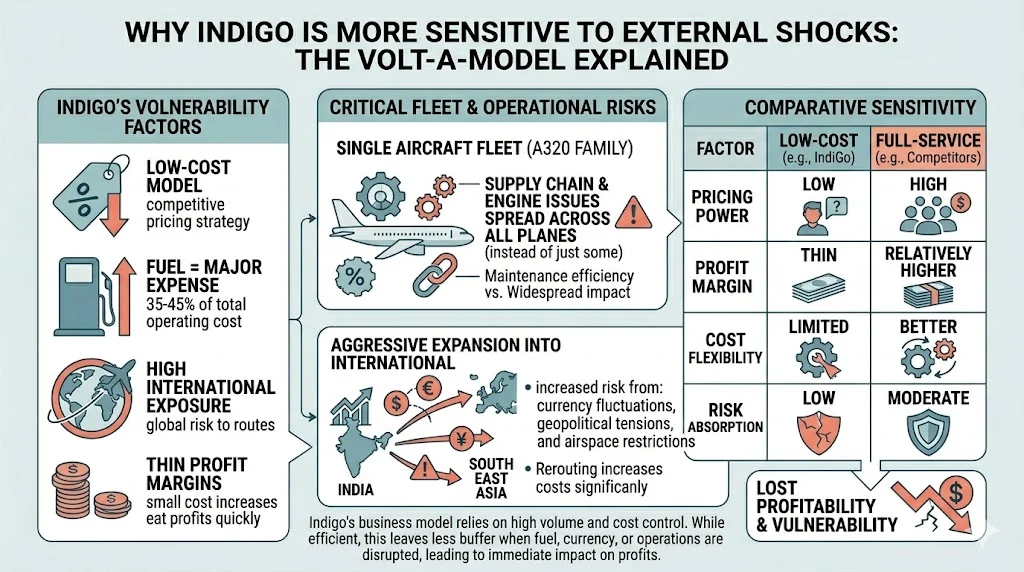
Let’s be real not all airlines fall equally. IndiGo gets impacted more because its entire business model is built around efficiency, scale, and cost control. While this strategy works extremely well during stable conditions, it also makes the company more vulnerable when external factors suddenly change.
- It operates on a low-cost model
- Fuel cost is a major expense
- High exposure to international routes
- Thin margins compared to premium airlines
To understand this better, think of IndiGo as a high-volume, low-margin business. It earns profits by flying more passengers at competitive prices rather than charging premium fares. This means even a small increase in costs especially fuel can quickly eat into profits.
Another important factor is fleet structure. IndiGo primarily operates a single aircraft type (Airbus A320 family), which helps reduce maintenance and training costs. However, when there are supply chain issues or engine-related problems, the impact becomes widespread across the entire fleet instead of being limited to a few aircraft types.
Additionally, IndiGo’s aggressive expansion into international routes has increased its exposure to global risks. Currency fluctuations, geopolitical tensions, and airspace restrictions directly affect these routes more than domestic ones. When disruptions happen, rerouting flights or cancellations increase operational costs significantly.
Here’s a quick comparison to understand the sensitivity:
| Factor | Low-Cost Airline (IndiGo) | Full-Service Airline |
|---|---|---|
| Pricing Power | Low | High |
| Profit Margin | Thin | Relatively Higher |
| Cost Flexibility | Limited | Better |
| Risk Absorption | Low | Moderate |
So when things go wrong whether it’s fuel prices, currency movement, or operational disruptions the impact becomes sharper and more immediate for IndiGo compared to airlines with stronger pricing power and diversified revenue streams.
Is This A Temporary Fall Or Long-Term Problem?
This is the most important question, especially for investors trying to decide whether to hold, buy, or exit the stock. The answer isn’t black and white because the current situation is influenced by both temporary disruptions and structural factors.
Short-Term View
- High volatility expected
- Oil prices and geopolitics will drive movement
- Stock can remain under pressure
In the short term, the stock is likely to remain highly sensitive to external triggers. Any sudden spike in crude oil prices or escalation in geopolitical tensions can immediately impact airline profitability. Additionally, investor sentiment is currently weak, which means even small negative news can lead to sharp price corrections. Traders should also keep an eye on quarterly earnings updates, as any further disappointment could trigger another round of selling. Overall, short-term movement will be unpredictable and largely news-driven.
Long-Term View
- India’s aviation market is growing fast
- IndiGo still has strong market share
- Recovery possible if costs stabilize
From a long-term perspective, the fundamentals of the aviation industry in India remain strong. Rising middle-class income, increasing air travel demand, and expansion of regional connectivity are all positive indicators. IndiGo continues to dominate the domestic market with a significant share, which gives it a competitive advantage over smaller players. If fuel prices stabilize and operational efficiency improves, the company has the potential to bounce back. Long-term investors often look beyond temporary disruptions and focus on industry growth trends, which still favor IndiGo.
So, it’s not a broken business. But timing matters. Investors need to balance patience with caution and closely monitor key factors like fuel costs, currency movement, and management decisions before making any major investment move.
My Final Views On InterGlobe Aviation Share
The fall in InterGlobe Aviation share isn’t happening because of just one issue it’s really a mix of several challenges coming together at the same time. When you look closely, rising fuel costs, operational disruptions, weaker earnings, leadership changes, and negative sentiment have all played their part. It’s like everything hit the company at once, which naturally made investors nervous.
If you ask me, this is one of those phases where patience matters more than panic. The situation does look uncertain right now, but markets have a way of turning around when key factors like oil prices and global tensions start settling down.
So instead of reacting emotionally, it’s better to stay informed, watch how things unfold, and make decisions calmly. Sometimes, the best move in the market is simply to wait and observe.
Related Posts :



Share This Post