Why Siemens Energy Share Is Falling Since 6 Months: Strong Growth But Short Term Pain Explained
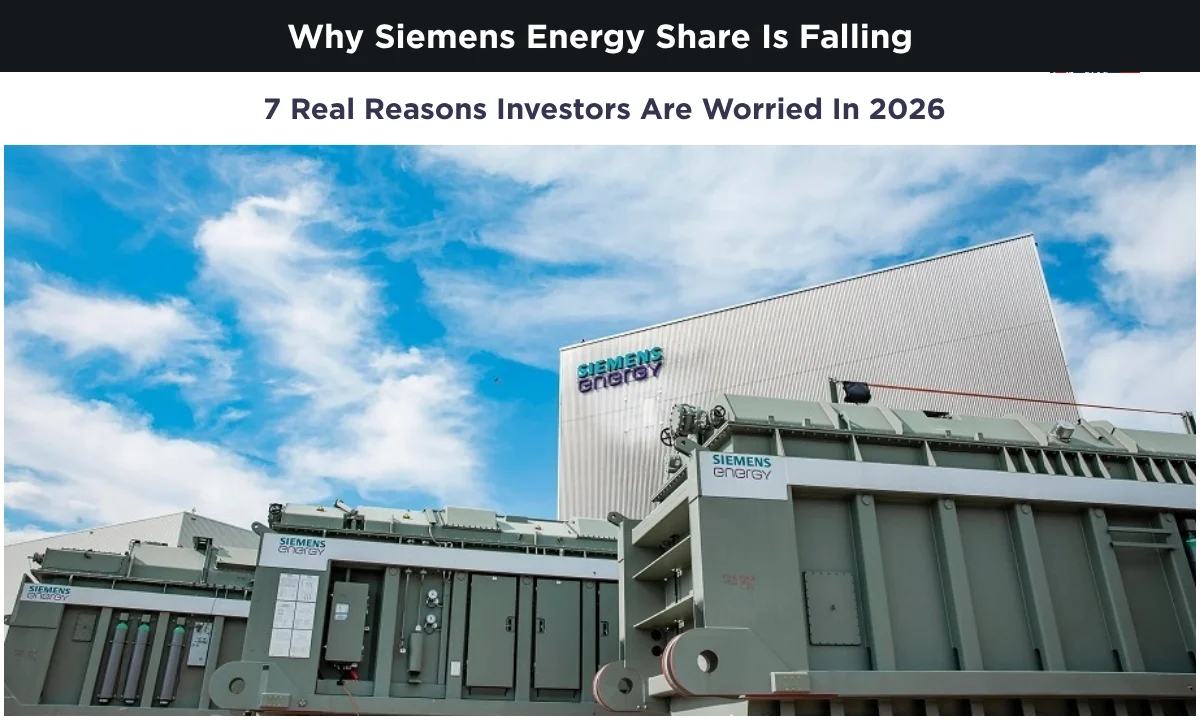
Why Siemens Energy Share Is Falling | Image Via © tndindia.com
If you have been tracking Siemens Energy lately, one thing is very clear. The company is doing well fundamentally, but the share price is not behaving the same way. This creates confusion for many investors. You see strong results, record orders, and still the stock is falling. So what is actually going on here?
In the last few weeks, Siemens Energy shares have seen noticeable corrections even after a massive rally over the past couple of years. This situation is not unique, but it is definitely worth understanding in detail. Because if you are searching “Why Siemens Energy share is falling”, you are not alone. Many investors are asking the same question right now.
Key Takeaways On Siemens Energy Share Fall
- Siemens Energy shares are falling mainly due to short term factors, not weak fundamentals
- Profit booking after a massive rally is a major reason
- Geopolitical tensions like Middle East conflicts are impacting investor sentiment
- High valuation is making investors cautious
- Siemens Gamesa losses still act as a risk factor
- Strong order book and AI driven demand still support long term growth
- Indian subsidiary is facing separate challenges like margin pressure and institutional selling
Table of Contents
What Is Happening With Siemens Energy Share Price?
To understand the fall, first you need to see the bigger picture. Siemens Energy has had a strong rally over the last few years. From very low levels in 2023, the stock moved up sharply and created large gains for early investors. Many investors who entered at lower prices saw their investment multiply in a short time.
Recently, the stock touched highs near €170 and then corrected towards the €130 to €145 range. Short term drops of 8 percent to even 17 percent have been seen in a few weeks. This kind of movement may look worrying at first, but it is quite common after a strong rally. Let us break this down in a simple way:
- When a stock rises very fast, it often becomes expensive compared to its past levels
- Early investors start booking profits to secure gains
- New investors wait for better entry prices
- This creates selling pressure in the short term
Now here is the interesting part. Even after this fall, the stock is still up strongly on a yearly basis. This shows that the long term trend is still positive. The recent drop is more like a pause or adjustment in price rather than a major breakdown.
Also, markets do not move in a straight line. Every strong uptrend includes small corrections. These corrections help the stock cool down and remove excess speculation. They also give new investors a chance to enter at better prices.
So the real question is not why it is falling. The real question is why it is correcting after such a strong rally. When you look at it from this angle, the fall starts to make more sense and looks like a normal market cycle rather than a serious problem.

Profit Booking After Massive Rally
This is probably the biggest and most simple reason behind the recent fall. When a stock rises 100 percent or even 500 percent over a period of time, investors usually start booking profits. This is a normal part of the stock market cycle. No stock keeps going up without pauses. After a strong rally, some cooling down is expected.
In the case of Siemens Energy, the stock has given very strong returns in the past few years. Many early investors who bought at lower levels are now sitting on large gains. It is natural for them to sell a part of their holdings to lock in profits. This selling creates pressure on the stock price in the short term.
At the same time, new investors become cautious. When they see a stock that has already moved up a lot, they feel it may be expensive. They worry that they might enter at the top and face losses if the price falls. Because of this fear, fresh buying slows down.
There is also another factor. Large institutional investors like mutual funds and hedge funds often rebalance their portfolios after a big rally. They reduce exposure to stocks that have run up sharply and move money into other opportunities. This adds more selling pressure. You can understand this better with a simple flow:
- Stock rises sharply over time
- Early investors start booking profits
- Institutions rebalance their portfolios
- New investors hesitate to enter
- Buying slows down and selling increases
All these factors together create a temporary imbalance between demand and supply. When supply is higher than demand, the price starts to fall. So this correction is not a sign of weakness in the company. It is simply a natural reaction after a strong rally.
High Valuation Making Investors Nervous
Another major reason is valuation. Many analysts believe Siemens Energy is trading at a premium valuation. The P/E ratio has gone quite high compared to industry averages. This means investors are already paying a higher price for each unit of earnings compared to similar companies in the sector.
To understand this better, you need to see how valuation works. When a stock trades at a high P/E ratio, it shows that the market expects strong growth in the future. Investors are willing to pay more today because they believe the company will earn much more in the coming years. But this also creates pressure. The company must keep delivering strong results to justify this high price.
Now think like a smart investor. If a stock is already expensive, you expect strong future growth. But if any uncertainty comes, even small, investors start selling. This is because they feel the risk is higher at elevated prices.
For example, if growth slows down even slightly or if margins come under pressure, the stock can correct quickly. This is not because the company is weak, but because expectations were too high.
This is exactly what is happening here.
The company is strong, but the price already reflects a lot of future growth. So any negative trigger leads to correction. Investors become cautious and prefer to wait for better entry levels. This creates short term selling pressure even when the long term story remains intact.
Also Read: 20 Stock Falling Since Last 6 Months: The Complete 2026 Survival Guide Every Investor Needs
Geopolitical Tensions Impacting Sentiment
This is where things get interesting. Recent geopolitical tensions, especially in the Middle East, have created uncertainty in global markets. Energy companies are directly impacted by such events because their business depends on stable supply chains, predictable fuel prices, and long term project planning.
When conflicts increase, investors become cautious. They move money away from risky or cyclical sectors and shift towards safer assets like gold or government bonds. This reduces demand for stocks like Siemens Energy in the short term.
There are a few key ways geopolitical tensions affect the company:
- Oil and gas price volatility increases, which impacts project costs
- Supply chain disruptions delay equipment delivery and execution
- Governments may delay or rethink energy investments
- Currency fluctuations affect international contracts
According to recent data, Siemens Energy shares dropped around 5 to 8 percent during such events.
Even the company management has indicated that customers are delaying new projects due to uncertainty in energy prices and raw material costs. Large infrastructure projects require long term visibility. When uncertainty rises, companies prefer to wait instead of committing capital.
Another important point is investor psychology. Markets react quickly to news. Even if the actual business impact is small, fear can drive selling. This creates short term pressure on the stock price.
So even if the company is doing well, external factors are pulling the stock down. This type of impact is usually temporary, but it can create volatility in the near term.
Strong Results But Still Falling?
This is what confuses most people. Siemens Energy reported strong results:
- Record orders of around €17.6 billion
- Revenue growth of around 13 percent
- Profit more than doubled
- Strong cash flow
- Massive order backlog
At first look, these numbers show a healthy and growing business. A strong order book means the company has future revenue visibility. Higher profit shows better efficiency and demand. Good cash flow means the company can manage its operations and invest in growth without stress.
Still, the stock fell. Why?
Because the stock market does not react only to current results. It reacts to future expectations. Investors always try to guess what will happen next, not just what has already happened.
If expectations are already very high, then even strong results may not be enough. Investors may feel that the good news is already included in the stock price. So instead of buying more, they start booking profits. This is called “sell the news”.
Another important point is guidance. Investors also look at what the company says about the future. If the company gives cautious guidance or highlights risks like cost pressure or project delays, then the market reacts negatively even if current results are strong.
Also, large institutional investors often move early. They may reduce their positions after results to lock in gains. This creates selling pressure in the market.
So in simple words, strong results do not always mean the stock will go up. The market looks at expectations, future growth, and overall sentiment before deciding the direction.
Siemens Gamesa Problem Still Not Fully Solved
One more important factor is Siemens Gamesa. This is the wind energy division of Siemens Energy. It plays a big role in the company’s future because wind energy is a key part of the global shift toward clean energy. However, this division has faced many challenges over the past few years.
Even though losses have reduced recently, the business is still not fully stable. There are still operational and financial issues that need to be fixed before investors gain full confidence. Investors are worried about:
- Execution issues in wind projects
- Losses in previous years
- Ongoing restructuring
Let us understand these concerns in a simple way.
Execution issues mean delays in project delivery, higher costs, and technical problems in turbines. These issues affect customer trust and reduce profitability. When projects do not run smoothly, it directly impacts margins.
Losses from previous years also create pressure. Even if current performance improves, past losses take time to recover. Investors want to see consistent profits before they feel confident again.
The company is also going through restructuring. This includes cost cutting, improving operations, and fixing supply chain problems. While this is a positive step for the long term, it creates short term uncertainty.
Another important point is competition. The wind energy sector is highly competitive. Companies need to offer better technology at lower cost. If Siemens Gamesa cannot improve efficiency, it may lose market share.
All these factors together create uncertainty. Until Siemens Gamesa fully stabilizes and shows consistent performance, it will continue to act as a negative factor for the stock. Investors are waiting for clear signs of improvement before they become fully positive on this segment.
Impact Of AI And Data Center Demand
Now here is the positive side. Siemens Energy is benefiting from the AI boom. Data centers require huge amounts of power. Companies need strong energy infrastructure. Siemens Energy is a key player in this space.
AI applications like cloud computing, machine learning, and large language models need continuous and stable electricity. Data centers run 24 hours and cannot afford power cuts. This increases demand for reliable energy systems such as gas turbines, grid solutions, and transmission networks. Siemens Energy provides many of these solutions, which puts the company in a strong position.
Many global tech companies are investing billions in building new data centers. This creates long term demand for energy infrastructure. Siemens Energy gets orders for power generation equipment, grid expansion, and maintenance services. This helps in revenue growth and improves future visibility.
This is one of the reasons why the stock rallied so much. But recently, when AI related stocks corrected globally, Siemens Energy also got impacted.
Investors started booking profits in AI linked stocks. Since Siemens Energy is connected to this theme, it also saw selling pressure. Short term traders reacted quickly, which increased volatility. So the same factor that pushed the stock up is now causing short term volatility.
Broader Market And Sector Pressure
Sometimes the reason is not the company itself. If the overall market is weak, even strong stocks fall. Recently, there has been:
- Selling in European markets
- Weakness in industrial stocks
- Rotation from high valuation stocks
All this has impacted Siemens Energy. Also, energy and capital goods sectors are cyclical. They are sensitive to economic conditions.
When interest rates stay high, companies delay large projects. This reduces new orders in the short term. Investors become cautious and shift money to safer sectors like banking or consumer goods.
Global economic slowdown fears also affect sentiment. If growth slows down, demand for energy projects may reduce. This creates pressure on stocks like Siemens Energy. So when uncertainty increases, these stocks face pressure.
India Specific Factors (Siemens Energy India)
If you are tracking the Indian entity, then the story is slightly different. Siemens Energy India has also seen corrections, but the reasons are more linked to local market conditions and business mix rather than global factors alone.
Key reasons include:
- Margin pressure due to project mix
- Institutional selling like large block deals
- Missing some key orders
- Policy related concerns in the power sector
Let us understand these points in a bit more detail.
Margin pressure is one of the biggest concerns. The company is getting strong revenue growth, but a large part of this growth is coming from project based business. Project work usually has lower margins compared to service or product based segments. So even when revenue increases, profit margins do not grow at the same pace.
Institutional selling is another important factor. Large investors sometimes sell big quantities of shares through block deals. This creates sudden supply in the market and pushes the price down. Retail investors often get nervous when they see such selling.
Missing key orders also affects sentiment. In the power and energy sector, order wins are very important. If the company misses a few large contracts, investors start questioning future growth visibility.
Policy related concerns also play a role. The Indian power sector depends heavily on government policies, regulations, and approvals. Any delay or uncertainty in policies can slow down project execution and impact investor confidence. For example, even after good profit growth, margins were impacted due to higher project business share.
Also, the stock has seen sharp corrections from highs above ₹3300 to lower levels. So Indian investors are also facing similar confusion, where strong business performance does not fully reflect in the share price in the short term.
Public Opinion From Investors (Twitter Insights)
Now let us talk about what real investors are thinking. Based on recent discussions:
Bullish View
- Many investors are impressed with the turnaround story
- Strong order book gives confidence
- AI and data center demand seen as long term growth driver
- Some believe dips are buying opportunities
Bearish View
- High valuation is a major concern
- Some feel the stock is overhyped
- Short term traders are cautious
- Geopolitical risks are worrying investors
Neutral View
- Long term story is strong
- Short term volatility is expected
- Investors are waiting for better entry points
This mix of opinions clearly shows that the stock is in a transition phase.
Key Factors Summary Table
| Factor | Impact On Stock |
|---|---|
| Profit Booking | Negative (Short Term) |
| High Valuation | Negative |
| Geopolitical Tension | Negative |
| Strong Results | Positive |
| AI Demand | Positive |
| Siemens Gamesa Issues | Negative |
| Order Backlog | Strong Positive |
Is This Fall A Warning Sign?
Now comes the most important question. Should you be worried? The answer depends on your perspective and your investment style.
If you are a short term trader, then yes, volatility is high and risk is present. Price swings can happen quickly due to news, global events, or market sentiment. In such cases, timing becomes very important and mistakes can lead to losses.
If you are a long term investor, then the situation looks different. Long term investors focus more on business strength rather than short term price movement. For them, corrections are often seen as normal and sometimes even as opportunities. The company fundamentals are still strong:
- Huge order backlog which gives revenue visibility for future years
- Growing demand for energy infrastructure due to rising electricity needs
- Strong position in gas and grid technologies which are critical for power supply
- Benefiting from global energy transition towards cleaner and more efficient systems
In addition to this, Siemens Energy is also gaining from increasing investments in renewable energy and power transmission. Governments and private companies are spending more on upgrading energy systems. This supports long term growth. However, investors should also stay aware of risks:
- High valuation can limit upside in the short term
- Siemens Gamesa still needs full stability
- Global uncertainty can affect project execution
So the fall is not due to business weakness. It is more due to market behaviour and external factors. For long term investors, this phase may not be a warning sign but a period of adjustment.
What Investors Should Watch Next
If you are tracking Siemens Energy, here are the key factors you should actively monitor, along with why they matter and what signals to watch:
1. Upcoming Earnings Reports
Earnings are the most direct indicator of business health.
- Watch for revenue growth consistency and margin expansion
- Check if order inflow continues at a strong pace
- Look at management guidance for future quarters
Strong earnings can rebuild investor confidence, while any slowdown may trigger further corrections.
2. Siemens Gamesa Turnaround Progress
This remains one of the biggest risk factors.
- Monitor whether losses are reducing quarter by quarter
- Look for improvements in project execution and cost control
- Watch for any restructuring updates or strategic changes
A successful turnaround here can significantly boost overall valuation.
3. Geopolitical Developments
External risks can quickly impact sentiment.
- Track tensions in key regions like the Middle East and Europe
- Watch how energy prices and supply chains react
- Observe if customers delay or cancel projects
Even strong companies can face short-term pressure due to global uncertainty.
4. Valuation and Market Positioning
The stock’s pricing relative to its growth matters a lot.
- Compare P/E ratio with industry peers
- Watch for corrections that bring valuation to more reasonable levels
- Look for institutional buying or selling trends
A fair valuation often attracts long-term investors and stabilizes the stock.
5. AI and Data Center Energy Demand
This is one of the biggest long-term growth drivers.
- Track investments in data centers globally
- Watch for new contracts related to power infrastructure
- Monitor how Siemens Energy positions itself in this segment
Rising demand for AI infrastructure could significantly boost future revenues.
By keeping a close eye on these five areas, you can better understand whether the current fall is temporary or part of a larger trend.
My Final Thoughts On Siemens Energy share Fall
So now you have a clear answer.
Siemens Energy share is falling not because the company is weak, but because of a mix of external and market driven factors. Many investors only look at price movement, but it is important to understand what is happening behind the scenes. Here are the main reasons again:
- Profit booking after huge rally
- High valuation concerns
- Geopolitical tensions
- Sector wide pressure
Let us understand this in a simple way. When a stock rises very fast, early investors start selling to lock in profits. This creates selling pressure. At the same time, new investors feel the stock is expensive, so they wait. This reduces buying demand.
High valuation also plays a big role. When a stock trades at a premium price, even small negative news can trigger a fall. Investors become cautious because they do not want to take risk at higher levels.
Geopolitical tensions add another layer of uncertainty. Energy companies depend on global stability. Any conflict or disruption can delay projects and affect future growth expectations.
Sector wide pressure also matters. If the overall energy or industrial sector is weak, even strong companies face selling pressure. This is normal market behavior. At the same time, Siemens Energy continues to show strong fundamentals. The company has a strong order book, growing demand, and a clear role in the global energy transition.
This creates a classic situation where a strong company sees short term correction due to external factors, not because of weak business. For smart investors, this is the phase where clarity matters more than emotions. Instead of reacting to short term price moves, it is better to focus on long term growth and business strength.
Related Posts :



Share This Post