Why Gsp Crop Science Share Price Falling: 7 Real Reasons Behind The Weak Performance
Why Gsp Crop Science Share Price Falling
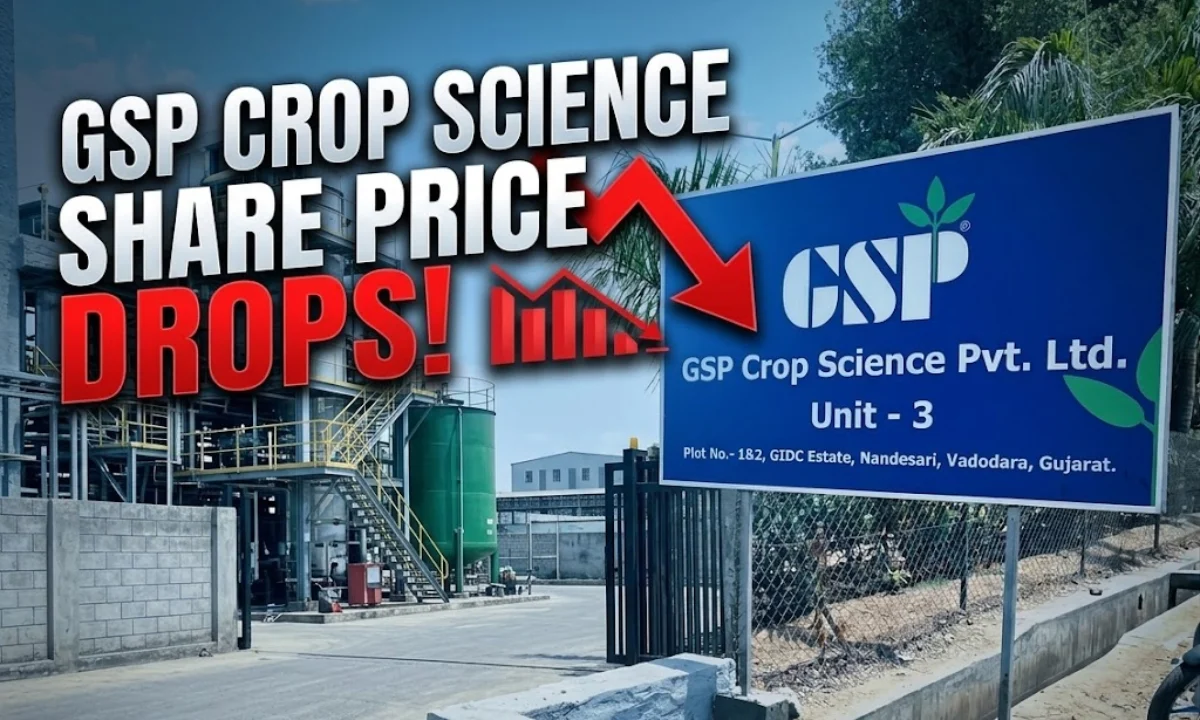
GSP Crop Science made its stock market debut on March 24, 2026. Many investors expected strong listing gains. The reality was different. The stock listed at just 2.5% to 4% premium over its issue price of ₹320. Since then, the share price has shown weakness. It trades in the range of ₹356 to ₹388. Some days it drops by 5% or more.
If you are searching for why GSP Crop Science share price is falling, this article gives you the real reasons. We look at the numbers. We look at the sector. We look at what experts are saying. No complex jargon. Just simple facts.
Table of Contents
What The Numbers Say About GSP Crop Science Stock Performance
Before we dive into the reasons, let us look at the basic stock performance data. This helps you understand the current situation clearly.
Stock Price Movement Since Listing
| Date | Event | Price (₹) | Change From Issue Price |
|---|---|---|---|
| March 16-18, 2026 | IPO Open | 320 (Issue Price) | Base Price |
| March 24, 2026 | NSE Listing | 328 | +2.50% |
| March 24, 2026 | BSE Listing | 332.30 | +3.84% |
| March 24, 2026 | Intraday High | ~362 | +13% |
| Early April 2026 | Trading Range | 356-388 | +11% to +21% |
| April 5, 2026 | Current Price | 368.10 | +15% (volatile) |
The table shows that the stock never gave the big listing gains that many IPO investors expect. A normal strong IPO lists at 20% to 50% premium. GSP Crop Science gave only 2.5% to 4%. This was the first warning sign.
IPO Subscription Data Reveals The Real Story
| Investor Category | Subscription (Times) | What It Means |
|---|---|---|
| Qualified Institutional Buyers (QIB) | 2.66x | Moderate interest from big funds |
| Non-Institutional Investors (NII) | 3.05x | Good interest from HNIs |
| Retail Individual Investors (RII) | 0.40x | Very weak retail participation |
| Overall | 1.61x | Below average for mainboard IPOs |
The retail subscription was only 0.40 times. This means retail investors applied for only 40% of the shares reserved for them. This is a big red flag. Retail investors usually drive post-listing demand. When they stay away, the stock lacks buying support after listing.
Reason 1: The IPO Was Priced Too High From The Start
The issue price of ₹320 was not cheap. Analysts called it “fairly valued” at best. Some called it expensive. The company asked for a valuation of about ₹1,489 crore at the upper price band.
Let us look at the valuation metrics:
| Metric | GSP Crop Science Value | Industry Average | Assessment |
|---|---|---|---|
| Price to Earnings (P/E) | 15.1x (FY25) | 15-25x | Fair but not cheap |
| Return on Equity (ROE) | 15.11% | 15-20% | Average |
| EBITDA Margin | 12.74% (FY25) | 15-20% | Below peers |
| Debt to Equity | 0.67x | 0.3-0.5x | Higher than ideal |
The problem is not just the P/E ratio. The problem is that profits have been unstable. When earnings are volatile, even a moderate P/E becomes risky. The company made only ₹21.53 crore profit in FY23. It improved to ₹83.44 crore in FY25. But this jump came from a very low base.
The IPO price left little room for error. When the company does not deliver perfect results, the stock price falls. This is exactly what is happening now.
Reason 2: Profit Margins Are Under Pressure
Profit margins tell you how much money a company keeps from each rupee of sales. GSP Crop Science margins have been weak and volatile.
Margin Trend Over The Years
| Financial Year | EBITDA Margin | PAT Margin | What Happened |
|---|---|---|---|
| FY22 | 11.80% | 6.37% | Normal operations |
| FY23 | 6.75% | 1.79% | Sharp decline, inventory losses |
| FY24 | 11.32% | 5.31% | Partial recovery |
| FY25 | 12.74% | 6.26% | Improvement but still low |
| H1 FY26 | 16.45% | 9.56% | Better half-year performance |
The FY23 margin crash is worrying. The company went from 11.8% EBITDA margin to just 6.75%. That is nearly half. The profit after tax margin fell to just 1.79%. This means for every ₹100 of sales, the company kept less than ₹2 as profit.
Why did this happen? The company depends on imported raw materials. When chemical prices fluctuate, inventory losses occur. The company also faces pricing pressure from competitors. Generic products form a big part of the portfolio. Generic products have lower margins than patented products.
Investors see this margin volatility and worry. They do not pay high valuations for companies with unstable profits.
Reason 3: Retail Investors Did Not Trust The IPO
Retail investors are the backbone of post-listing stock performance. They create demand after the IPO. They hold shares for the long term. When retail investors stay away, the stock struggles.
What The Subscription Data Shows
The retail portion of the GSP Crop Science IPO was subscribed only 0.40 times. This is extremely low. Let us put this in context:
| IPO Category | GSP Crop Science | Normal Strong IPO | Difference |
|---|---|---|---|
| Retail Subscription | 0.40x | 5x to 50x | 12x to 125x lower |
| QIB Subscription | 2.66x | 10x to 100x | 4x to 37x lower |
| Overall Subscription | 1.61x | 10x to 100x | 6x to 62x lower |
This weak retail interest sent a clear signal. Small investors were not excited. They did not see quick gains. They stayed away.
After listing, this lack of retail support hurt the stock. There were no fresh buyers to push the price up. When some investors sold, there were not enough buyers. The price fell.
Reason 4: The Agrochemical Sector Faces Multiple Headwinds
GSP Crop Science operates in the agrochemical sector. This sector has specific risks that affect stock prices.
Key Sector Risks In 2026
| Risk Factor | Impact on GSP Crop Science | Current Status |
|---|---|---|
| Monsoon Dependency | Low rainfall reduces demand for pesticides | El Niño risk for 2026 monsoon |
| Raw Material Volatility | Imported chemicals get expensive | China supply chain issues |
| Regulatory Approvals | Delayed approvals stop product launches | 524 registrations held but new ones take time |
| Competition | Price wars with PI Industries, Sumitomo | Intense pressure from big players |
| Inventory Cycles | Unsold stock leads to write-downs | FY23 saw inventory losses |
The biggest worry right now is the monsoon. Weather forecasts suggest El Niño conditions may develop in 2026. El Niño usually brings weaker monsoons to India. Weak monsoon means less farming activity. Less farming means lower demand for insecticides, herbicides, and fungicides.
The company also depends on China for raw materials. Chemical intermediate prices fluctuate based on global supply. When input costs rise, the company cannot always pass them to customers. Margins get squeezed.
Reason 5: Debt Still Weighs On The Balance Sheet
The IPO was supposed to reduce debt. The company raised ₹240 crore through fresh issue. Of this, ₹170 crore was earmarked for debt repayment. This is good. But debt did not disappear completely.
Debt Position Before and After IPO
| Metric | Pre-IPO (Sep 2024) | Post-IPO (Expected) | Assessment |
|---|---|---|---|
| Total Debt | ₹288.96 crore | ~₹120 crore | Reduced but not zero |
| Debt to Equity | 0.67x | ~0.30x | Improved |
| Interest Cost | High | Lower | Positive |
Even after debt reduction, the company still has borrowings. The interest burden continues. Investors want to see debt-free companies or very low debt. The residual debt creates concern.
The company also has contingent liabilities. Trade payables were ₹3,436 crore in FY25. Other financial liabilities were ₹388 crore. These are obligations the company must meet.
High debt means less money for expansion. It means vulnerability to interest rate hikes. It means risk in bad years. Investors factor this into the share price.
Reason 6: Lock-In Expiry Creates Selling Pressure
IPO stocks often face pressure when lock-in periods end. Promoters and anchor investors cannot sell for a certain period. When this period ends, selling happens.
Lock-In Timeline For GSP Crop Science
| Shareholder Type | Lock-In Period | Expiry Window | Potential Impact |
|---|---|---|---|
| Promoters | 6 months | September 2026 | Large supply possible |
| Anchor Investors | 30 days | April-May 2026 | Immediate pressure |
| Pre-IPO Investors | 6 months | September 2026 | Secondary selling |
Anchor investors put in ₹120 crore before the IPO. These include Craft Emerging Market Fund and others. Their lock-in expires in April-May 2026. This is now.
When these investors sell, supply increases. If demand does not match, the price falls. Many IPOs see 10% to 20% correction during lock-in expiry. GSP Crop Science faces this risk right now.
The market knows this. Smart investors sell before the lock-in expiry. They anticipate the supply. This creates downward pressure even before the actual selling starts.
Reason 7: The Broader IPO Market Is Weak In 2026
GSP Crop Science is not alone. The entire IPO market in 2026 is struggling. This affects sentiment for all new listings.
2026 IPO Market Performance
| Metric | 2024 | 2025 | 2026 (Current) | Change |
|---|---|---|---|---|
| Average Listing Gains | 30% | 10% | -1.9% | Big drop |
| BSE IPO Index | Strong | Moderate | Down 9% | Negative |
| Sensex Performance | Positive | Flat | Down 13% | Bearish |
| Number of IPOs | Many | Many | 18 so far | Active but weak |
The average listing gain in 2026 is negative 1.9%. This means most IPOs are listing below their issue price. GSP Crop Science actually did better than average. It listed at a small premium. But the weak market sentiment pulls it down.
When investors lose money in other IPOs, they avoid new stocks. They sell quickly to book whatever gains they have. This creates a cycle of selling pressure.
Global factors also play a role. Foreign investors are pulling money from India. The BSE Sensex is down 13% year to date. In such an environment, new stocks struggle.
What The Social Media Buzz Says (Data Taken From X)
Public discussion on X (formerly Twitter) about GSP Crop Science has been muted. There is no panic. There is no excitement either. This is actually concerning.
Common Themes In Public Discussions
| Theme | Sentiment | Frequency |
|---|---|---|
| Muted listing | Neutral to negative | High |
| Weak retail subscription | Negative | Medium |
| Institutional buying | Positive | Low |
| Monsoon risk | Cautious | Medium |
| Wait and watch | Neutral | High |
Most retail investors are in “wait and watch” mode. They are not buying more. They are not selling in panic. They are just holding and observing. This creates a stalemate. Without fresh buying, the stock cannot rise.
Some traders see the current price around ₹368 as a buying opportunity. They point to the 6.62% stake bought by CRAFT Emerging Market Fund as a positive sign. But this is minority view. Most investors remain cautious.
Can GSP Crop Science Share Price Recover
The stock can recover. But it needs specific conditions. Let us look at what needs to happen.
Factors That Could Drive Recovery
| Factor | Probability | Impact If It Happens |
|---|---|---|
| Strong Q4 FY26 results | Medium | High positive impact |
| Good monsoon in 2026 | Uncertain | Very high positive impact |
| Debt further reduced | High | Moderate positive impact |
| New product approvals | Medium | Moderate positive impact |
| Sector sentiment improves | Low in short term | High positive impact |
The company needs to prove that FY25 profit growth was not a one-time event. The H1 FY26 results were good. PAT was ₹81 crore in just six months. If this continues, full year FY26 profit could cross ₹120 crore. This would make the current valuation attractive.
The monsoon is the big unknown. If India gets good rainfall, agrochemical stocks rally. If El Niño hurts the monsoon, the sector suffers. GSP Crop Science cannot control this. It must prepare for both scenarios.
Should You Buy Sell Or Hold GSP Crop Science
This is not investment advice. This is analysis of the situation. Each investor must decide based on their goals.
For Short Term Traders
The stock is volatile. It swings between ₹356 and ₹388. Lock-in expiry in April-May 2026 creates risk. Short term traders should be careful. The downside risk is higher than upside potential in the next two months.
For Long Term Investors
The company has 39 years of history. It has 524 product registrations. It exports to 37 countries. The debt is being reduced. The profit trend is improving. If you believe in the agrochemical sector long term, this stock could be a value pick. But you need patience. The stock may not give quick returns.
Key Levels To Watch
| Level | Significance |
|---|---|
| ₹320 | Issue price, strong support |
| ₹350 | Recent support level |
| ₹390 | Resistance level |
| ₹420 | Breakout level for uptrend |
If the stock holds above ₹320, the IPO investors do not lose money. This is important for sentiment. A break below ₹320 would be very negative.
Final Thoughts On GSP Crop Science Share Price Weakness
GSP Crop Science share price is not crashing. It is simply not rising as much as some hoped. The reasons are clear:
- The IPO price was fair but not cheap
- Profit margins are unstable
- Retail investors did not participate
- Sector headwinds are strong
- Debt remains a concern
- Lock-in expiry is near
- The overall market is weak
None of these reasons suggest the company is failing. It is a solid agrochemical player. But the stock price reflects real risks. Investors who bought expecting quick 50% gains are disappointed. Those who understand the business cycle may find value at current levels.
The stock trades around ₹368 as of early April 2026. This is 15% above the issue price. In a year where most IPOs are losing money, this is actually decent performance. The question is what happens next. That depends on earnings, monsoon, and market sentiment.
If you own the stock, watch the quarterly results. Watch the monsoon forecasts. Watch the promoter shareholding after lock-in expiry. These will tell you where the price goes next.
Related Posts :


Share This Post